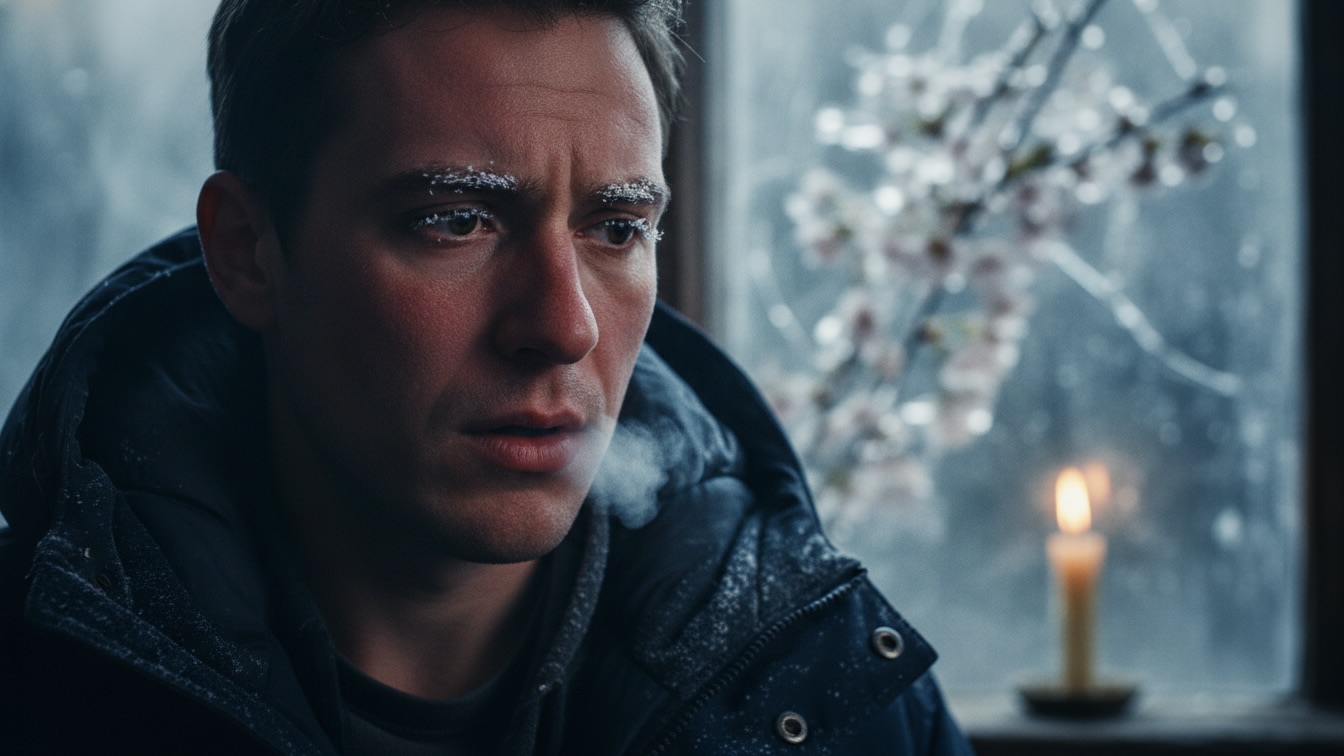
Max tries to sell hope in a frozen basement while the city’s plumbing turns into a solid ice block.
The pipes groaned. It wasn't a metaphor. It was a physical sound, a deep, metal-on-metal scream coming from the foundations of the building. Max checked his watch. It was 2:14 PM on a Tuesday in May, and the temperature outside was negative twenty-four. Winnipeg wasn't just cold; it was structurally failing. The frost had gone deep this year, deeper than the city’s aging nervous system could handle.
He stood in the basement of the St. Jude Community Center. The power had been out for three hours. The main hall upstairs was a graveyard of folding chairs and dead Wi-Fi routers, so he’d moved the seminar down here. His audience sat on the floor, their faces illuminated by the blue, jittery light of their phones. They weren't looking at him. They were checking the outages.
"The hustle is dead," Max said. His breath came out in a visible cloud, hanging in the air like a ghost. "The old version of success? The 5 AM club? The green juices and the fifteen-step morning routines? That’s all legacy code. It’s trash. We’re not building empires anymore. We’re managing the decline."
He paced the small patch of clear floor. His boots crunched on the grit. He felt the weight of his own parka, a heavy, salt-stained thing that cost more than his current bank balance. This was the 'Doom-Set' seminar. It was a pivot from his previous life as a high-performance coach, a job that had evaporated when people realized that 'manifesting' didn't pay the carbon tax or heat a studio apartment.
"The world is glitching," Max continued. "And the only way to win is to stop trying to fix the glitch. You have to inhabit it. You have to optimize for the crash."
A girl in the front row, Brenda, looked up from her screen. She was wearing a neon-orange beanie that looked like a warning sign. Her eyes were flat, the kind of expression you get from scrolling through too many end-of-the-world threads.
"Max," she said. Her voice was dry.
"Yeah, Brenda?"
"The stickers," she said. She held up a small, circular piece of silver plastic. It had a stylized sun on it and the words 'BIO-THERMAL ANCHOR' in a font that looked like it belonged on a high-end tech product. "You told us these use nanotechnology to reflect body heat. You charged fifty bucks for a pack of five."
Max didn't blink. He’d practiced this. "It’s a psychological anchor. It focuses your intent on thermal retention. It’s about the mindset of warmth."
"I’m wearing three of them," Brenda said. "I’m still shivering. My fingers are actually turning blue. Is the mindset supposed to stop frostbite?"
Max shifted his weight. The floor was cold enough that he could feel it through the thick rubber soles of his boots. "The sticker is a tool for the Doom-Set. It’s not a heater. It’s a reminder that you are the only source of energy in a closed system. If you’re cold, it’s because you’re leaking focus."
"It’s a piece of plastic, Max," Brenda said. "I peeled one off. It’s literally just a decal from a craft store. You didn't even scrape the 'Made in China' stamp off the backing properly."
A murmur went through the room. It wasn't an angry murmur. Anger required too much energy. It was a weary, transactional sound. They were just calculating the loss. Max felt a bead of sweat break out under his thermal undershirt, then immediately turn cold.
"The value isn't in the material," Max said, his voice tightening. "The value is in the commitment to the brand of survival. We’re here because we’re the ones who aren't waiting for the city to turn the lights back on. We’re the ones who know the lights are never coming back on."
As if on cue, a notification chime went off. Then another. Then twenty more, a jagged, digital chorus that cut through the basement’s silence. Everyone looked at their phones.
Max pulled his own device from his pocket. The screen was cracked in the upper right corner, a spiderweb of glass that distorted the text. It was a city-wide emergency alert.
'URGENT: PERMAFROST HAS REACHED SEWER MAINLINES. ALL WATER AND WASTE SYSTEMS SUSPENDED UNTIL FURTHER NOTICE. DO NOT FLUSH. DO NOT RUN TAPS.'
The silence that followed was different. It wasn't just weary; it was heavy. The city had finally snapped. The basic transaction of urban life—you pay your taxes, you get to use the toilet—was over.
"Well," Brenda said, standing up. Her joints made a clicking sound. "I guess the 'Doom-Set' just got a lot more real. Does the mindset cover how to deal with a bucket of frozen waste in a two-hundred-square-foot apartment?"
Max didn't have an answer. The script was gone. He watched as his audience began to stand, their movements slow and robotic. They didn't ask for refunds. They didn't yell. They just zipped up their coats and walked toward the stairs, their boots thudding on the wood. They were leaving to go deal with the new reality, a reality that didn't have room for silver stickers or rebranded cynicism.
Max stayed in the basement. He sat down on a stack of plastic crates. He was alone, except for the hum of the emergency lights that were powered by a dying battery. He reached into his pocket and pulled out a protein bar. It was a 'Hustle-Hard' brand bar, left over from his previous career. He tried to take a bite, but the bar was frozen solid. It was like biting into a piece of flavored wood.
He stared at the bar. He thought about his landlord, Mr. Henderson. Henderson had stopped calling three weeks ago. No more 'Where’s the rent, Max?' or 'The plumbing is your responsibility, Max.' Now, it was just silence. Henderson was probably hunkered down in his own basement, burning old furniture for warmth.
Max felt a strange, hollow sensation in his chest. It wasn't guilt. Guilt was a luxury. It was more like a system error. He had spent his whole life trying to sell a version of himself that was always one step ahead, always more optimized, always more 'on.' But now, there was nowhere to go. The city was a frozen block, and he was just a guy in a basement with a mouthful of frozen chocolate.
He stood up and walked out of the community center. The wind hit him like a physical blow. The sky was a pale, sickly grey, the sun a weak white dot behind the clouds. The streetlights were dead. The cars parked along the curb were buried in drifts of hard, crystalline snow that looked like it would never melt.
He saw a drone hovering a few meters above the street. It was one of the city's 'Infrastructure Monitors,' a small, black quadcopter with a blinking red light. It was probably recording the failure, gathering data for a committee that would never meet.
Max felt a sudden, irrational surge of anger. He needed to do something. He needed a moment. He needed a 'content' moment. He grabbed his phone and set it up on a snowbank, leaning it against a frozen trash can. He hit record.
"Hey guys," he said to the lens, his voice shaking from the cold. "Max here. We’re live in the deep-freeze. The sewers are down. The grid is toast. But the 'Doom-Set' doesn't stop. Watch this. This is the energy of the future."
He reached into his bag and pulled out a thermos. He’d filled it with boiling water before leaving his apartment. He unscrewed the lid. The steam rose in a thick, white plume. This was the classic viral move—throwing boiling water into the air to watch it turn into a cloud of ice. It was a cliché, but it was all he had.
"Transformation," Max shouted. "Optimization!"
He flung the water upward with everything he had.
But the wind caught it. Instead of turning into a beautiful, cinematic cloud, the water stayed in a tight, heavy arc. It didn't freeze instantly. It slammed directly into the drone hovering above him.
There was a short, sharp hiss. A spark of blue light. The drone’s rotors stuttered, then stopped. It fell out of the sky like a dead bird, landing with a dull thud in a snowbank three feet away from Max.
Max stared at the drone. The red light was out. His phone, still recording, sat on the trash can, capturing the total, pathetic failure of the moment.
He didn't pick up the phone. He didn't check the footage. He just stood there, the empty thermos in his hand, as the wind began to pick up again. The city was silent, except for the distant, rhythmic cracking of trees in the park nearby, their branches snapping under the weight of the ice.
He looked down at his hand. He was wearing one of his own warmth stickers on his thumb. It was peeling at the edges. He tried to press it back down, but the adhesive was dead. The cold had won.
He walked toward the drone and picked it up. It was surprisingly heavy. He tucked it under his arm, a piece of high-tech garbage that might be worth something to someone, though he couldn't imagine who.
He began the long walk back to his apartment. He didn't think about his brand. He didn't think about his hustle. He just focused on the physical sensation of his feet hitting the pavement, the dull rhythm of survival. He passed a window where a family was huddled around a single candle. They looked at him, and he looked at them. There was no subtext. There was just the cold.
When he reached his building, he didn't use the elevator. He climbed the stairs to the fourth floor, his lungs burning with every breath. He opened his door and walked into the dark, freezing space he called home.
He went to the window and looked out at the city. The sun was finally disappearing, leaving behind a world of deep blues and jagged shadows. He took the silver sticker off his thumb and stuck it to the glass. It stayed there, a small, fake sun against the real, frozen world.
He sat down on his bed and pulled the duvet over his head. He could hear his own heartbeat, a slow, steady thud in the silence. It was the only thing in the city that was still working perfectly.
He closed his eyes and waited for the morning, or whatever came next.
“The sticker on the window began to slide, leaving a trail of grey adhesive against the frost.”


