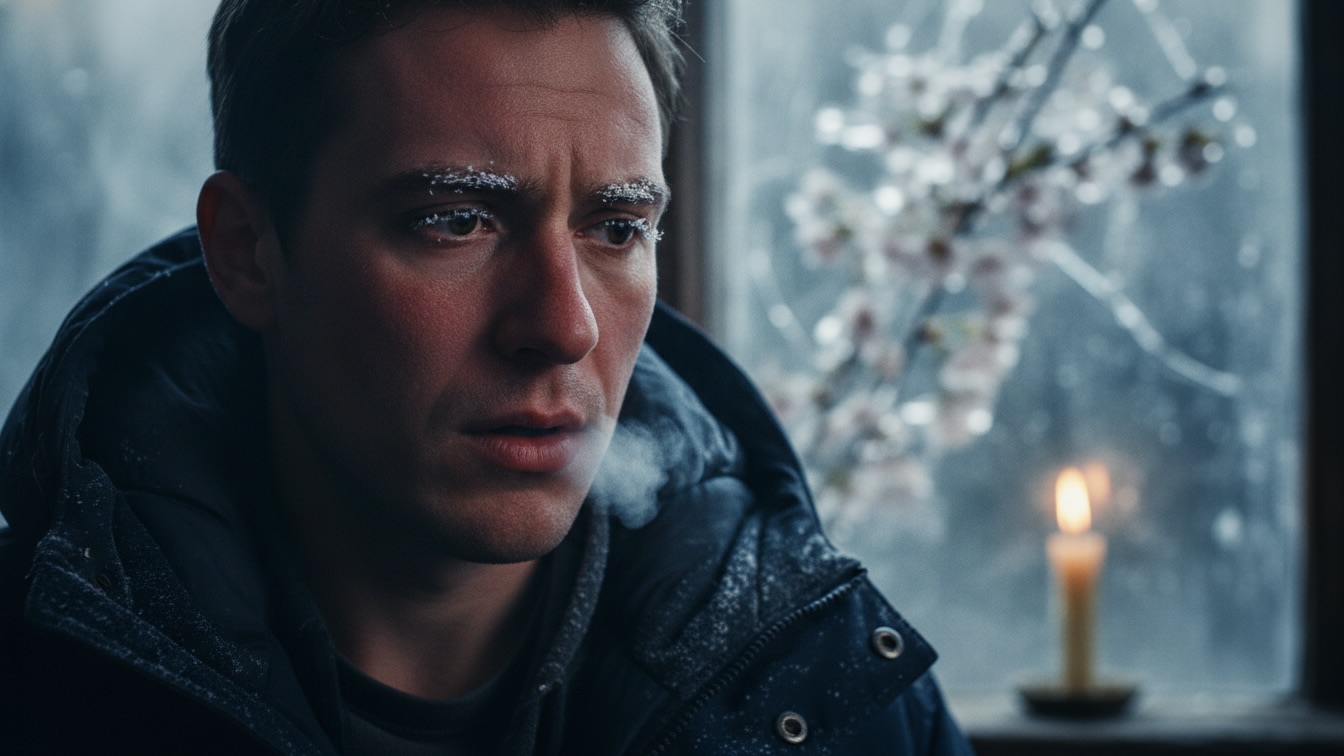
The story follows Max, a disgraced high-performance coach who has rebranded himself as a "Doom-Set" guru during a catastrophic deep freeze in Winnipeg. He conducts a seminar in a freezing community center basement, attempting to sell useless "thermal stickers" to a weary, cynical audience. His performance is interrupted by a city-wide emergency alert announcing the total failure of the sewer and water systems due to permafrost.
As his audience abandons him to face the reality of the infrastructure collapse, Max is left alone with his own fraudulent products and a frozen protein bar. He attempts to regain a sense of control by filming a viral video outside, but the stunt fails spectacularly when he accidentally disables a city drone with boiling water. He eventually retreats to his dark, unheated apartment, forced to abandon his performative persona. The narrative ends with Max huddled under a duvet, finally stripped of his "hustle" and left with nothing but the rhythm of his own heartbeat.
The central theme of the narrative is the collision between the performative digital economy and the unyielding reality of physical collapse. Max represents a modern archetype who attempts to commodify desperation, transforming a literal disaster into a "brand" or a "mindset." The story suggests that while "manifesting" and "optimization" might function in a stable society, they are useless against the visceral, entropic force of a frozen environment. The "legacy code" Max speaks of is not just old success models, but the very infrastructure of urban civilization that has finally reached its breaking point.
Another prominent theme is the death of the social contract in the face of environmental catastrophe. The emergency alert regarding the sewer system serves as a turning point where the basic expectations of modern living—sanitation and heat—evaporate. The audience's reaction is not one of outrage but of weary acceptance, indicating a society that has already been psychologically hollowed out by previous failures. The transaction between the citizen and the state, much like the transaction between Max and his "students," has been revealed as a hollow promise.
Finally, the story explores the theme of authenticity versus fraudulence. Max’s stickers are literal pieces of craft store plastic, yet he attempts to imbue them with psychological value to justify his own survival. This reflects a broader cultural tendency to prioritize the "narrative" of a solution over an actual solution. By the end of the story, the "cold" functions as a purifying force that strips away these layers of artifice, leaving the protagonist with no choice but to inhabit his own physical vulnerability.
Max is a man whose entire identity is built upon the shifting sands of self-help charlatanism. He is a psychological survivor who uses the language of tech and optimization to mask his own profound fear and financial instability. Even as his world literally freezes over, he cannot stop "pivoting," showing a compulsive need to frame his failures as part of a larger, intentional strategy. His internal state is characterized by a "system error" rather than genuine guilt, suggesting he has become so disconnected from his own humanity that he views his emotions through a mechanical lens.
His attempt to film a viral video in the midst of a city-wide emergency reveals his deep-seated need for external validation. He cannot simply exist in the cold; he must perform the cold for an audience that no longer exists. The failure of the boiling water stunt acts as a moment of forced clarity, where the physical world finally refuses to cooperate with his narrative. When he returns to his apartment, his decision to stick the silver sticker on the window is a final, pathetic act of defiance, a lingering attachment to the lie that he can somehow "anchor" his intent against the void.
Brenda serves as the grounded, cynical foil to Max’s delusional optimism. She represents the segment of society that has seen through the "hustle" and is now focused solely on the grim logistics of survival. Her eyes are described as "flat," a psychological symptom of overexposure to crisis and the realization that no "mindset" can fix a broken radiator. She is the one who exposes the physical reality of Max's scam, pointing out the "Made in China" stamp on the stickers.
Her departure from the seminar signifies the moment where the "Doom-Set" brand loses its power over the collective imagination. She does not demand a refund because she understands that money and contracts are becoming meaningless in the new reality. Brenda’s pragmatism highlights Max's absurdity, as she focuses on the literal problem of "frozen waste" while he tries to sell her a "psychological anchor." She is the voice of the physical world, reminding both Max and the reader that some glitches cannot be inhabited; they can only be endured.
The pacing of the story mirrors the slow, creeping onset of hypothermia, beginning with the rhythmic "groaning" of pipes and ending in the near-silent stillness of a dark bedroom. The author uses a cold, clinical tone that avoids sentimentality, which emphasizes the harshness of the Winnipeg setting. Short, punchy sentences create a sense of urgency and fragmentation, reflecting the "glitching" world Max describes. This stylistic choice keeps the reader anchored in the immediate physical sensations of the characters.
Sensory details are used effectively to create an atmosphere of decay and stagnation. The smell of "unwashed polyester," the "jagged, digital chorus" of phone notifications, and the "metal-on-metal scream" of the foundations all contribute to a sense of sensory overload followed by an eerie quiet. The description of the frozen protein bar as "flavored wood" is particularly evocative, serving as a metaphor for the uselessness of modern consumer goods in a true survival situation. These details ensure that the cold is not just a backdrop but an active antagonist in the narrative.
The narrative voice is a third-person limited perspective that stays close to Max’s internal monologue while maintaining a critical, almost mocking distance. This allows the author to explore Max’s self-delusion without endorsing it. The use of tech-heavy jargon like "legacy code," "optimization," and "infrastructure monitors" contrasts sharply with the primal reality of ice and wind. This linguistic juxtaposition reinforces the story’s central conflict between the artificial world of the "hustle" and the unforgiving laws of nature.


