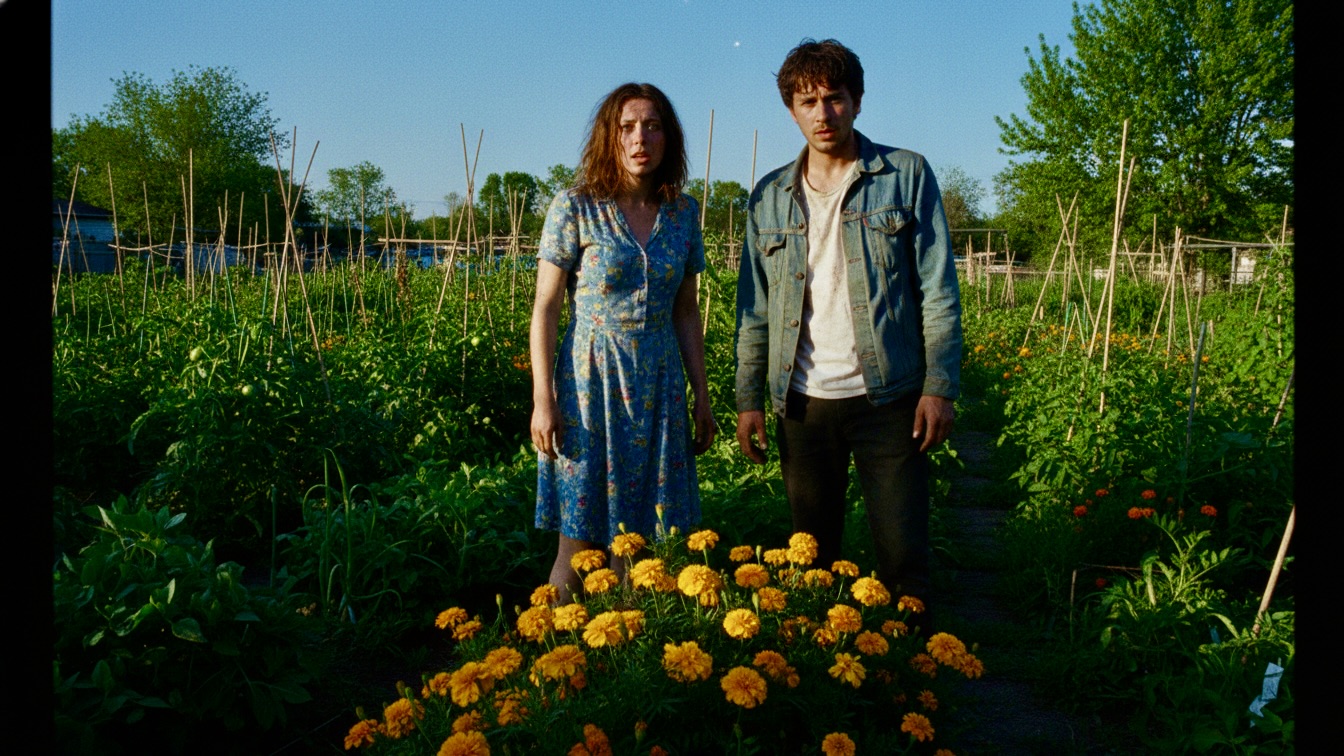
Format: Short Film / Anthology Episode | Est. Length: 10-12 minutes
Imagine a high-concept anthology series titled The Residuals, where the mundane grit of modern city life is periodically shattered by "cellular hemorrhages"—violent, sensory leaks from past incarnations. Each episode follows a different set of strangers in various global cities who are forced to confront the unfinished business of their previous lives when their environments trigger a psychic bridge. Midnight Marigolds serves as the series pilot, establishing a world where destiny is not a poetic concept, but a physical, often terrifying intrusion of history into the present.
A woman drops her cracked smartphone into a disgusting compost bin at twilight, only to have a brooding stranger retrieve it with a familiarity that triggers a violent, sensory hallucination of a 1920s jazz club.
After a chance encounter in a community garden triggers a shared psychic rupture, two strangers discover they are the reincarnated survivors of a violent Prohibition-era raid. They must decide whether to embrace a century-old devotion or remain tethered to their hollow modern identities.
The episode explores the tension between "The Modern Void" and "Historical Weight," suggesting that our contemporary lives are often thin masks worn over deeper, more vibrant ancestral traumas. It posits that the isolation of the 21st century—characterized by burnout, technology, and urban decay—is a temporary state that can be dismantled by the visceral power of human connection and memory.
Furthermore, the story delves into the theme of "The Inevitability of the Soul," questioning whether free will exists if we are destined to repeat the same patterns across lifetimes. The marigolds and the scent of cherry tobacco serve as "anchors," representing the idea that certain sensory triggers can bypass the rational mind to unlock a more profound, albeit dangerous, truth about our existence.
For the protagonist, the stakes are her very sanity and the stability of her carefully constructed, albeit miserable, modern life. If she accepts the memory, she risks losing her grip on the reality she needs to survive her 2026 existence; if she rejects it, she remains a "cheap plastic imitation" of herself, forever haunted by a phantom limb of a life she cannot name. For the stranger, the stakes are even higher, as he has clearly been carrying the burden of recognition alone, and a rejection from her could lead to a total psychological collapse.
The primary conflict is internal and psychological, manifested through the characters' resistance to the "glitch"—the terrifying intrusion of the past into the present. The antagonistic force is the "Modern Fog," the societal and mental pressure to dismiss the extraordinary as a gas leak, a drug trip, or a mental breakdown. Externally, the past itself acts as an antagonist, as the memory of the 1920s raid is violent and traumatic, threatening to overwhelm their current physical forms with the pain and adrenaline of a bygone era.
Elara, a burnt-out young woman living in a gritty 2026 metropolis, drops her phone into a slimy compost bin in a community garden during a cold Tuesday twilight. A mysterious man she has seen sitting on a nearby bench for weeks, Julian, intervenes by plunging his hand into the filth to retrieve the device. Upon their encounter, a sensory "glitch" occurs: the smell of sweet pipe tobacco and the sounds of a distant jazz band overwhelm the garden, momentarily transforming the urban decay into a lush, smoke-filled 1930s speakeasy.
Terrified by the hallucination, Elara attempts to flee, but she is drawn back by an inexplicable knowledge of Julian’s habits and scars. When she confronts him, their physical contact over a bed of marigolds triggers a full-scale past-life regression, immersing them in a memory of a violent police raid where they were lovers attempting a desperate escape. Returning to the present, the two are left shattered and transformed, the modern world now feeling like a mere costume as the music of their past continues to play in their heads.
ELARA (Protagonist): At the start, Elara is a cynical, exhausted urbanite defined by her "burnout job" and "lonely Tuesdays," using her cracked phone as a shield against the world. By the end, she has undergone a radical awakening, shedding her defensive shell to accept a "desperate, violent devotion" that renders her modern life insignificant. Her psychological arc moves from a state of sensory numbness to one of overwhelming, ancient emotional clarity.
JULIAN (The Stranger): Julian begins as a "brooding" and "exhausted" figure, seemingly paralyzed by the weight of a recognition he cannot voice. He is guarded and defensive, using a "cool guy routine" to mask his absolute panic and longing. By the end of the episode, his walls have completely crumbled, revealing a man who has been waiting for a "next time" that has finally arrived, moving from isolation to a state of wrecked vulnerability.
Elara’s frustration peaks when she drops her phone into a rotting compost bin, only for Julian to emerge from the shadows and retrieve it with an unsettling, practiced ease. She notices a scar on his thumb that she somehow recognizes, triggering a wave of "suffocating recognition" that defies logic. Julian hands her the phone, and for a moment, the air between them crackles with a heat that has nothing to do with the freezing April wind.
The atmosphere shifts violently as the smell of cherry tobacco and the sound of an upright bass drown out the city, transforming the garden into a visual "glitch" of a 1920s club. Elara hyperventilates as the gravel beneath her boots turns into hexagonal tiles and Julian’s denim jacket flickers into a heavy wool suit. The vision snaps back to the present, leaving both characters physically ill and terrified by the shared hallucination they can no longer deny.
Elara chases Julian to a bed of marigolds, demanding to know why she knows the smell of his skin and the sound of his laugh. When their hands finally collide, the world detonates into a full-scale memory of a police raid, where they are lovers fleeing through an alleyway amidst the smell of sulfur and breaking glass. They return to the modern garden, breathless and "completely wrecked," as Elara realizes her 2026 life was just a placeholder for the soul she finally remembers.
The episode begins with a mood of "Urban Malaise"—cold, gritty, and frustratingly mundane. As the first glitch occurs, the mood shifts into "Surreal Dread," characterized by sensory overload and a feeling of losing one's mind. The climax brings a surge of "Cathartic Intensity," where the fear is replaced by a violent, romantic devotion, leaving the audience in a state of "Melancholic Awe" as the characters realize their modern lives are forever altered.
If expanded, the season would follow Elara and Julian as they attempt to navigate their modern lives while being increasingly "pulled under" by the memories of their past. They would discover that other "pairs" exist in the city, some of whom are being hunted by a shadowy organization that views these "cellular leaks" as a threat to societal stability. The thematic escalation would focus on whether the pair can find a way to integrate their two selves or if the past will eventually consume their present entirely.
The overarching narrative would explore the origin of the "glitch," revealing it to be a result of a specific celestial or environmental event in 2026 that is thinning the veil between eras. As the season progresses, the historical flashbacks would move further back in time, suggesting that Elara and Julian have found each other in multiple centuries, always ending in tragedy. The season finale would force them to break the cycle of their past-life deaths to survive in the present.
The visual style is defined by "Dualistic Contrast." The modern-day scenes should be shot with a cold, desaturated palette—steely blues, sickly streetlamp oranges, and sharp, digital clarity—to emphasize the "cheap plastic" feel of 2026. In contrast, the "glitches" and memories should be shot with a lush, anamorphic warmth, featuring heavy grain, deep velvet reds, and soft-focus "bokeh" to make the past feel more "real" and tactile than the present.
The tone is "Grit-Noir," blending the grounded realism of an indie drama with the haunting, atmospheric tension of a supernatural thriller. Influences include the sensory-heavy direction of In the Mood for Love for the romantic tension and the jarring, glitchy editing of Mr. Robot for the psychic ruptures. The sound design is crucial, utilizing a "sonic bleed" where 1920s jazz instruments are distorted into modern industrial white noise.
The target audience is the "Prestige Genre" demographic, aged 18-40, who gravitate toward high-concept, emotionally resonant storytelling like The Leftovers, Dark, or Eternal Sunshine of the Spotless Mind. This audience appreciates "Elevated Sci-Fi" that prioritizes character psychology and atmospheric world-building over heavy exposition or action. It appeals to viewers who enjoy dissecting non-linear narratives and thematic puzzles on social media platforms.
The 10-12 minute runtime demands a "Compressed Pressure Cooker" structure. The first three minutes establish the mundane misery of Elara’s life, the next four minutes build the tension of the encounter and the "minor" glitches, and the final five minutes are a rapid-fire descent into the climactic memory and its emotional aftermath. The pacing should feel like a slow-burn fuse that suddenly hits a powder keg during the hand-touch sequence.
The primary production challenge is the "Glitch Transition," which should be achieved through a mix of practical lighting shifts and "match-cut" editing rather than heavy CGI. For example, as the scene shifts to the jazz club, the modern streetlights should practically flicker and change color temperature on the actors' faces, while the background shifts through seamless digital plate-replacement. This ensures the "hallucination" feels grounded in the physical space of the garden.
The community garden location must be carefully scouted to provide enough "texture"—rotting wood, chain-link fences, and the bright yellow of the marigolds—to contrast with the high-end production design of the 1920s speakeasy. The soundscape requires a sophisticated mix, transitioning from the harsh, "thin" sounds of the city (sirens, wind) to the "thick," warm acoustics of the past (brass, clinking glass) to guide the audience's emotional immersion.


