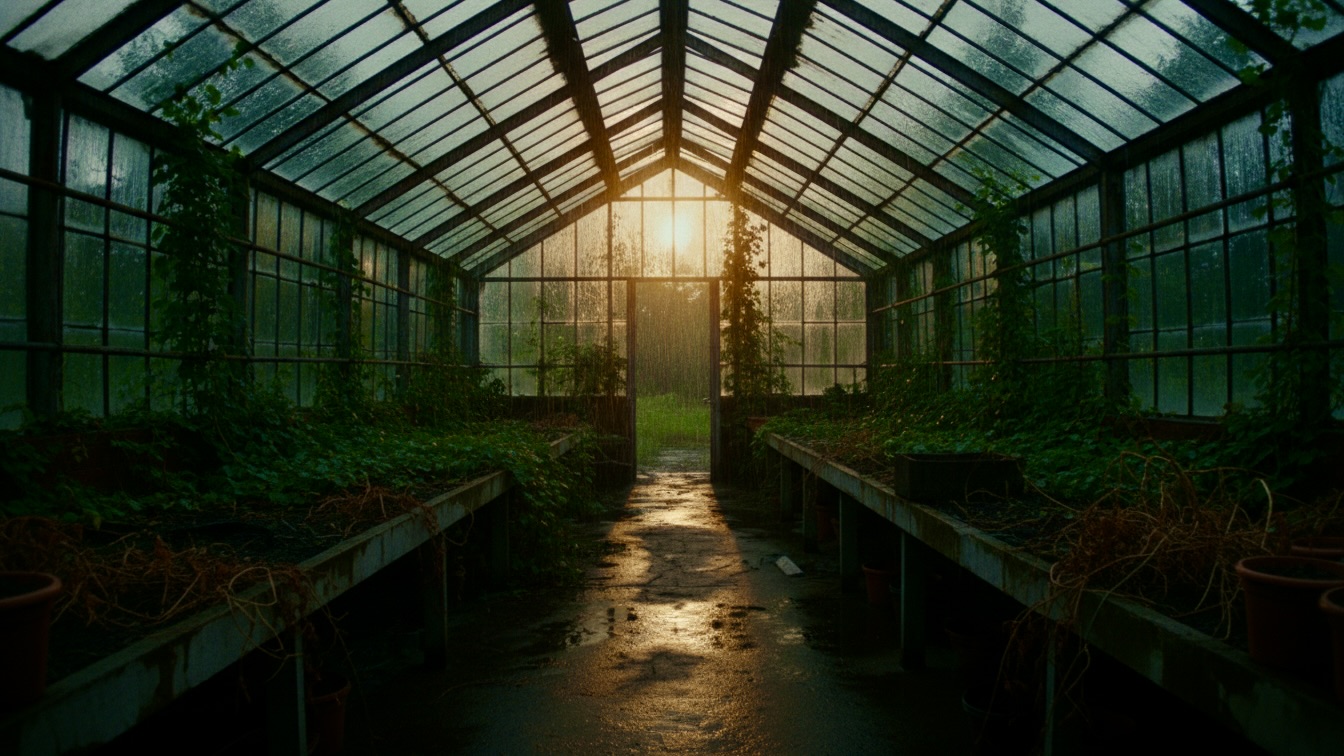
Format: Short Film / Anthology Episode | Est. Length: 10-12 minutes
This story serves as a standalone entry in a psychological thriller anthology series titled The Static Between Us, which explores the fragility of perception and the terrifying ease with which reality can be manipulated. Each episode focuses on a different protagonist whose life is systematically dismantled by a "shadow architect"—someone close to them who has weaponized intimacy to control their victim's environment and sanity.
Wendy enters an abandoned greenhouse to retrieve stolen study notes from Shawn, only to realize the heavy iron door has been locked from the outside. As the spring rain begins to thunder against the glass, the power dynamic shifts from a simple academic favor to a claustrophobic trap.
A desperate college student seeking study materials is cornered in a decaying greenhouse by a friend who reveals he orchestrated her social and romantic isolation. She must find a way to escape her captor before his obsession turns from psychological manipulation to physical possession.
The episode explores the theme of "gaslighting as a weapon," illustrating how a predator can rewrite a victim's history to make them doubt their own sanity. It also examines the toxicity of "covert narcissism," where the antagonist views his controlling behavior as a form of altruistic sacrifice.
The narrative delves into the loss of agency and the suffocating nature of isolation, contrasting the protagonist's academic pressure with the internal collapse of her personal life. The greenhouse serves as a metaphor for a fragile, controlled environment that is rapidly being reclaimed by the elements.
Wendy’s academic future is on the line, but the true stakes are her life and her grip on reality. If she fails to escape or fails to prove Shawn’s culpability, she risks being permanently labeled as unstable, effectively handing Shawn total control over her narrative and future.
The primary conflict is the power imbalance between Wendy, who is physically and mentally exhausted, and Shawn, who is prepared, calculated, and holds the physical advantage. Shawn acts as a "mirror antagonist," reflecting Wendy’s own insecurities back at her to paralyze her, while the environment itself—the locked greenhouse—acts as an external force of containment.
Wendy arrives at a rotting campus greenhouse expecting a quick exchange of bio notes, but finds Shawn waiting for her with a confession instead of a flash drive. He reveals that he used spoofing technology to frame her for infidelity, effectively destroying her relationship with her boyfriend, Sam, and isolating her to ensure she would rely solely on him.
As the reality of his manipulation sinks in, Shawn attempts to justify his actions as an act of love, forcing Wendy to realize that her "breakdown" the previous semester was entirely manufactured by him. The episode culminates in a desperate physical confrontation as Wendy attempts to break out of the locked greenhouse while the storm outside intensifies.
Wendy is a high-achieving student whose arc moves from academic-focused exhaustion to a state of hyper-aware terror. By the end, she transitions from a victim of gaslighting to a survivor who realizes the extent of her betrayal, though her physical safety remains in question.
Shawn is a calculating, obsessive manipulator who believes he is the hero of his own story. His psychological arc is static; he remains convinced of his own righteousness throughout, viewing his systematic destruction of Wendy’s life as a necessary chore to "save" her from others.
The opening beat establishes the oppressive atmosphere of the greenhouse and the immediate tension between Wendy’s academic panic and Shawn’s unsettling, calm presence. The midpoint occurs when Shawn reveals the text thread on his phone, shattering Wendy’s reality and forcing her to confront the truth about her past. The final beat is a high-stakes climax where the greenhouse becomes a cage, and the physical struggle for the door ends in a stalemate of terrifying uncertainty.
The mood begins with a sense of mundane, low-level stress and evolves into a sharp, jagged paranoia. The audience experiences a trajectory from confusion to cold, suffocating dread, peaking in a frantic, adrenaline-fueled climax that leaves the viewer feeling trapped alongside the protagonist.
If expanded, the season would follow a detectives' investigation into a string of "unexplained" campus incidents, slowly linking the different victims to a single, unseen network of manipulators. Each episode adds a piece to the puzzle, revealing that the antagonists are not working alone but are part of a larger, systemic effort to control vulnerable students.
The thematic escalation moves from individual gaslighting to institutionalized control, with the final episodes focusing on the survivors banding together to expose the architects. The series would culminate in a confrontation that challenges the nature of truth in a digital age where identities can be spoofed and memories rewritten.
The visual style relies on "flat, gray" lighting to emphasize the exhaustion of the protagonist, with high-contrast shots when the storm hits to heighten the drama. The camera work should be handheld and claustrophobic, focusing on extreme close-ups of Wendy’s eyes and hands to emphasize her internal panic and lack of control.
Comparable in tone to The Invisible Man (2020) and Black Mirror, the film maintains a grounded, realistic aesthetic that makes the psychological horror feel immediate and plausible. The use of sound—the rhythmic "tick" of water and the roar of the rain—is essential to building the tension.
The target audience is young adults and fans of psychological thrillers who enjoy character-driven tension and suspense. It is best suited for streaming platforms that cater to viewers who appreciate anthology-style storytelling and dark, contemporary narratives.
The pacing starts deliberately slow to mirror Wendy’s fatigue, gradually accelerating as the truth is revealed and the storm begins. The final act is a rapid-fire sequence of physical desperation, ensuring the 10-12 minute runtime maintains a relentless grip on the viewer.
The greenhouse set requires careful attention to texture; the contrast between the "optic white" of Shawn’s shoes and the muddy, decaying environment is a critical visual cue for his artificiality. Practical rain effects are necessary to create the deafening, isolating roar that cuts Wendy off from the outside world during the climax.
Safety protocols for the physical struggle are paramount, as the set is filled with glass and rusted metal. The "spoofing" app interface on the phone should be designed to look authentic to modern messaging platforms to ground the horror in reality.


