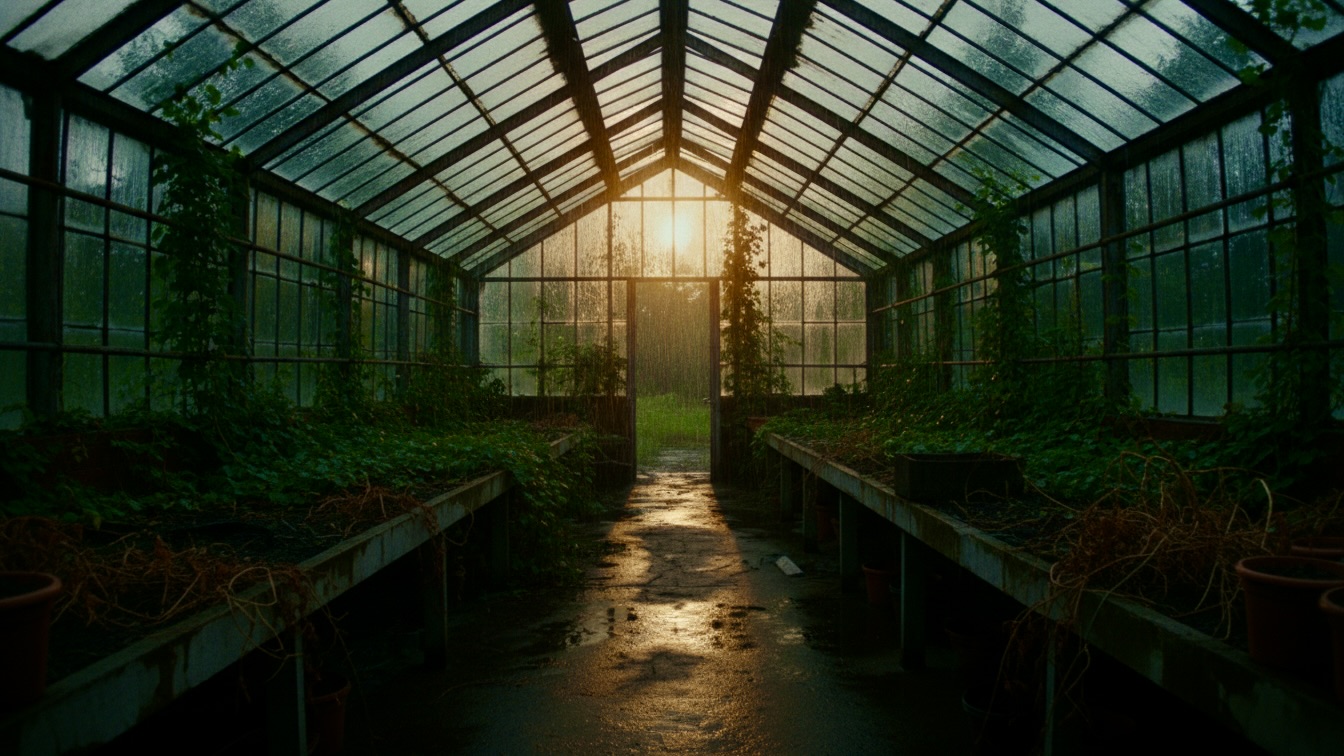
The story follows Wendy, a stressed college student, who meets her acquaintance Shawn in an abandoned greenhouse under the guise of retrieving biology notes. As the atmosphere grows increasingly claustrophobic, Shawn reveals his true colors, admitting that he systematically sabotaged Wendy’s previous relationship with a boy named Sam. He used spoofing technology to fabricate messages of infidelity, effectively isolating Wendy from her support system. When Wendy attempts to flee, she discovers that Shawn has locked them inside the greenhouse, trapping her with his dangerous, obsessive delusions.
The narrative explores the terrifying intersection of gaslighting and performative altruism. Shawn justifies his destructive actions by framing them as an act of salvation, believing he had the right to curate Wendy’s life for her own benefit. This highlights the theme of toxic entitlement, where an individual views their romantic interests as objects to be managed rather than autonomous human beings. By removing her agency, Shawn attempts to force a reality where he is her only remaining support.
Isolation serves as a primary catalyst for the horror within the chapter. The physical setting of the abandoned greenhouse mirrors Wendy’s internal state, reflecting her feelings of decay and being trapped. The contrast between the outside world, where midterms and social expectations loom, and the greenhouse, where time seems to stand still, emphasizes how Shawn has effectively severed her connection to normalcy. The rainstorm at the climax acts as a sensory barrier, cutting off any hope of external intervention and sealing Wendy into a nightmare of her own making.
Wendy is characterized by a profound sense of exhaustion and cognitive dissonance. She begins the chapter in a state of high-functioning panic, prioritizing academic survival over her own intuition, which allows Shawn to manipulate the situation further. Her internal struggle is marked by a desperate need to maintain normalcy even as the environment becomes overtly threatening. As she realizes the depth of the betrayal, her transition from academic stress to survival-mode terror is palpable. She is not a passive victim, however, as evidenced by her attempt to physically defend herself against her captor.
Shawn represents the archetype of the malignant narcissist who disguises his control as care. He is defined by his meticulous nature, evidenced by his pristine white sneakers, which contrast sharply with the filth of the greenhouse. This attention to detail reflects his approach to stalking and manipulation; he plans his intrusions with cold, calculated precision. His lack of empathy is masked by a soft, reasonable tone, which makes his sudden shifts into rage all the more jarring. He views himself as the protagonist of a romance, completely ignoring Wendy’s clear fear and rejection in favor of his own delusional narrative.
The pacing of the chapter is expertly handled, beginning with a slow, heavy atmosphere that mimics the humidity of the greenhouse before accelerating into frantic action. The author uses the physical environment to build tension, such as the recurring, rhythmic dripping of water that acts as an auditory reminder of time running out. The sensory details, particularly the smell of artificial detergent and the sight of dead ivy, ground the reader in the suffocating reality of the scene. This creates a visceral reading experience that forces the reader to feel the same claustrophobia Wendy experiences.
The narrative voice is intimate and deeply subjective, keeping the reader locked within Wendy’s panicked perspective. By focusing on her internal monologue and her struggle to process the revelations, the story effectively builds sympathy for her plight. The tone shifts from professional and academic to primal and desperate, mirroring the breakdown of the social contract between the two characters. The final image of the locked door provides a chilling conclusion, leaving the reader with a sense of dread that underscores the effectiveness of the story’s structural tension.


