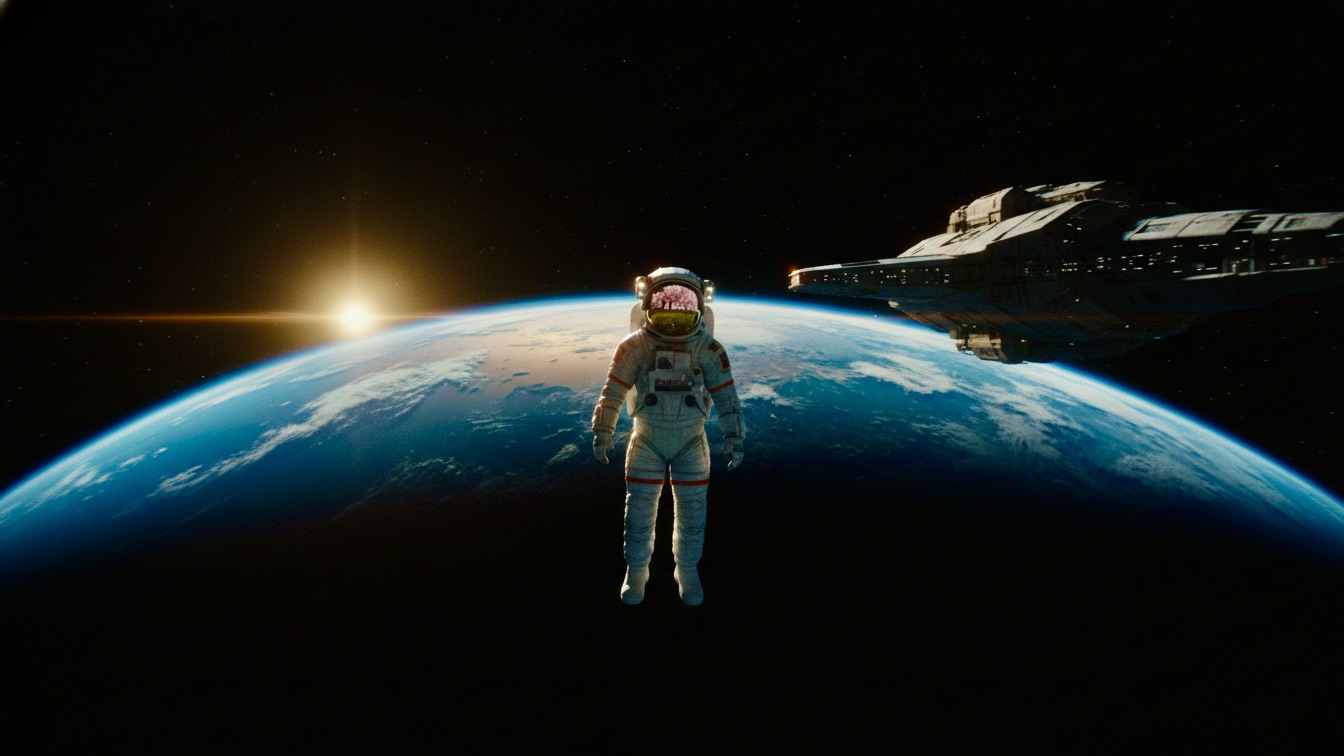
Elias wakes in a cold hull, the scent of phantom lilacs fading as reality's sterile grip takes hold again.
The dream always ended with the mud. It was a thick, cold North Carolina sludge that caked between Elias's toes and smelled of rotted leaves and new life. In the dream, it was April. The air was heavy with the scent of lilacs—so thick he could almost chew it. Then the alarm clock, a shrill, digital scream that didn't belong in the woods, tore the sky open. Elias opened his eyes to the gray ceiling of the Vesper-7. The lilacs were gone. In their place was the smell of recycled sweat and a faint, worrying hint of ozone.
He lay still for a moment, letting his heart rate settle. His bunk was narrow, the mattress thin enough that he could feel the structural ribs of the ship pressing into his spine. He was forty-two years old, and his joints clicked like a bag of marbles every time he moved. This was the cost of the return trip. Three years out, six months back, and a body that felt like it had been through a car crash every single morning.
"Mina," he croaked. His voice was a dry rasp. "Status."
"You look like hell, Elias," the ship's voice responded. Mina didn't sound like a computer. She sounded like a woman who had been smoking for thirty years and found everything you said mildly insulting. "Also, the CO2 scrubbers in Sector 3 are throwing a tantrum again. Good morning."
"Can we not? Just for ten minutes?" Elias swung his legs over the side of the bunk. The deck was freezing. He’d lost his left slipper somewhere near Jupiter, and he still hadn't found it. It was one of those small, nagging losses that stayed with him. He could picture it, floating in some dark corner behind a server rack, a useless piece of plaid flannel.
"The life support system doesn't take coffee breaks," Mina said. "Unlike some people. You've been asleep for nine hours. The schedule said seven."
"I was busy dreaming about dirt," Elias said, standing up and feeling his knees pop. "Do you know what dirt smells like, Mina? Not the stuff in the hydroponics tray. Real dirt. With worms and old beer cans in it."
"I am a collection of circuits and pressurized gas, Elias. I don't do dirt. I do math. And the math says you're behind on your maintenance rotation."
He padded across the small cabin to the sink. The mirror was cracked in the lower right corner, a jagged spiderweb that cut his reflection's chest in half. He splashed cold water on his face. The water was gray. It was always a little gray these days. He looked at the shelf above the sink. There was a ring of dust where his shaving cream used to sit. He’d run out of that two weeks ago. Now he just hacked at his face with a dull razor and a bit of hand soap. Everything was disappearing, piece by piece. The ship was a sieve, and time was the leak.
He walked into the galley, a space no bigger than a walk-in closet. The light overhead flickered. It was a yellow, sickly pulse that made the shadows jump. This room used to be full. When they’d launched, there were three of them. Sarah had the seat by the window. Miller had the one by the locker. Now, the chairs were bolted down but empty. Sarah’s seat had a stain on the headrest from her hair oil. Miller’s locker was still locked, the key code lost when he’d died in the airlock accident off the belt. Elias hadn't touched it. He didn't want to know what was inside. Probably just more things that didn't exist anymore.
"Coffee?" Elias asked, more to the air than to the AI.
"The machine is making a sound like a cat in a blender," Mina said. "I’d stick to tea. Or better yet, just drink the hot water and pretend."
"You're a real ray of sunshine today."
"I'm a realist. We’re eighty million miles from the nearest Starbucks. Adjust your expectations, Elias."
He pressed the button on the dispenser. It groaned, a mechanical heave that vibrated through the floorboards. A thin stream of brownish liquid trickled into his mug. He took a sip. It tasted like burnt plastic and regret. He sat at the small table, staring at the empty wall where a digital calendar used to hang. It had burned out a month ago. He missed the red 'X' marks. They were the only proof he was moving forward.
"How's the trajectory?" Elias asked.
"Stable-ish," Mina replied. "We're still on track for Earth intercept in twenty-two days. Assuming the main thruster doesn't decide to retire early. It’s been vibrating in a way that suggests a mid-life crisis."
"Twenty-two days," Elias whispered. "That’s May. It’ll be late spring. The dogwoods will be dropping their petals. Everything will be green. Not this... metal gray. Not this dead white."
"Don't get your hopes up. Last data burst said the East Coast is having a record-breaking heatwave. It might just be brown and crispy by the time you get there."
"Shut up, Mina. Just let me have the green."
He stood up and walked toward the cockpit. The transition between modules was marked by a heavy pressure door. The seal was worn, a strip of black rubber peeling away like a dead snake's skin. He touched it as he passed. Everything was fraying at the edges. The ship was a collection of things that were missing their other halves. The backup generator was missing a belt. The kitchen was missing a cook. He was missing a reason to stay awake.
In the cockpit, the stars were too bright. Without the filter of an atmosphere, they looked like holes poked in a black sheet. He sat in the pilot’s chair. The leather was cracked, exposing the yellow foam beneath. He reached for the control stick, then stopped. His hand was shaking. Just a little. A fine tremor that he couldn't quite suppress.
"You're twitching," Mina observed.
"Low blood sugar," Elias lied.
"It's cortisol. You're stressed. Your heart rate is up twelve percent since you sat down. Want me to play some music? I have that playlist Miller liked. The one with all the banjos."
"God, no. No banjos. Just silence. Can we have some actual silence?"
"Silence is just the sound of things not working, Elias. You don't actually like it."
She was right, which made it worse. The hum of the ship was the only thing keeping him sane. It was the sound of the lungs of the beast, the recycled air moving through the vents. If that stopped, the silence would be final. He looked at the console. A small red light was blinking near the oxygen readouts. It wasn't a crisis light, just a 'hey, look at me' light. A slow leak. One they’d been chasing for three months.
"Did you find the leak in the secondary tank?" he asked.
"Negative. It's ghosting us. I suspect it's behind the bulkhead in the crawlspace. The one you hate."
Elias groaned. The crawlspace was a narrow, terrifying tube of wires and sharp edges. It was where the ship hid its secrets. "I'll go down there after I eat."
"You already ate. You had the brown liquid."
"That wasn't food, Mina. That was a threat."
He got up and headed toward the storage lockers. He needed a wrench and a flashlight. As he opened the tool locker, he saw it. Or rather, he saw the space where it should have been. The small, wooden carving of a bird his daughter had made him. It had been stuck to the locker door with a piece of blue putty for three years. Now, the putty was there, a dry, crusty smear, but the bird was gone.
Elias felt a cold spike of panic hit his chest. "Mina? Where's the bird?"
"The what?"
"The wooden bird. On the locker. It's gone."
"Oh. That. There was a vibration spike during the course correction yesterday. It probably fell off. Check the floor."
Elias dropped to his knees, ignoring the bite of the cold metal. He swept his hands under the lockers, feeling for the familiar shape of the cedar wood. His fingers came back with nothing but gray dust and a stray screw. He moved to the next locker, then the next. He was breathing hard now, the thin air making his lungs ache.
"It's just a piece of wood, Elias," Mina said, her voice unusually soft.
"It's not just wood!" he snapped. "It's the only thing I have that isn't made of plastic or steel. It's... it's her."
He crawled toward the vent, peering into the shadows. He saw something dark wedged near the floor plates. He reached in, his knuckles scraping against a jagged edge of aluminum. He pulled it out. It wasn't the bird. It was a dried-up piece of a protein bar, hard as a rock.
He sat back on his heels, his hand bleeding where he'd cut it. The red blood looked startlingly bright against the gray floor. He watched a drop fall. It didn't splash; it just sat there, a perfect, glistening bead. He felt a sudden, overwhelming sense of grief, not for the bird, but for everything. For the way the light in the cabin was too dim. For the way the air tasted like a basement. For the fact that he couldn't remember the exact shade of his daughter's eyes anymore, only that they were 'bright.'
"I'll find it, Elias," Mina said. "I'll run a sweep with the internal cameras. It couldn't have gone far. Physics is a bitch, but it's consistent."
"Don't bother," Elias said, standing up and wiping his bloody hand on his jumpsuit. The stain was dark, almost black. "It's gone. Everything's going. The ship's eating itself."
"That's the spirit. Total nihilism. Very trendy for 2026."
"Shut up."
He grabbed the wrench and headed for the crawlspace. He needed to do something physical. He needed to fight the ship. He popped the hatch in the floor of the galley. A puff of stale, cold air hit him. It smelled of copper and old grease. He slid inside, the walls pressing in on his shoulders immediately. He was a big man in a small space, a recipe for claustrophobia that he usually managed to suppress. Today, it felt like the ship was closing its teeth on him.
He switched on his headlamp. The beam was weak, the batteries dying. He crawled forward, his elbows barking against the rivets. "Talk to me, Mina. Give me a readout on the pressure drop."
"Zero-point-two PSI per hour. It's accelerating. If you don't find it, we're going to be breathing very shallowly by next Tuesday."
"Great. No pressure."
"Actually, that's exactly what it is. Lack of pressure."
He ignored her. He reached a junction where four pipes met in a tangle of insulation and sensors. He saw the frost first. A delicate, white crystalline structure blooming on the side of the main oxygen line. It looked like a flower. A winter rose made of frozen air.
"Found it," he whispered. "Section 4-B. The seal's cracked."
"Copy that. Can you patch it, or do we need to bypass?"
"I can patch it. If I can get the sealant to flow in this cold."
He reached for his belt, but his fingers were numb. He fumbled with the tube of epoxy. As he did, his headlamp flickered and died. Total darkness. The kind of dark you only find in deep space, where there's no such thing as ambient light. Elias froze. He could hear his own heartbeat, a frantic drumming in his ears. He could hear the hiss of the leak—a tiny, murderous whistle.
"Mina? Headlamp's dead."
"I'm seeing that. Hang on, I'll turn up the internal bus lights in the galley. Maybe some will bleed through the hatch."
A dim, pathetic glow filtered down the tube behind him. It didn't reach the junction. He was working by touch now. He felt the cold of the pipe, the jagged edge of the crack. He squeezed the epoxy onto his gloved finger and pressed it against the leak. The hiss stopped. The silence returned. It was heavy. It was the silence he’d told Mina he wanted, and now he hated it.
He lay there in the dark, his chest pressed against the vibrating hull. On the other side of that inch of metal was nothing. Miles and miles of nothing. He thought about the spring again. He thought about the way the sun felt on the back of his neck when he was weeding the garden. It was a specific kind of heat—not the dry, forced warmth of the ship's heaters, but a living, radiating glow that felt like it was recharging his bones.
He remembered the way the dirt felt under his fingernails. He’d complained about it at the time. He’d hated the way it stained his skin. Now, he’d give anything for a handful of it. Just to know that something could grow. Something that wasn't a computer program or a recycled nutrient paste.
"Elias?" Mina's voice was different. Sharp. "Get out of there. Now."
"I'm almost done, Mina. Just letting the seal set."
"Elias, move! The pressure in the secondary line is spiking. Something's blocked. It's going to blow."
He didn't argue. He scrambled backward, his heart hammering against his ribs. He felt the vibration before he heard it—a deep, thrumming growl that shook the entire frame of the ship. He threw himself toward the hatch, his fingers clawing at the edge of the galley floor. He hauled himself up just as a deafening crack echoed through the crawlspace. A jet of supercooled gas erupted from the hatch, turning the air in the galley into a thick, white fog.
Elias slammed the hatch shut and locked it, gasping for air. The fog swirled around his ankles. He was shivering violently. "Status! Status!"
"Line 2 is gone," Mina said. Her voice was flickering, distorted by static. "I've isolated the sector, but we just lost forty percent of our reserve. Elias, we have a problem."
"I noticed!" He screamed, kicking the hatch. "I noticed the giant explosion, Mina!"
"The trajectory is shifting. The force of the vent acted like a thruster. We're off-course. By a lot."
Elias slumped against the galley table. The mug of 'tea' had fallen over, and the brown liquid was dripping onto the floor, mixing with the white frost from the leak. He looked at the mess. It looked like a map of a country he didn't recognize.
"How much off-course?" he asked, his voice shaking.
"If we don't correct in the next six hours, we'll miss the Earth-Moon system entirely. We'll be headed for the outer rim. And we don't have the fuel to turn back."
Elias looked around the room. The flickering light. The empty chairs. The missing bird. The fading hope. He felt a strange, detached sense of calm. The thriller of his life had finally reached the part where the hero realizes he might not be the hero. He might just be the guy who dies in the first act.
"Can we fix the thruster?" he asked.
"The main engine is unresponsive. Something in the blast severed the control lines. You’d have to go outside, Elias. An EVA. In the dark. While we’re tumbling."
He looked at his hands. The blood had dried into a crusty brown. He thought of the lilacs. He thought of the mud between his toes. If he stayed inside, he’d drift forever in this gray tin can, breathing stale air until the scrubbers finally gave up. He’d be a ghost in a machine.
"Get the suit ready," Elias said.
"Elias, the odds of a successful repair in these conditions are..."
"I don't care about the odds, Mina. I'm not dying in this kitchen. I'm not dying smelling like burnt plastic."
"You're being dramatic. I like it. It's very cinematic."
"Is that a joke? Did you just make a joke while we're dying?"
"If I don't laugh, I'll have to deal with the fact that my only friend is a sweaty man who talks to himself. Now get in the airlock before I change my mind about helping you."
Elias walked toward the airlock. He passed the locker again. He stopped. There, wedged in the hinge of the door, was a tiny sliver of cedar. It was a wing. The wooden bird hadn't fallen; it had been crushed. The door must have swung shut on it during a maneuver. It was broken into a dozen tiny pieces.
He reached out and touched the splinter. It was soft. It felt like home. He didn't pick it up. He left it there, a small, broken sacrifice to the ship.
He entered the airlock. The suit was waiting for him, a bulky, white ghost hanging from the rack. It smelled of rubber and old sweat. He climbed in, the seals clicking shut with a finality that made his stomach turn. He put on the helmet. The world became a small, circular view. His own breath was the only sound.
"Depressurizing," Mina said. "See you on the other side, Elias. Try not to let go of the ship. It's a long walk home."
"Funny," Elias said. "Really funny."
He felt the air being sucked out of the room. The silence deepened. It wasn't the heavy silence of the cabin anymore. It was the absolute silence of the vacuum. He looked at the outer door. The green light turned red. The door slid open.
The stars were a blinding, chaotic mess. Earth was there, a small, blue marble in the distance. It looked so fragile. It looked like it could be blinked away. Elias stepped out into the void, his tether snapping taut behind him. He felt the ship beneath his boots, a vibrating, dying thing.
He began to crawl toward the engine housing. Every movement was a struggle. The suit was stiff, fighting him. The tumbling of the ship made the stars spin in a nauseating whirl. He focused on the metal. The rivets. The peeling paint. He found the access panel, his fingers fumbling with the latches.
Inside, it was a mess of melted wire and scorched metal. "Mina, I'm at the junction. It's bad. It's really bad."
"Tell me something I don't know. Like, what's your favorite color?"
"Green," he said, his voice cracking. "Lush, wet, spring green. The kind that makes your eyes hurt."
"Good choice. Now, see that blue wire? The one that's currently on fire?"
"Yeah."
"Don't touch that one. Touch the one next to it."
Elias worked. He lost track of time. His hands were cramping, his oxygen alarm was chirping a low, rhythmic warning. He was a thousand miles from everything, trying to sew a heartbeat back into a corpse. He felt a sudden, sharp pain in his shoulder. A piece of debris? A micro-meteorite?
He looked down. There was a tear in his suit. A tiny, jagged hole near the seam. He could see the white mist of his atmosphere escaping into the black.
"Mina... I have a breach."
There was a long pause. The static on the comms grew louder.
"Elias, listen to me. You have to finish the connection. If you don't, the thruster won't fire. You won't make the turn."
"I'm losing air, Mina. I'm getting lightheaded."
"Just a few more seconds. Connect the red to the gold. Do it for the dirt, Elias. Do it for the mud."
He reached out. His vision was blurring. The stars were starting to smear into long, white streaks. He felt the wires. He felt the click as they snapped together. A surge of power hummed through the hull, nearly knocking him off his feet.
"Connection established!" Mina shouted. "I'm firing the correction now! Hold on!"
Elias didn't hold on. He couldn't. His fingers lost their grip as the ship lurched, the thruster's roar vibrating through his very bones. He felt the tether snap. It was a clean, sharp break. He was drifting. Away from the gray metal. Away from the flickering lights and the broken birds.
He watched the Vesper-7 shrink. It looked like a toy. A small, lonely spark against the dark. He was floating in the black, the air in his suit hissing out of the hole in his shoulder. He wasn't afraid. The panic had been left behind on the ship. Here, there was only the cold and the stars.
He closed his eyes. The smell came back. It wasn't the ozone or the sweat. It was the lilacs. The smell of a rainy Tuesday in April. He could feel the mud between his toes. He could hear the sound of the wind in the dogwood trees. It was so loud it drowned out the silence.
"Elias?" Mina's voice was faint, a ghost in his ear. "Elias, can you hear me? The trajectory is corrected. We're going home. Elias?"
He didn't answer. He was busy looking at the flowers.
The ship continued its long, arcing path toward the blue marble, a silent needle stitching its way through the dark. Behind it, a single white speck drifted further and further into the deep, becoming just another star in the crowded sky.
In the galley of the Vesper-7, a small splinter of cedar wood vibrated on the floor as the engines hummed, a tiny, forgotten piece of home returning to the world it had left behind.
Elias felt the cold seep into his marrow, but in his mind, the sun was just beginning to rise over the ridge, and the air was finally, beautifully, sweet.
He watched the Earth grow larger in his fading vision, a promise of a spring he would never touch, yet somehow, the scent of the wet earth was the last thing he knew before the dark became total.
Something bumped against his helmet.
“Something bumped against his helmet.”


