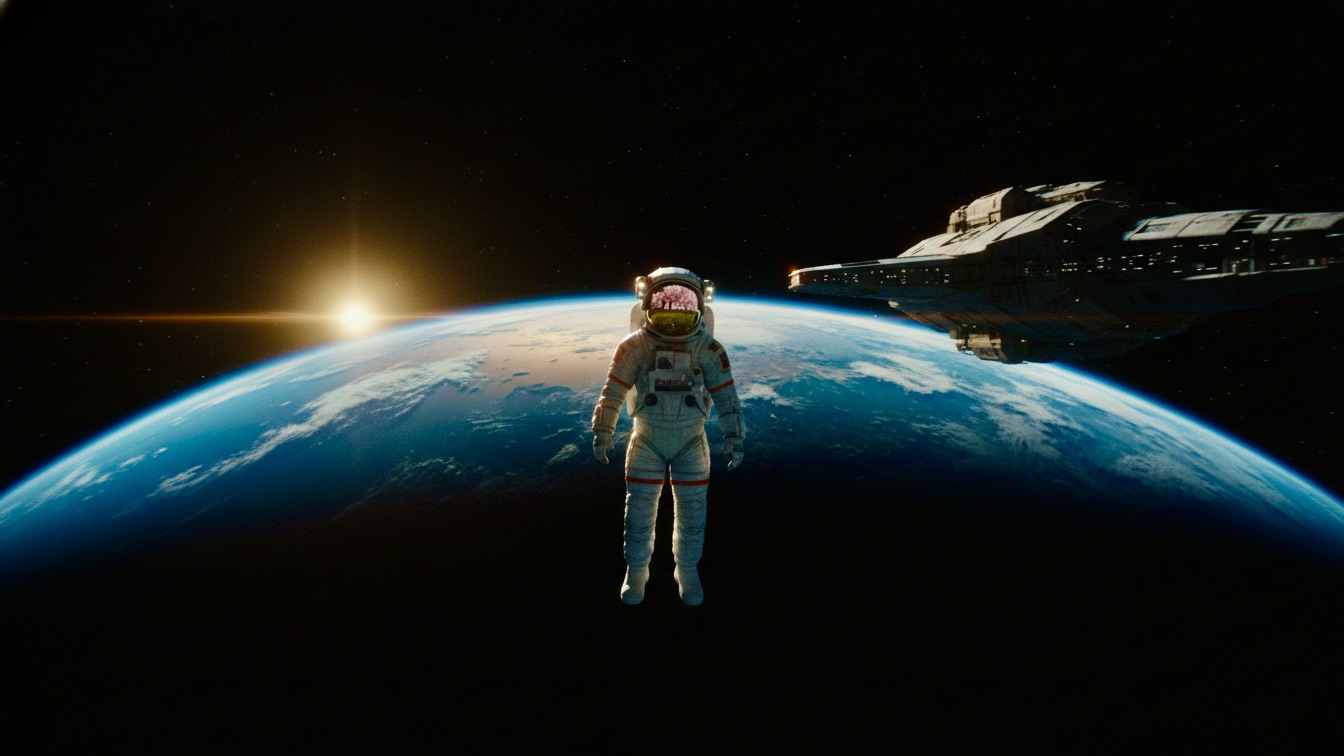
The story follows Elias, a forty-two-year-old astronaut and the sole survivor of a three-person crew aboard the decaying spacecraft Vesper-7. He is haunted by vivid dreams of the North Carolina spring, specifically the tactile sensation of mud and the scent of lilacs, which stand in stark contrast to the sterile, failing environment of his ship. Elias interacts with Mina, the ship’s cynical and world-weary artificial intelligence, as he navigates the physical and psychological toll of a years-long journey back to Earth. The ship is a graveyard of memories, filled with the ghosts of his former crewmates and the tangible loss of personal mementos, such as a wooden bird carved by his daughter.
When a critical oxygen leak leads to a catastrophic explosion in a secondary line, the Vesper-7 is knocked off its trajectory, threatening to miss Earth and drift into the outer rim. Despite his exhaustion and a growing sense of nihilism, Elias chooses to perform a dangerous extravehicular activity to repair the thruster control lines. He succeeds in correcting the ship's path, ensuring its return to Earth, but a suit breach and a snapped tether leave him drifting into the vacuum of space. In his final moments, the boundary between his reality and his memories dissolves, and he dies enveloped in the sensory hallucination of the spring he sacrificed himself to save.
The central theme of the narrative is the conflict between the synthetic and the organic, framed as a struggle for the protagonist's soul. Elias is trapped in a world of "plastic and steel," where even the water is gray and the air tastes of recycled sweat. His obsession with "dirt" and "lilacs" represents a primal psychological need for connection to the living world. This longing is not merely nostalgia; it is a rejection of the entropic, mechanical existence that has claimed his youth and his companions.
Entropy serves as a secondary, pervasive theme throughout the chapter. The ship is described as a "sieve," and time is the "leak" that drains Elias of his vitality and his memories. This decay is reflected in the cracked mirrors, the flickering lights, and the literal breakdown of the vessel's life support systems. The narrative suggests that while technology is fragile and prone to failure, the human spirit's connection to the natural world remains a powerful, albeit tragic, motivator even at the edge of death.
Sacrifice and the nature of legacy also play a significant role in the story's conclusion. Elias realizes that he is "missing a reason to stay awake," yet he risks everything to ensure the ship—and the small, broken splinter of his daughter’s carving—returns home. His death is a final act of devotion to a world he can no longer inhabit. The "broken sacrifice" of the cedar bird mirrors Elias’s own fate; both are fragments of a home that will eventually return to the earth, even if he cannot be there to witness it.
Elias is a man defined by profound psychological and physical exhaustion. At forty-two, he perceives his body as a collection of clicking joints and "bag of marbles," indicating that the rigors of space travel have aged him prematurely. He suffers from a form of survivor’s guilt, evidenced by his refusal to open Miller’s locker or clean the stain from Sarah’s headrest. His internal world is a battlefield where the "gray ceiling" of his reality constantly fights against the "lush, wet, spring green" of his memories.
Psychologically, Elias is experiencing a slow dissolution of self. The loss of the wooden bird acts as a catalyst for a total emotional breakdown, as it represents the final tether to his identity as a father and a terrestrial being. When he tells Mina that the "ship’s eating itself," he is actually describing his own internal state. His decision to go on the EVA is not born of a traditional heroic impulse, but rather a refusal to die in a "kitchen" smelling of "burnt plastic." He chooses a death that aligns with his vision of the natural world, allowing his mind to retreat into a peaceful hallucination of the North Carolina ridge.
Mina serves as more than just an artificial intelligence; she functions as a psychological mirror and a surrogate companion for Elias. By adopting the persona of a woman who has "been smoking for thirty years," she provides a grit and realism that prevents Elias from slipping entirely into catatonia. Her cynicism is a defensive mechanism that helps him manage the overwhelming isolation of the Vesper-7. She understands his psychological state better than he does, correctly identifying his "twitching" as a symptom of cortisol and stress rather than low blood sugar.
Despite her insistence that she is merely a "collection of circuits," Mina exhibits a nuanced form of empathy. Her voice softens when she discusses the lost wooden bird, and she uses Elias’s memories of the "dirt" to motivate him during the crisis. In the final moments, her frantic calls to him reveal a deep-seated attachment that transcends her programming. She is the witness to his sacrifice, the only entity left to carry the memory of his humanity back to the "blue marble" of Earth.
The narrative voice is characterized by a heavy, atmospheric use of sensory detail that anchors the reader in Elias’s deteriorating reality. The author employs a sharp contrast between olfactory and tactile descriptions to emphasize the protagonist's alienation. The "thick, cold North Carolina sludge" and "scent of lilacs" are described with a richness that makes the "recycled sweat" and "faint, worrying hint of ozone" on the ship feel even more oppressive. This sensory layering creates a visceral experience of Elias’s discomfort and longing.
Pacing is used effectively to mirror the protagonist's fluctuating mental state. The story begins with a slow, rhythmic quality that reflects the monotony and lethargy of life on the Vesper-7. However, the tempo quickens during the crawlspace repair and the subsequent EVA, with short, punchy dialogue and urgent action descriptions. This acceleration heightens the tension before the narrative finally slows down into a lyrical, ethereal conclusion as Elias drifts away. The shift from the mechanical "clatter" of the ship to the "absolute silence" of space signals the transition from life to death.
The tone of the chapter is one of gritty melancholia infused with a sense of the sublime. The ship is described with industrial harshness—"jagged spiderwebs" in mirrors and "peeling snake’s skin" on door seals—which makes the eventual transition to the "blinding, chaotic mess" of the stars feel transformative. The final paragraphs move away from the "burnt plastic and regret" of the galley toward a poetic acceptance. By ending on the image of the "sweet" air and the rising sun, the author provides a sense of emotional resolution that balances the tragic nature of Elias’s physical end.


