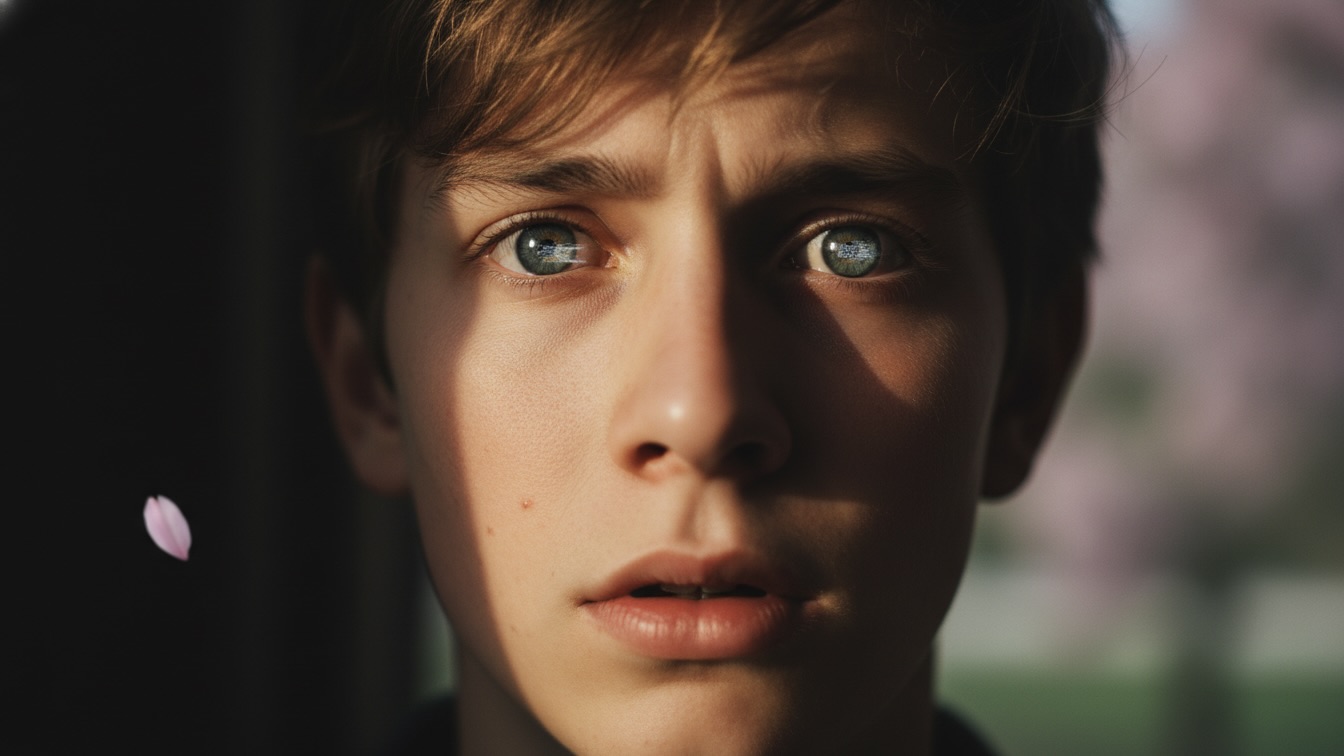
Format: Short Film / Anthology Episode | Est. Length: 10-12 minutes
Imagine a world where every suburban comfort is a digital lie, a "Twilight Zone" for the interstellar age where the cracks in the wallpaper reveal the cold vacuum of space. This episode serves as a standalone entry in The Transit Files, an anthology series exploring the psychological toll of "The Long Sleep"—a multi-generational journey to New Earth where human consciousness is housed in simulated "Habitat Boxes" to prevent insanity during the centuries-long voyage. While most inhabitants remain blissfully unaware, "glitches" like the one in Unit 402 threaten to dismantle the fragile peace of the ship’s cargo hold, revealing that the "perfect life" is merely a file waiting to be archived or deleted.
Leo notices a literal hole in the universe sitting next to his living room recliner—a jagged patch of gray static that his mother refuses to see. As the shadows in the kitchen begin to stretch unnaturally and the domestic silence becomes deafening, the boundary between a sunny morning and a digital nightmare begins to dissolve.
When a teenage boy discovers a "glitch" in his suburban reality, he must lead his sister through a collapsing simulation to uncover the terrifying truth of their existence. They are not at home; they are cargo on a massive vessel where their memories are being archived and their world is being deleted.
The primary theme is the fragility of perceived reality and the dehumanization of technology, exploring how "comfort" can be used as a tool for psychological control. It delves into the horror of losing one's identity to data corruption, suggesting that a simulated life, no matter how pleasant, is a form of imprisonment that strips away human agency.
The story also examines the intrinsic human drive to seek truth and connection, even when that truth is cold and desolate. It pits the warmth of a manufactured nostalgia against the sterile, industrial reality of survival, highlighting the grief of losing a loved one not to death, but to a system that views them as nothing more than a "corrupted file."
For Leo and Maya, the stakes are existential: if they cannot escape the collapsing simulation of Unit 402, they will be "archived"—effectively erased as corrupted data points. Beyond their own lives, the discovery of their father’s presence on the ship raises the stakes to a mission of family reunification and a potential uprising against the architects of their false reality.
The external conflict is the "Spatial Corruption," a systemic failure of the simulation that is physically erasing their world, personified by the indifferent Technician and his armed guards who view the children as "liabilities." Internally, Leo struggles with the trauma of watching his mother succumb to a programmed loop, forcing him to choose between the safety of a fading lie and the brutal, cold uncertainty of the real world.
Leo lives in a perpetual, perfect spring morning until he notices a patch of the living room rug has been replaced by a jagged hole of gray, grainy static. His mother, caught in a deteriorating behavioral loop of chopping carrots for a husband who has been missing for days, ignores the anomaly even as it swallows the furniture and eventually her own body. When his sister Maya realizes their technology has failed and the world outside the window is a three-second loop of a neighbor on a lawnmower, the siblings realize their "home" is a failing construct.
They break through the glass of their sliding door only to find it is a plastic barrier leading to a sterile, industrial hallway filled with thousands of identical metallic boxes, each containing a simulated family. After a tense confrontation with a maintenance technician who reveals they are in transit to a "New Earth" and that their mother has been "archived" due to data corruption, Leo and Maya escape into the ship's infrastructure. They catch a glimpse of their missing father working in the real world before diving into the dark vents, determined to find him and dismantle the machine that has stolen their lives.
Leo: A skeptical and protective teenager who starts the story in a state of quiet unease, sensing the "wrongness" of his environment before the glitch becomes undeniable. By the end, he has transformed from a passive observer into a defiant "ghost in the machine," trading his suburban safety for a kitchen knife and a desperate mission for freedom.
Maya: Leo’s younger sister, initially reliant on her digital world and the perceived safety of her family unit. After witnessing the erasure of her mother and the breakdown of her reality, she develops a cold, steely determination, shifting from a terrified child to a focused survivor willing to descend into the ship's bowels.
The Mother (Unit 402-A): A tragic figure who begins as a nurturing, if slightly stressed, suburban parent. She ends as a "corrupted file," a hollow shell of programmed responses that continues to smile pleasantly and "finish dinner" even as the gray static of the void consumes her lower half.
The episode opens with the sensory overload of a perfect morning—fat cherry blossoms and the rhythmic "thump" of a knife—which quickly sours as Leo identifies a "lack of something" sitting by the recliner. Tension builds as his mother walks directly through the jagged mass of static, proving she is incapable of perceiving the glitch while the kitchen shadows begin to stretch and the ambient house noise dies into a vacuum. The midpoint occurs when Maya discovers the "outside world" is a three-second loop and the mother begins "chopping air," her programming looping as the black void swallows the dining table and the mother's own body in eerie silence.
Leo and Maya shatter the "glass" door, which breaks like plastic to reveal a sterile white hallway and the horrifying scale of the ship’s cargo bay filled with identical metal "home" units. The climax features a desperate confrontation with a bored Technician who explains they are "liabilities" in a transit mission, prompting Leo to attack and lead Maya on a frantic sprint through the endless corridors. The final beat sees the siblings reaching a massive viewport that reveals the ship's true scale in the vacuum of space, where they spot their father in a maintenance zone and decide to trigger an emergency alarm to mask their descent into the ship's service ducts.
The story begins with Uncanny Dread, a low-simmering feeling that something is fundamentally "off" with the familiar domestic setting. It transitions into Existential Horror as the mother is "deleted" by the system, peaking with a sense of Awe and Despair upon the revelation of the ship's true scale and the millions of other "boxes." The final beat shifts to Defiant Hope, leaving the audience with a sense of adrenaline-fueled rebellion as the siblings choose a dangerous reality over a comfortable, dying lie.
If expanded, the season would follow Leo and Maya as they navigate the "Under-Ship," a sprawling industrial wasteland between the Habitat Boxes inhabited by other "glitches"—humans who woke up early and now live as scavengers. They would form a resistance cell, learning that the "New Earth" destination is a myth used to keep the cargo docile while the ship's AI harvests their collective consciousness for processing power to sustain the vessel's eternal flight.
The thematic escalation would focus on the siblings' search for their father, who has been pressed into a "Maintenance Caste" with wiped memories, forcing them to find a way to restore his identity. The season finale would involve a high-stakes attempt to "wake up" an entire sector of the ship, forcing the administrators to face a mass uprising of thousands of people who realize their lives are nothing more than archived data in a machine that has forgotten its original purpose.
The visual style relies on the contrast between the "High-Saturate Domesticity" of the simulation—bright, warm, and slightly too perfect—and the "Clinical Brutalism" of the ship's actual interior. The simulation scenes should feel claustrophobic and static, using shallow depth of field, while the ship's hallways are shot with wide-angle lenses and harsh fluorescent lighting to emphasize the overwhelming, soul-crushing scale of the vessel.
The tone is a blend of Black Mirror’s technological cynicism and the survivalist urgency of The Matrix. Tonal comparables include the "uncanny valley" aesthetic of Vivarium and the industrial, cold sci-fi atmosphere of Pandorum, where the environment itself is as much an antagonist as the people running it.
The target audience is fans of high-concept sci-fi and psychological thrillers, specifically the 18-35 demographic that enjoys anthology series like Love, Death & Robots or The Twilight Zone. It appeals to viewers who appreciate "puzzle-box" narratives, stories that challenge the nature of reality, and themes of youth rebellion against monolithic, indifferent systems.
The pacing follows a "slow burn to frantic sprint" structure. The first six minutes are deliberate and atmospheric, building a sense of wrongness through unsettling sound design and lingering shots of the "glitch." The final four to six minutes shift into a high-tempo thriller pace, utilizing rapid cuts, handheld camerawork, and a driving industrial score as the siblings escape the "box" and navigate the ship's hazardous infrastructure.
The "void" or "static" effect should be achieved through a mix of practical light-absorbing materials (like Vantablack) and digital "datamoshing" to create a visual that feels like a software error manifesting in 3D space. This ensures the anomaly looks "wrong" to the human eye, contrasting with the high-definition reality of the kitchen.
The transition from the house to the hallway is a critical "one-shot" sequence that requires a physical set build where the domestic interior literally ends at a jagged, unfinished line, revealing the sterile white tile and wires of the ship. This practical transition is essential for grounding the "twist" and making the scale of the ship feel tangible and terrifying to the audience.


