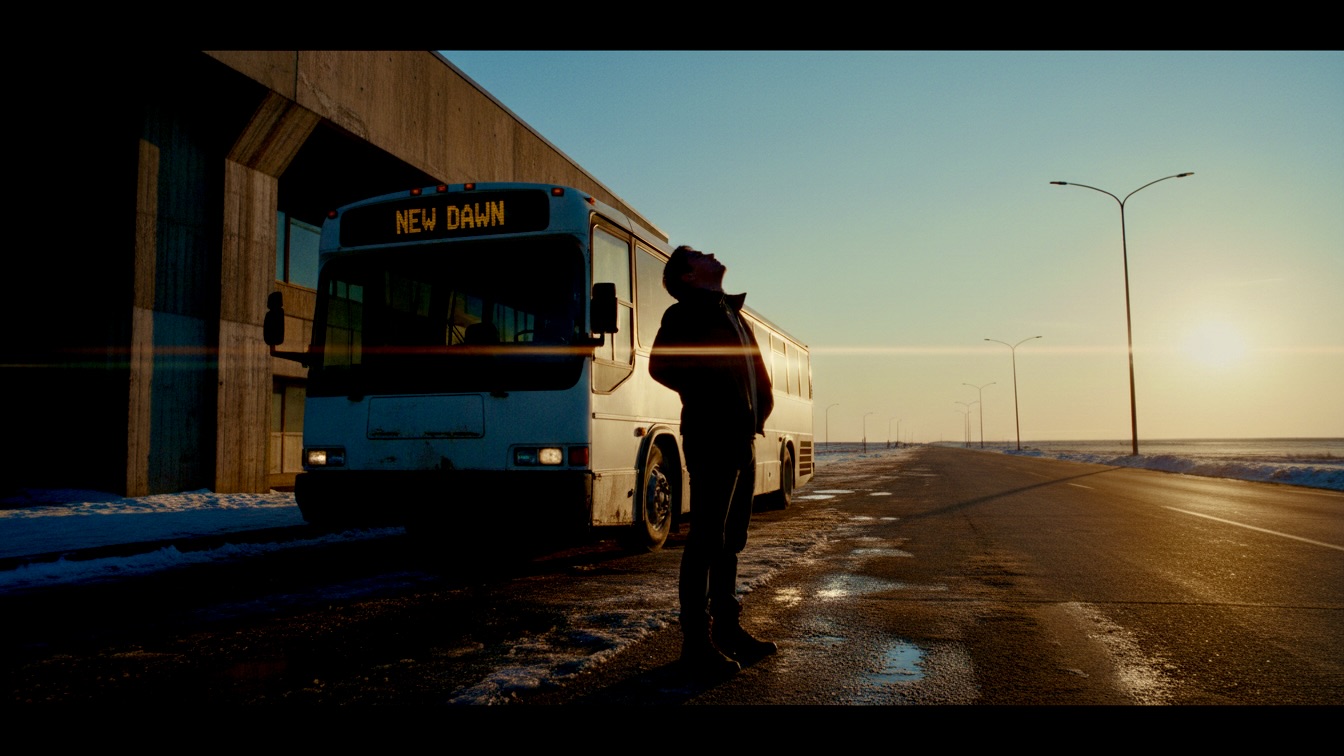
Format: Short Film / Anthology Episode | Est. Length: 10-12 minutes
This episode serves as a standalone entry in a supernatural anthology series titled The Transit of Souls, which explores the liminal spaces of the Canadian wilderness. Each episode focuses on travelers trapped in transit—buses, trains, or isolated highways—where the physical landscape shifts into a purgatorial realm governed by entities that feed on regret and unresolved history.
In a vibrating, fluorescent-lit Winnipeg bus terminal at 3:00 AM, a desperate dropout named Tyler is handed a transit card by a mysterious, high-society man who commands him to "RUN." As the bus departs into the frozen night, the air outside shifts from the smell of diesel to the impossible, sudden scent of spring, signaling a breach in reality.
A failed university student fleeing his past boards a late-night bus, only to realize the vehicle is a vessel for a supernatural entity. He must navigate a shifting, frozen purgatory or lose his soul to the road.
The episode explores the crushing weight of existential failure and the desperate, often futile, desire to physically outrun one's own identity. It examines the "liminal space" of the Trans-Canada Highway as a psychological barrier, where the transition from civilization to the wilderness mirrors the protagonist's descent into a surreal, inescapable nightmare.
The narrative also touches on the theme of inherited burdens, suggesting that our pasts are not merely memories but physical objects that follow us. The recurring motif of the "transit card" symbolizes the false promise of escape, highlighting the irony that movement does not equate to progress when one is running from themselves.
Tyler risks more than just his life; he risks being permanently erased from reality, effectively becoming another "passenger" in the entity’s collection. If he fails to escape the bus and the faceless man, he will be trapped in a perpetual cycle of transit, eternally reliving his failures in a frozen, colorless void.
The external conflict pits Tyler against the mysterious Man in the Suit, an entity that represents the cold, indifferent judgment of the life Tyler has abandoned. Internally, Tyler battles his own crushing self-loathing and the paralyzing fear that he is inherently a failure, a belief that the entity exploits to keep him tethered to the bus.
Tyler, a twenty-two-year-old dropout, attempts to leave his failed life in Winnipeg behind by taking a 3:00 AM bus to Dryden. His journey takes a sinister turn when a faceless, supernatural entity provides him with a marked transit card, and the bus begins to travel through a fog-laden, impossible landscape where the laws of physics and biology begin to decay.
After a catastrophic crash into an otherworldly forest, Tyler and a fellow passenger, Sarah, find themselves in a silent, frozen purgatory. The entity reappears, revealing that the "ticket" to leave his life was a trap, and as the environment shifts into a hostile, alien space, Tyler must confront the reality that he cannot outrun his own history.
Tyler is a young man defined by his perceived failures, starting the episode as a passive, defeated soul and ending it as a desperate, terrified survivor who realizes the gravity of his situation. His arc is one of forced awakening, moving from the numbness of depression to the sharp, agonizing clarity of life-or-death survival.
Sarah acts as a mirror to Tyler, a fellow runaway who represents the shared desperation of those who feel they have nowhere left to go. She serves as a catalyst for Tyler’s realization that his plight is not unique, and her presence highlights the isolation of their shared, doomed journey.
The episode opens in the sterile, humming Winnipeg terminal, establishing Tyler's isolation and the oppressive atmosphere of his failure. The inciting incident occurs when the Man in the Suit hands him the card, immediately shifting the tone from mundane to ominous.
The midpoint transition occurs when the bus enters the unnatural fog, the radio begins to click like a Geiger counter, and the driver’s ears begin to bleed. This sequence marks the point of no return, where the physical world is replaced by the entity’s distorted reality.
The climax erupts as the bus crashes and the man reveals his faceless form, forcing Tyler to choose between surrender and a futile, desperate flight. The final beat sees Tyler and Sarah running into the dark, only to discover that the road ahead is a loop, and their escape is an illusion.
The episode begins with a sense of heavy, stagnant depression, characterized by the hum of fluorescent lights and the gray slush of Winnipeg. As the bus enters the wilderness, the mood shifts into a high-tension, paranoid thriller, culminating in a cold, existential dread that leaves the audience feeling trapped and breathless.
If expanded, the season would follow various travelers who encounter the Man in the Suit, revealing him to be a "collector" of the lost and the guilty. Each episode would piece together the history of the entity and the dark, hidden geography of the Trans-Canada Highway, suggesting that these events are part of a larger, cosmic harvest.
The overarching narrative would track the evolution of the entity’s influence, showing how these "bus rides" are slowly bleeding into the real world. Characters from previous episodes might appear as "lost souls" in the background of subsequent stories, building a tapestry of interconnected tragedies.
The visual style is defined by high-contrast, clinical lighting in the terminal, shifting to claustrophobic, dark, and desaturated tones once the bus hits the highway. The cinematography should emphasize the "vibrating" nature of the world, using shaky, handheld camera work to mirror the protagonist's internal instability and the mechanical hum of the bus.
Tonal influences include the surreal, dread-filled atmosphere of It Follows and the isolationist horror of The Twilight Zone. The overall tone is one of "cold dread"—a film that feels like a fever dream where the silence is as dangerous as the monsters.
The target audience is fans of psychological horror, supernatural thrillers, and "weird fiction" aged 18-35. The episode is designed for viewers who enjoy slow-burn tension, metaphorical storytelling, and narratives that leave lingering, unsettling questions rather than easy answers.
The pacing starts deliberately slow to mirror the monotony of a long bus ride, allowing the audience to sink into Tyler’s depression. Once the bus hits the fog, the tempo accelerates rapidly, shifting into a frantic, chaotic rhythm that mimics the panic of the crash and the subsequent flight through the woods.
The production will require significant practical effects for the bus crash, focusing on the "otherworldly" nature of the wreckage rather than standard carnage. The "white trees" and the faceless entity will rely on a mix of high-quality prosthetics and subtle, unsettling CGI to maintain a grounded yet uncanny aesthetic.


