Format: Short Film / Anthology Episode | Est. Length: 10-12 minutes
Visualize this narrative as the pilot for a surrealist anthology series that captures the intersection of Gen Z nihilism and unexplained phenomena in the forgotten corners of the world. The story transforms the mundane, freezing reality of a Winnipeg spring into a vibrant, neon-lit exploration of how youth culture is instantly commodified by the digital gaze.
Telescope Trash Talk serves as an entry in Prairie Static, an anthology series set in the frost-bitten, industrial landscapes of Manitoba. The series focuses on the "Lost Generation" of the digital age, following different groups of students at St. Boniface High as they navigate the intersection of crushing boredom, social media performance, and the occasional unexplained phenomenon. The overarching narrative arc explores the commodification of youth rebellion and the search for authentic connection in a world where every "organic" moment is instantly converted into content.
On a freezing, slush-covered football field in Winnipeg, three cynical teenagers discover a vibrating, neon-yellow sludge that pulses with organic light. What starts as a prank to ruin the school’s astronomy night quickly spirals into a viral phenomenon that threatens their comfortable apathy.
When three disillusioned teens smear a mysterious glowing pollen onto their school’s telescope, they accidentally trigger a viral sensation and an underground economy. As their prank is co-opted by an influencer for "content," they must face the terrifying reality that even their most absurd rebellions are destined to be monetized.
The primary theme is the commodification of experience, exploring how Gen Z’s attempts at authenticity or rebellion are immediately absorbed into the digital "feed." The story highlights the tension between the "Bleak Smirk"—a defense mechanism against a ridiculous universe—and the genuine dread of a future that demands productivity and participation in a capitalist machine.
The secondary theme is the inevitability of growth and the fear of the future. Landon’s resistance to the "petal prophecy" reflects a broader generational anxiety about entering a world that feels both physically cold and digitally superficial, where even a miracle is just another "aesthetic of the week."
For Landon, the stakes are existential: the "petal prophecy" threatens his plan to remain safely invisible, forcing him to confront a future of responsibility and academic success he isn't ready for. For the group, the stakes involve the loss of their subculture; their "Glow Buddy" economy and private jokes are stripped of their meaning once they are broadcast to millions by a professional influencer.
The external conflict is driven by Principal Rodgers’ desperate need for institutional validation and Bree’s predatory "content creation" which strip-mines the students' experiences for views. Internally, Landon struggles with his own fear of the future, personified by the prophecy that he will pass his math final and thus be forced to engage with a world he finds fundamentally absurd and cold.
In the freezing slush of a Winnipeg April, Landon, Sam, and Lena are enduring a mandatory "astronomy night" led by their desperate Principal Rodgers. When they discover a patch of vibrating, neon-yellow pollen in the mud, they decide to sabotage the school’s telescope by smearing the sludge on the lens, tricking the school into believing they’ve discovered a new nebula. The prank escalates as the trio uses modified technology to hijack a "Warming Wind Relay," turning a sentimental school exercise into a cacophony of bass-boosted memes and viral audio that delights the student body.
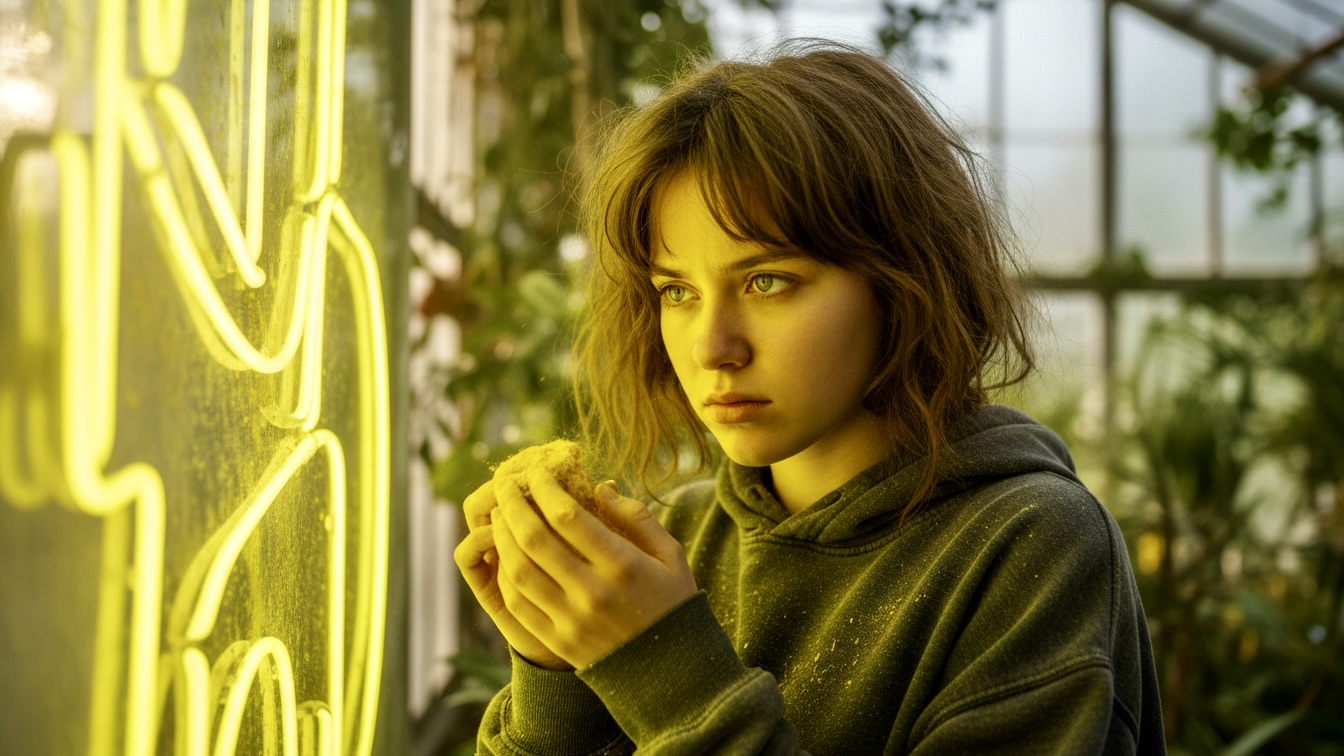
The chaos moves to the school greenhouse, where Lena dries the pollen to create "Glow Buddies," a useless trinket that becomes a high-stakes underground currency. However, the night takes a surreal turn when the pollen forms a prophecy on a mural, predicting Landon’s academic success and forcing him to face a future he hoped to avoid. The episode concludes at a marsh where they meet Bree, an influencer who reveals their "rebellion" has already gone viral as a curated aesthetic, leaving the trio to realize that their attempt to break the world only served to fill a content feed.
Landon: Landon begins as a master of "vibrating in the basement," a teenager whose primary goal is to fail his way into a life of zero expectations. By the end, he is haunted by the "petal prophecy" of his own success, realizing that even his cynicism cannot protect him from the inevitability of a career and a future.
Sam: Sam is the group’s chaotic engineer, moving from a state of bored technical sabotage to the height of "peak capitalism" as he manages the Glow Buddy economy. By the end of the night, he realizes his ingenuity has unintentionally become free R&D for a professional influencer, stripping him of his sense of subversive agency.
Lena: Lena is the pragmatic artist and catalyst who transforms the pollen into a currency and a prophecy, starting the night as a detached observer. She is the one who ultimately forces Landon to accept the reality of the digital storm they’ve created, transitioning from a prankster to a voice of cold, realistic clarity.
Beat 1 (The Slush): Landon, Sam, and Lena shiver on the St. Boniface football field while Principal Rodgers delivers a hollow speech about the heavens through a taped-together megaphone. Sam complains about the low-quality telescope while Lena discovers a patch of pulsing, neon-yellow dust that feels warm and organic to the touch. The trio decides to use the "glow-stick" mud to prank the school, smearing it on the telescope lens to create a fake astronomical discovery that sends Rodgers into a frenzy.
Beat 2 (The Relay): During the "Warming Wind Relay," Sam uses coin-sized speakers to replace hopeful notes with deep-fried memes and screaming goat audio, transforming a bleak school exercise into a chaotic, loud dance party. This midpoint marks the peak of the students' rebellion, as the football field becomes a cacophony of viral audio that Rodgers is powerless to stop. Inside the greenhouse, Lena establishes an underground "Glow Buddy" economy, turning the mysterious pollen into a high-value currency that seniors trade for textbooks and rides home.
Beat 3 (The Prophecy): The tone shifts when Landon discovers the pollen has formed a legible prophecy on a communal mural, declaring that he will pass his math final and enter the adult world. The climax occurs at the wetland center, where they encounter Bree, an influencer who reveals that their entire night of "rebellion" has already been packaged into a viral trend with millions of views. Landon sits on the boardwalk as the sun rises, realizing the "miracle" mud was just content, and the cold reality of his predicted success is now unavoidable.
The episode begins with a tone of gritty, grey-scale nihilism, reflecting the freezing Winnipeg environment and the characters' apathy. As the glowing pollen and viral audio take over, the mood shifts into a frenetic, neon-soaked absurdity, creating a sense of manic triumph for the protagonists. This peak is followed by a sharp, cold descent into disillusionment in the final act, as the characters realize their "authentic" chaos is merely "aesthetic of the week" for the digital masses, leaving the audience with a sense of lingering, quiet dread.
Throughout the season, the "Glow Buddy" phenomenon would evolve from a school-yard trend into a localized cult movement, with various episodes exploring how different social strata at St. Boniface High react to the "petal prophecy." The pollen would begin to appear in other locations, suggesting a sentient or invasive quality that mirrors the spread of viral information.
The overarching narrative would track the gradual encroachment of corporate interests—represented by Bree’s sponsors—as they attempt to harvest the glowing pollen for a new line of "bio-digital" lifestyle products. The season finale would involve the trio attempting to "delete" the pollen from reality, only to find that the digital and physical worlds have become inextricably linked.
The visual style utilizes a high-contrast palette, pitting the desaturated, muddy greys of a Canadian spring against the hyper-saturated, "radioactive" yellows and greens of the pollen. Handheld, documentary-style camerawork captures the school scenes to emphasize realism, while the telescope and greenhouse sequences use anamorphic lenses and shallow depth of field to create a dreamlike, surreal atmosphere.
Tonal influences include the deadpan humor of Napoleon Dynamite mixed with the neon-noir existentialism of Euphoria. The cinematic style should feel "lo-fi" yet intentional, using the "ring light" glow of the final scene to contrast sharply with the natural, fading light of the Winnipeg sunrise.
The target audience is Gen Z and young Millennials (ages 16-30) who resonate with themes of climate anxiety, digital fatigue, and the "absurdist" humor prevalent on platforms like TikTok. It appeals to viewers who enjoy dark comedies that blend mundane realism with speculative or "weird fiction" elements, similar to the tone of Atlanta or The End of the F*ing World.
The 12-minute runtime follows a rapid, three-act structure designed to mimic the attention span of a scrolling social media feed. The first four minutes establish the bleak setting and the discovery; the middle four minutes are a high-tempo montage of the prank and the greenhouse economy; the final four minutes slow down significantly to a somber, reflective pace as the sun rises and the digital reality sets in.
The "Glow Buddy" and pollen effects should be achieved through a mix of UV-reactive practical materials and subtle post-production glow enhancements to ensure the light feels "organic" rather than digital. This maintains the tactile, "slushy" reality of the setting while allowing the supernatural elements to pop.
The "Warming Wind Relay" sequence requires a complex sound design layer, blending diegetic wind noise with a layered cacophony of distorted viral audio clips to create a disorienting, immersive experience. Production must also account for the cold-weather filming in Winnipeg, utilizing the natural "sidewalk grey" sky to minimize the need for color grading in the non-glow scenes.


