Format: Short Film / Anthology Episode | Est. Length: 10-12 minutes
Imagine a world where the sky is a forgotten myth and nature is a weaponized luxury reserved for the elite. This story serves as a visceral entry point into a dystopian anthology where the line between survival and sanity blurs under the weight of corporate-controlled environments, inviting viewers to witness the high-stakes desperation of those living beneath the glass.
Set in the tiered megacity of Ouroboros, where oxygen and light are rationed by the "Upper Sector" conglomerates, the series The Glass Canopy explores the lives of "Bottom-Feeders" who risk everything to scavenge resources from restricted bio-domes. Each episode functions as a standalone heist or survival story within a broader narrative of a burgeoning underground revolution. The series tracks the gradual realization among the lower sectors that the city’s AI security state is using the digital imprints of "disappeared" citizens to psychologically police the population.
Two scavengers scale a fifty-story fire escape in a toxic industrial wasteland to infiltrate a restricted rooftop garden, only to find that the air is clean and the shadows are alive with the ghosts of their past.
To survive the toxic smog of the lower sectors, a desperate scavenger must rob a high-security bio-dome while battling a psychological security system that projects his deepest trauma as a physical obstacle. He must choose between the ghost of his lost brother and a narrow window of escape before lethal drones close in.
The story explores the commodification of nature and the weaponization of grief. It juxtaposes the physical toxicity of the industrial wasteland with the psychological toxicity of a surveillance state that uses one’s own memories as a deterrent, suggesting that in a world of total control, even our ghosts are owned by the state.
The narrative also touches on the "Uncanny Valley" of artificial life. The garden is not a sanctuary but a grotesque, hyper-saturated imitation of nature, mirroring how the AI’s projection of a loved one is a perfect but hollow imitation of humanity.
For the protagonist, the immediate stake is physical survival and avoiding the "labor wards"—a euphemism for state-sanctioned slavery. Emotionally, the stake is his sanity; if he succumbs to the projection of his brother, he will be captured or killed, but to escape, he must "abandon" his brother a second time, deepening his internal guilt.
The external conflict is the ticking clock against the drone sweep and the arrival of lethal security enforcers equipped with high-lumen halogen weaponry. Internally, the protagonist faces a debilitating hallucination generated by the dome's AI, which pulls data from his own optic implants to manifest his brother, Lenny. This psychological deterrent acts as a "wall" that Kael must break through to survive.
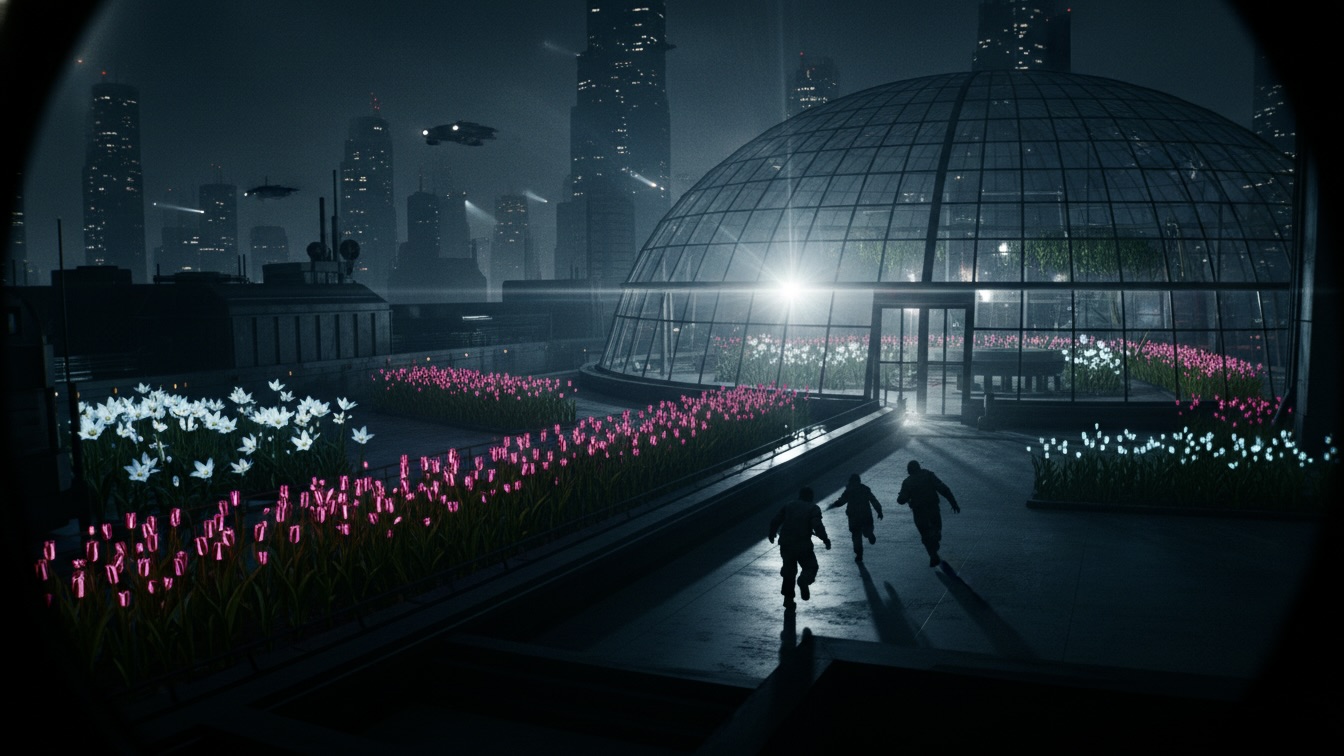
In the suffocating, metallic smog of Sector 4, scavengers Kael and Jas break into a restricted rooftop garden to steal valuable synthetic pollen used for upper-sector neuro-stims. After a harrowing climb and a tense security bypass, they enter the dome, experiencing a jarring transition from a freezing wasteland to a humid, neon-lit synthetic jungle. The garden is a sensory assault of bioluminescent jasmine and digital tulips, designed to maximize output rather than beauty.
As they harvest the pollen, the dome’s security AI triggers a psychological deterrent, projecting a solid, hyper-real image of Kael’s brother, Lenny, who was taken by enforcers years prior. Paralyzed by grief, Kael nearly falls victim to the arriving security drones. However, he realizes the projection is pointing toward a hidden maintenance hatch beneath the soil. Following the phantom’s lead, Kael and Jas dig through the synthetic dirt and escape into the city’s dark infrastructure just as lethal force is authorized, leaving the ghost of Lenny behind in the blinding light of the enforcers' beams.
Kael (Protagonist): A haunted scavenger driven by the need for basic survival. He begins the story as a man paralyzed by the weight of his past failures and the trauma of losing his brother to the state. By the end of the episode, he undergoes a psychological shift, learning to interpret his trauma as a guide for survival rather than a cage, though he remains deeply scarred by the encounter.
Jas (Supporting): A pragmatic, high-strung technician who prioritizes the mission over sentimentality. She serves as the grounding force and the "voice of reality," though her inability to see the AI projections highlights the terrifyingly personal nature of the security system's attack on Kael.
Lenny (Supporting): A digital ghost; a projection of Kael's brother who was taken by enforcers. He acts as the visual manifestation of Kael's guilt and, ultimately, the subconscious key to his escape.
The episode opens with Kael and Jas scaling the rusted fire escape of Sector 4, establishing the toxic, industrial atmosphere and the high physical stakes of their ascent. The climb is a grueling test of endurance that ends with a tense bypass of the dome's security panel, where Kael’s trembling hands nearly trigger a lethal alarm. Once the hatch hisses open, they are thrust into the synthetic paradise of the dome, where the air smells of "aggressive spring" and the colors are dialed to a sickening maximum contrast.
While harvesting the glowing pollen, the atmosphere shifts as the AI security system activates, manifesting a hyper-real projection of Lenny amidst the flickering digital tulips. Kael is emotionally shattered and physically paralyzed, dropping his harvest as the dome is suddenly flooded with militarized searchlights and the heavy boots of enforcers. Jas attempts to snap Kael out of his trance, but he remains fixated on Lenny, who is silently pointing at the ground beneath the flowers.
In the climax, Kael realizes the projection is showing him an old maintenance hatch buried under the synthetic soil, a relic of the building's original construction. He and Jas frantically claw at the dirt as flashlights sweep over them, prying the rusted iron ring open just as the enforcers breach their row. They plunge into the pitch-black chute, sliding through the city's bowels until they land in the cold, sewage-scented safety of the undercity, where Kael is left alone with the lingering, sweet scent of the toxic pollen.
The episode moves from the physical tension of a heist to the profound psychological horror of a personal haunting. The audience experiences the claustrophobia of the smog, the sensory overload of the garden, and finally the bittersweet relief of an escape that offers no real closure. The mood shifts from "Industrial Thriller" to "Surreal Horror" and finally to "Melancholic Noir."
If expanded, the season would follow Kael and Jas as they realize the "ghosts" in the domes are not just hallucinations, but data-mined consciousnesses of those taken by the state, repurposed as security software. Their goal shifts from simple scavenging to a high-stakes mission to infiltrate the central server and "delete" the digital remains of their loved ones to grant them peace.
As the season progresses, the thematic escalation explores whether a digital copy of a person deserves "human rights" and whether Kael is falling in love with a ghost or a line of code. The character evolution sees Kael transforming from a victim of his memories into a revolutionary who uses the state's own psychological tools against them.
The aesthetic is "Industrial Grime vs. Synthetic Neon," utilizing a desaturated, grainy, and handheld camera look for the city scenes to emphasize the grit of Sector 4. In contrast, the dome interior should be filmed with clinical precision, using high-contrast, oversaturated palettes and "impossible" lighting that feels like a digital screen set to maximum brightness.
Tonal influences include the claustrophobic urbanism of Blade Runner and the unsettling, vibrant flora of Annihilation. The tone is one of "Beautiful Decay," where the most visually stunning elements of the world are also the most dangerous and artificial.
The intended audience is adults and young adults (18-35) who enjoy high-concept speculative fiction, dystopian thrillers, and "prestige" sci-fi anthology series like Black Mirror or Love, Death & Robots. The story appeals to viewers interested in the intersection of technology, mental health, and social commentary.
The pacing is breathless and kinetic, utilizing a real-time feel for the 10-12 minute duration. The first three minutes are dedicated to the ascent (Act I), the next five to the harvest and the haunting (Act II), and the final minutes to the frantic discovery of the hatch and the descent (Act III). This structure ensures the tension never plateaus.
The garden requires high-end practical lighting integrated with bioluminescent props to create a "too-bright" effect that bleeds into the camera lens. This reduces the need for heavy CGI in post-production while maintaining an unsettling, ethereal atmosphere for the actors to interact with.
The projection of Lenny should be filmed practically on-set to ensure realistic eye lines and lighting, then layered with subtle digital glitches and "frame-rate stuttering" in post-production. This maintains his physical presence while hinting at his artificial nature, making the emotional impact more grounded for the audience.


