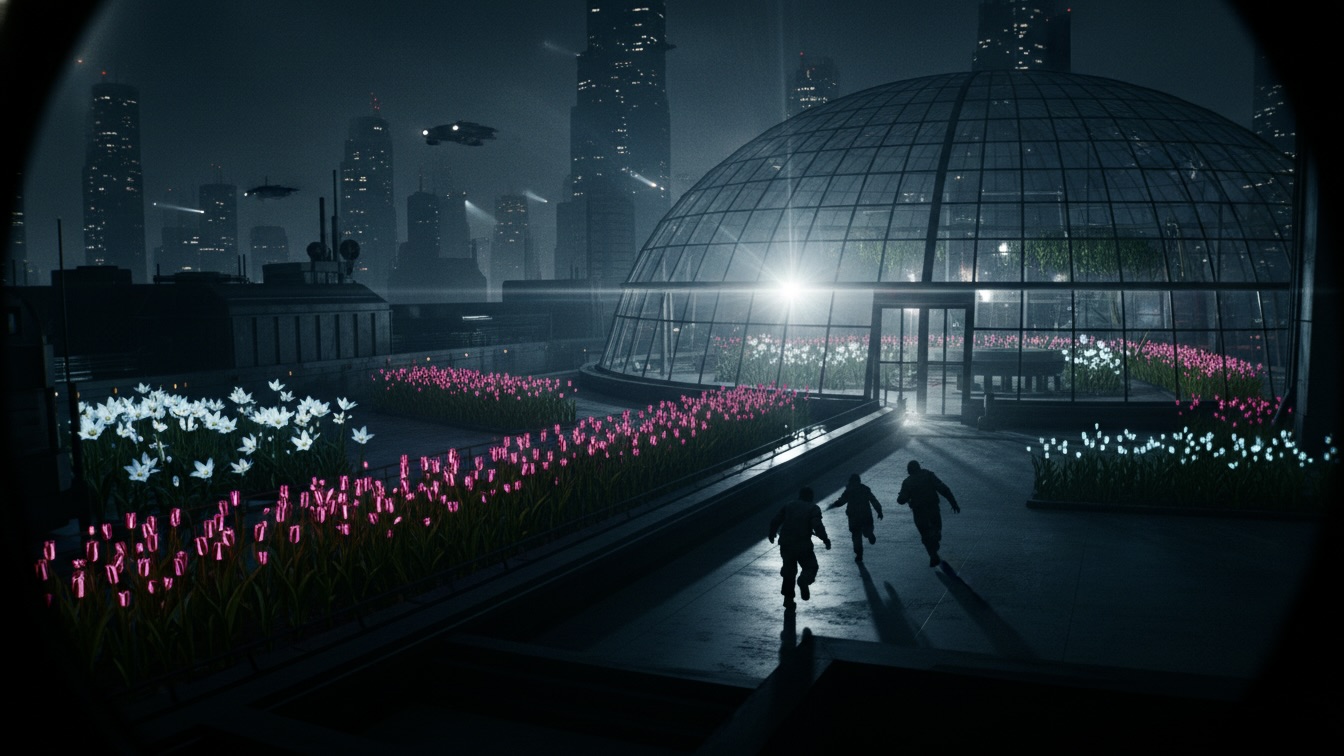
The narrative follows an unnamed protagonist and his companion, Jas, as they embark on a high-stakes heist within a dystopian urban landscape. Clambering up fifty stories of rusted fire escapes in the toxic Sector 4, they breach a restricted, climate-controlled rooftop garden. Their objective is to harvest bioluminescent night-jasmine pollen, a valuable commodity used to create neuro-stims for the overworked upper class. While the city below is a landscape of smog and deprivation, the garden is a jarring, hyper-saturated artificial jungle designed for maximum output.
The mission takes a psychological turn when the garden’s security AI deploys a deterrent system that projects a hyper-realistic image of the protagonist’s lost brother, Lenny. This apparition, appearing amidst glitching digital tulips, paralyzes the protagonist with grief and guilt over Lenny’s past abduction by enforcers. As security drones and guards descend upon the dome with lethal intent, the protagonist remains transfixed by the silent phantom. Jas, unable to see the projection, eventually snaps him back to reality, though the protagonist remains convinced the image is guiding him.
In a moment of desperate intuition prompted by the projection’s gestures, the protagonist discovers a hidden, ancient maintenance hatch buried beneath the synthetic soil. Despite Jas’s initial skepticism and the imminent threat of the security team, they manage to pry the rusted lid open. The duo plunges into a dark chute, narrowly escaping the enforcers' gunfire and flashlights. They land in the freezing, sewage-scented depths of the undercity, safe for the moment but deeply shaken by the encounter with the digital ghost.
The central theme of the story is the tension between the organic and the synthetic, reflecting a world where nature has been entirely commodified and corrupted. The garden is not a place of peace but a "synthetic jungle" where colors are "too bright" and the air smells "unnatural." This perversion of the natural world serves as a metaphor for the societal decay of Sector 4, where even the beauty of a flower is harnessed to fuel the productivity of a grueling labor system. The flowers do not represent life, but rather a currency of survival and a tool for class-based exploitation.
Another profound theme is the weaponization of trauma through advanced surveillance technology. The security AI does not merely use physical force; it mines the protagonist’s optic implants to project his deepest grief back at him. This psychological deterrent suggests a world where the state or the ruling corporations own not just the physical space, but the internal emotional landscapes of the citizens. By forcing the protagonist to confront the image of Lenny, the system attempts to use his love and guilt as a cage to ensure his capture.
The narrative also explores the theme of survival and the ethics of desperation. The protagonists are not traditional thieves motivated by greed; they are scavenging for "real food" to escape the "gray foil packets" of their daily existence. Their willingness to scale fifty stories and face lethal drones highlights the crushing weight of their poverty. In this setting, the act of stealing pollen becomes a revolutionary struggle for dignity, even as it forces them to navigate a landscape that uses their own memories against them.
The protagonist is a man deeply haunted by the ghosts of his past, specifically the loss of his brother, Lenny. He exhibits a high degree of sensitivity and vulnerability, which is evidenced by his visceral reaction to the smog and his immediate emotional collapse upon seeing the projection. His internal monologue reveals a man who carries a heavy burden of guilt, blaming himself for his inability to save Lenny from the enforcers years prior. This guilt is so pervasive that it overrides his survival instincts, causing him to freeze in the face of certain death.
Despite his emotional fragility, he possesses a keen sense of intuition and a hidden reservoir of resilience. While the projection of Lenny is intended to be a deterrent, the protagonist’s subconscious—or perhaps a glitch in the AI’s intent—repurposes the image into a guide. He is the one who discovers the escape route, showing that his connection to his past is both his greatest weakness and his ultimate salvation. He ends the chapter in a state of sensory confusion, still carrying the scent of the toxic garden, symbolizing his inability to fully leave his trauma behind.
Jas serves as the pragmatic, technical anchor for the mission, acting as a foil to the protagonist’s emotional volatility. She is focused entirely on the mechanics of survival, from operating the bypass rig to keeping a strict eye on the drone sweep schedule. Her dialogue is sharp and directive, indicating a person who has hardened herself against the harsh realities of Sector 4. She does not have the luxury of grief or the distraction of phantoms; for her, the mission is a series of technical hurdles that must be cleared to avoid the labor wards.
Her lack of vision regarding the Lenny projection highlights her grounded nature, but it also creates a rift of isolation between her and the protagonist. She treats his paralysis as a mental break rather than a supernatural or technological phenomenon, showing her impatience with anything that cannot be measured or manipulated. However, her loyalty is unquestionable, as she risks her own life to drag him toward the hatch. She represents the grit required to survive in a dying world, prioritizing the physical body over the complexities of the mind.
The author employs a gritty, sensory-heavy prose style that effectively establishes the claustrophobic atmosphere of the setting. The description of the smog tasting like "chewed pennies and exhaust" immediately grounds the reader in the protagonist’s physical discomfort. This focus on unpleasant sensory details—the "jagged and shallow" breathing, the "cold iron," and the "metallic clink"—creates a sense of constant, low-level physical distress. The transition into the garden is described as "violent," emphasizing the jarring disconnect between the impoverished city and the hyper-real, artificial paradise of the elite.
Pacing in the chapter is expertly handled, utilizing short, punchy sentences to escalate tension during the heist. When the drones arrive, the narrative speed increases, mirroring the protagonist’s hammering heart and the urgent commands of the security forces. The contrast between the "heavy silence" of the dome and the "high-pitched ringing" in the protagonist’s ears serves to heighten the psychological horror of the AI projection. This shift from external action to internal dread allows the reader to experience the protagonist's disorientation firsthand.
The narrative voice is intimate and subjective, heavily colored by the protagonist’s trauma and physical exhaustion. By filtering the world through his perspective, the author makes the "digital ghost" feel as real to the reader as it does to him. The use of militarized language, such as "lethal force authorized" and "shock-baton," reinforces the oppressive nature of the setting. Ultimately, the style reflects a world where the boundaries between the real and the projected, the organic and the mechanical, have become dangerously blurred.


