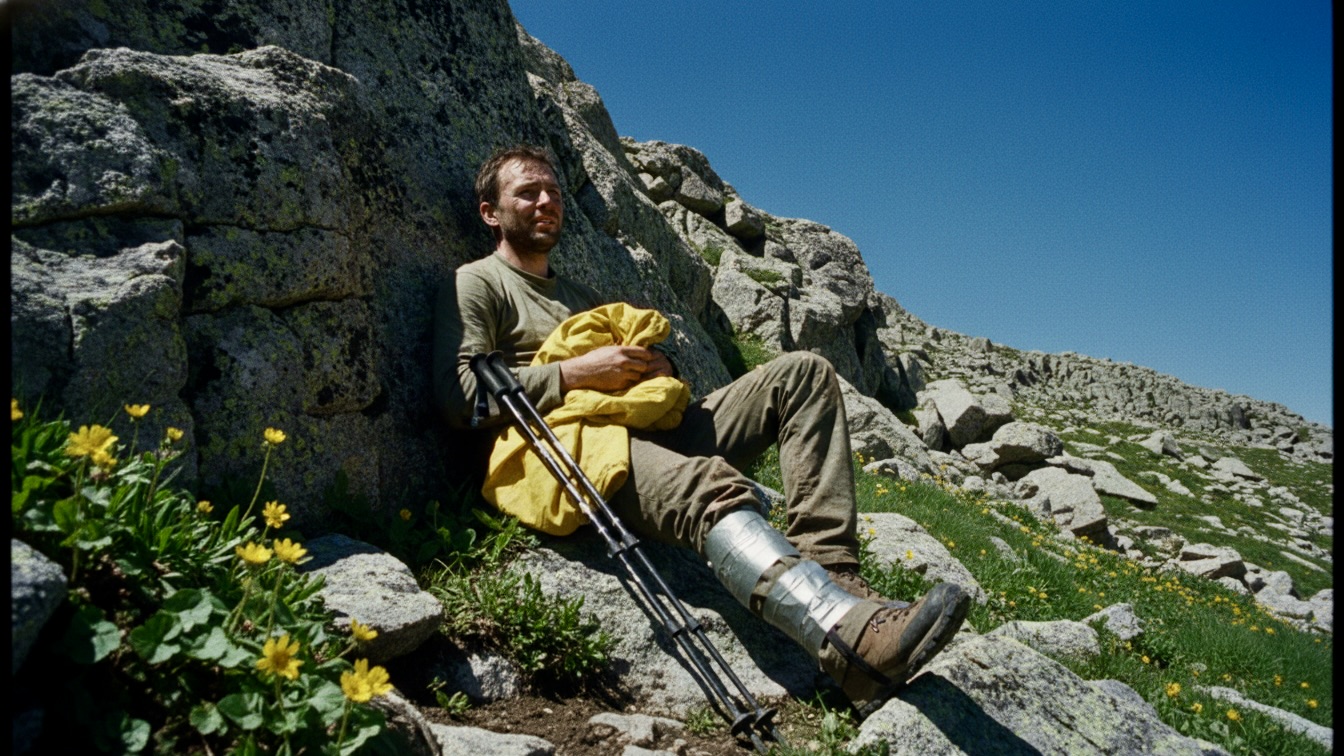
The mountain unzipped itself, taking the trail, my left ankle, and my dead husband's ashes with it.
The ground did not shake first. That is a myth they sell you in movies. There was no deep, cinematic rumble, no warning tremor to tell my nervous system to get ready. The mountain simply unzipped itself.
One second, I was stepping over a patch of bright green spring weeds pushing through the granite. The next, the audio dropped out of the world. A wall of gray dust exploded from the slope above me, moving faster than my brain could process. It smelled like sulfur and crushed quartz. I remember the sharp, distinct crack of a pine tree snapping in half. Then, gravity failed.
I was falling, but it was horizontal. The trail dissolved into a river of jagged gray stone. I threw my arms over my head, tucking my chin to my chest as the rocks battered my ribs, my shoulders, my back. I was in a washing machine filled with knives. Dust choked my throat, a thick, chalky paste that coated my tongue and burned my lungs.
I hit something hard. My body stopped moving, but the mountain kept going. Rocks poured over me, burying my legs, hammering my helmet. I squeezed my eyes shut and waited for the boulder that would turn off the lights for good.
It did not come.
The roar faded into a heavy, suffocating silence, broken only by the clatter of small pebbles trickling down the newly formed scar in the earth.
I did not open my eyes right away. I just lay there, face pressed into the dirt, listening to the high-pitched ringing in my ears. I took a breath. It was shallow, ragged, and it tasted like dirt, but it worked. My chest rose. My lungs filled.
"Okay," I said out loud. The word came out as a dry croak. "System check."
I wiggled my fingers. They worked. My right arm moved. My left arm moved, though the shoulder sent a hot spike of pain down to my elbow. I tried to pull my legs out from under the pile of loose scree.
My right leg slid free easily.
I pulled my left leg.
My stomach instantly turned over. A wave of nausea hit me so fast and so hard that I gagged, spitting a mouthful of gray dust onto the rocks. The pain was not a dull ache. It was a bright, flashing warning light in the center of my brain. It was electric.
I pushed myself up on my elbows and looked down.
My left boot was pointed at a ninety-degree angle to the outside. The dark gray fabric of my hiking pants was torn, and beneath the dust, a dark, wet stain was spreading fast.
I dropped my head back against the rocks and stared up at the sky. It was a perfectly clear spring day. The sky was an impossible, aggressive blue. A hawk was circling lazy loops way up high, riding the thermals, completely indifferent to the fact that I was bleeding out on a rock.
"You look like shit."
The voice came from my right, about three feet away. It was clear. Sharp. Familiar.
I snapped my head over, ignoring the pain in my neck.
James was sitting on a large, flat slab of granite. He was wearing the stupid vintage flannel shirt he bought at a thrift store in Portland, the one with the frayed cuffs. His hair was messy, the way it always was when he skipped his morning shower. He looked exactly the way he did before the chemo stripped the weight from his bones. He looked healthy. He looked real.
"You're dead," I said.
"Yeah, well," James said, leaning back and resting his elbows on his knees. "You're about to be, so I guess we're carpooling."
I squeezed my eyes shut. Hard. I pressed the heels of my hands into my eye sockets until I saw static. I was hallucinating. The shock, the pain, the blood loss. My brain was throwing up corrupted files. I opened my eyes again.
He was still there. He was picking at a piece of moss on the rock.
"You didn't pack the iodine, did you?" James asked, not looking up.
"Shut up," I muttered, dragging myself up into a sitting position. Every millimeter of movement ground the broken ends of my tibia together. I gritted my teeth, sweat breaking out across my forehead and stinging my eyes. The spring sun was already heating up the canyon. It was probably seventy degrees, but I was shivering.
"I told you to pack the iodine," James said. "I said, Paul, we might need to flush a wound. And you said, no, James, the iodine takes up too much weight in the ultralight pack. We need to save room for the portable espresso maker."
"I didn't bring the espresso maker," I hissed, reaching down with trembling fingers to unclip my waist belt.
"Point remains," James said. He stood up, walking lightly over the loose scree that had just nearly killed me. He didn't disturb a single pebble. He crouched down next to my ruined leg and whistled. "Oh, man. That is a compound fracture. You can see the white right there. That is your actual bone, Paul."
"I know what it is," I said, my voice shaking. I managed to get the heavy pack off my shoulders. I dragged it to my side, fumbling with the zippers. My hands were covered in scrapes, the knuckles raw and bleeding.
I needed the first aid kit. I needed the duct tape. I needed the trekking poles.
I ripped the main compartment open. My spare clothes had spilled out during the tumble. My sleeping bag was half out of its stuff sack. And then I saw it.
The blue plastic Nalgene bottle.
It was smashed. The heavy plastic had cracked open upon impact with a boulder. The cap was completely sheared off.
I stared at it. My brain stopped processing the pain in my leg for exactly three seconds.
"No," I whispered.
I reached into the pack and pulled out the broken bottle. It was empty. The gray dust inside had mixed completely with the gray dust of the mountain. There was no way to tell what was rock and what was James.
I dropped the plastic. I looked at the vast, chaotic slide of rocks stretching down the canyon. The ashes were gone. Scattered across half a mile of remote wilderness by a random geological event.
"Well," James said, standing over me. "That is efficient. Saved you a hike to the summit."
"I wanted to do it right," I said, my voice cracking. I wiped my nose with the back of my hand, leaving a smear of dirt and blood across my face. "I carried you for three days."
"You carried a plastic bottle full of calcium and carbon," James said gently. "I'm right here. And you are bleeding. Fix the leg, Paul."
He was right. The hallucination was right. If I didn't stop the bleeding and stabilize the bone, I was going to die of shock on this slope.
I dug into the side pocket of the pack and pulled out the small red first aid kit. It was pathetic. Band-Aids, gauze, some ibuprofen, a tiny roll of medical tape. Next to it, I pulled out the heavy roll of silver duct tape. I grabbed my two carbon-fiber trekking poles.
"Okay," I said, breathing heavily. "Okay. Splint. I need to straighten it first."
"Do not pass out," James said. He was standing directly in front of me now, blocking the sun. "If you pass out, you die. Your heart rate drops, the shock takes over, and nobody finds you until September."
"I'm not going to pass out," I said.
I grabbed the heel of my left boot with both hands. I took a deep breath of the pine-scented spring air. I held it.
I pulled.
The sound was the worst part. It sounded like thick celery snapping right next to my ear. A white-hot flash of agony ripped up my leg, through my spine, and exploded behind my eyes. I screamed. It was not a dignified sound. It was an animal noise, loud and desperate, echoing off the canyon walls.
The bone slid back under the skin. The angle of the boot corrected slightly.
I dropped the boot and fell backward, gasping for air. The sky spun in circles. Black spots danced at the edges of my vision. I turned my head and vomited a mixture of water and trail mix onto the rocks.
"Breathe," James said. His voice was suddenly much closer, right by my ear. "In through the nose. Out through the mouth. You reset it. Good job. Now tape it."
I wiped my mouth. I forced myself to sit up again. My hands were shaking so violently I could barely grip the trekking poles. I placed one on the inside of my leg and one on the outside.
I grabbed the duct tape. I tried to tear it with my teeth, but my jaw was trembling too much. I used my pocket knife, slicing a long strip. I wrapped it around the poles and my calf, pulling it as tight as I could.
I screamed again. The pressure on the fracture was unbearable.
"Tighter," James demanded. "It has to hold your weight. Tighter, Paul. You code software for a living, you sit in an ergonomic chair all day. You have no muscle tone. The tape has to do the work."
"Fuck you," I gasped, pulling the next strip of tape aggressively tight. "I bike to the office."
"An e-bike," James countered. "It does not count."
I wrapped my leg five times, securing the poles tightly against the break. I wrapped the ankle, securing the boot to the bottom of the poles to keep the foot from dropping. When I was done, my leg looked like a terrible, silver-and-black robotic appendage.
I collapsed back against my pack, chest heaving. My shirt was completely soaked with sweat. The sun was directly overhead now, beating down on the gray rocks, baking the dust into my skin.
"Water," I said.
I reached for the water bladder tube clipped to my shoulder strap. I bit the valve and sucked. Nothing.
I pressed on the bottom of the pack. The bladder had popped during the fall. My spare clothes were soaking wet.
"Well," James said, sitting cross-legged on a boulder a few feet away. "That is sub-optimal."
"Sub-optimal," I repeated, laughing. The laugh turned into a cough, which sent a jolt of pain through my ribs. "Sub-optimal. I have a broken leg, no water, a ruined pack, and I'm talking to a ghost. It's a system failure, James. It's a total crash."
"So reboot," he said.
He pointed down the mountain. The slide had wiped out the switchbacks. The only way down was straight through the debris field, a chaotic jumble of loose rock, shattered timber, and steep drops. At the bottom of the canyon, maybe two miles away, I could see a thin silver line. The creek.
"If you stay here, you die," James said. He wasn't smiling anymore. The irony was gone from his voice. "You need to move."
I looked at my splinted leg. I looked at the two miles of broken earth.
"I can't," I said.
"You can," James said. "You are going to stand up on your right leg. You are going to use the rocks. You are going to crawl like a miserable, pathetic bug if you have to. But you are not dying here."
"Why not?" I asked. The exhaustion was hitting me now. A heavy, dark blanket of fatigue. "You died in a hospital bed with machines beeping. At least this is quiet. At least there's a view."
James stood up. He walked over to me. He didn't look like a ghost. He looked like the man I married. He looked furious.
"Do not pull that dramatic bullshit with me, Paul. I didn't fight for three years just to watch you give up because you tripped over a rock. Get up."
I stared at him. The anger in his voice sparked something in my chest. It wasn't hope. It was spite. Pure, unfiltered spite.
I rolled over onto my stomach. I dragged myself up onto my right knee. I grabbed a solid outcropping of granite with both hands and pulled. My right leg took my weight. I kept my left leg completely straight, letting the trekking poles hover inches above the ground.
I was standing.
I looked at James. He gave me a slow nod.
"Now," he said. "Step."
I hopped forward on my right foot. I landed awkwardly, my left foot slamming into the ground.
The pain was blinding. I fell hard, scraping the side of my face against the rocks. Blood trickled down my cheek, mixing with the dust.
"Too fast," James said, standing over me. "You aren't coding. You can't just mash the keyboard. Calculate the distance. Find the grip. Move the right leg. Drag the left. Repeat."
I didn't answer him. I just dragged myself up again.
Right foot down. Balance. Drag the left leg forward. Lean on the hands. Shift the weight. Right foot down.
The first hundred yards took an hour.
The sun was relentless. Spring in the high country meant the air was cool, but the UV index was brutal. My lips were cracking. The inside of my mouth felt like sandpaper. Every time I shifted my left leg, the broken bone rubbed against the splint, sending a fresh wave of nausea through my gut.
We entered a section of the slide where the rocks were the size of microwaves. There was no flat surface. I had to climb over them, dragging the dead weight of my leg behind me.
"You should have sold the house," James said.
I stopped, draped over a boulder, panting. "What?"
"The house," he repeated. He was sitting on a rock slightly above me, watching me struggle. "It's too big for one person. You keep the heat at sixty-two degrees because you're cheap, and you eat takeout over the sink. You should have sold it and moved to an apartment in the city."
"I like the house," I wheezed, pushing myself up and dragging my leg over the rock.
"You like the idea of the house," James corrected. "You like the memory of us in the house. But I'm not there anymore. You're just paying property taxes on a museum."
"I haven't had time to clear out your office," I muttered.
"It's been a year, Paul. My clothes are still in the closet. You haven't touched my desk. You just shut the door and pretend that part of the house doesn't exist."
"I was busy," I snapped, slipping on a loose rock. I caught myself hard on my wrists, jarring my shoulders. "I had to manage the estate. I had to pay the hospital bills. I had to work."
"You worked ninety-hour weeks," James said, his voice dropping, losing the mocking edge. "You built a new UI for a banking app. Very important stuff. Definitely worth avoiding your own life."
"It paid the debt," I yelled, my voice echoing off the canyon walls. I looked around. There was nobody to hear me. Just the rocks and the spring weeds. "Those bills were massive, James. You didn't see the numbers. You were busy dying!"
Silence hung in the air, heavy and thick.
I froze, the words hanging between us. I looked up at him. I expected him to look hurt, or angry.
Instead, he smiled. It was a sad, quiet smile.
"I know," he said softly. "I know I left you with a mess. I know it wasn't fair."
I dropped my head onto my arms, resting against the hot granite. The spite faded, leaving nothing but an empty, hollow exhaustion.
"I didn't mean that," I whispered.
"You did," James said. "And it's okay. You're allowed to be angry at me. You're allowed to be mad that I got sick. But you are not allowed to use it as an excuse to stop living."
I closed my eyes. The static in my brain was getting louder. Dehydration was settling in deep. My heart was beating too fast, a rapid, fluttering rhythm in my chest.
"I can't make it to the creek," I said.
"Look up," James said.
I forced my head up.
We had cleared the boulder field. Below me, the slope smoothed out into a steep but manageable descent of dirt and small gravel. At the bottom, maybe four hundred yards away, the creek sparkled in the afternoon sun. Bright green willow bushes lined the banks.
It looked like a different planet.
"Gravity is your friend now," James said. "Slide."
I maneuvered myself onto my back. I kept my left leg elevated on the splint, pointing it straight down the hill. I used my hands and my right heel to control my descent, scooting down the dirt.
The friction tore through my hiking pants, scraping the skin off the back of my right thigh, but I didn't care. The distance was closing. Three hundred yards. Two hundred.
The smell of the water hit me before I reached it. It smelled like melted snow, crisp and sharp.
One hundred yards. Fifty.
I hit the flat ground at the bottom of the canyon. I didn't try to stand. I just rolled over onto my stomach and dragged myself through the thick spring grass. Mud squished beneath my hands. It was the best feeling in the world.
I reached the edge of the creek. I plunged my face directly into the water.
It was freezing. The shock of the cold snapped my brain back to reality. I drank greedily, slurping the water up, choking on it, coughing, and drinking more. I splashed it over my head, washing the blood and dust from my face. I poured it over the back of my neck.
I rolled over onto my back, staring up through the canopy of the willow bushes. The leaves were a bright, translucent green against the blue sky.
I let out a long, ragged breath.
"Okay," I said. "We made it to the water."
I waited for James to reply. I waited for him to tell me I was drinking too fast, or that I needed to filter it first, or that I was still miles from the trailhead.
Silence.
"James?" I asked.
I propped myself up on my elbows. I looked up and down the bank of the creek. I looked back up the massive gray scar of the rockslide.
He wasn't there.
The hallucination was over. The adrenaline had burned out, the hydration had cleared the worst of the static from my brain, and the ghost was gone.
I was completely alone.
For the first time since the slide, panic clawed at my throat. It was easy to keep moving when I was arguing with him. It was easy to push through the pain when I had something to prove to the phantom in my head.
Now, there was just the pain. The throbbing, relentless agony in my leg. The crushing reality of the miles of rugged terrain between me and the highway. I could not crawl for another two days. The splint wouldn't hold. I would get an infection.
I pulled off my pack. I started digging through it, looking for anything useful. I had my phone, but there was zero cell service out here. No bars. No satellite connection.
I pulled out my rain shell. It was a bright yellow nylon jacket.
I held it in my hands, staring at the synthetic fabric.
Then, I heard it.
It was a low, steady hum. At first, I thought it was a mosquito near my ear. I swatted at it. The hum persisted. It grew louder, shifting from a buzz to a mechanical whine.
I looked up.
Coming over the ridge, flying low over the treetops, was a quadcopter drone. It was large, painted white with bold orange stripes. An automated park ranger drone, running a standard patrol pattern over the backcountry trails.
It was moving fast. It was going to pass right over the canyon.
I scrambled to sit up. I grabbed the yellow nylon jacket. I waved it wildly over my head, ignoring the tearing pain in my shoulder.
"Here!" I screamed, my voice cracking. "Down here!"
The drone continued its path. It was programmed to look for thermal signatures on the trail. I was off the trail. I was hidden beneath the willows.
I dragged myself out from under the bushes, pulling my broken leg across the rocks. I moved into the direct sunlight.
I swung the bright yellow nylon in wide arcs.
"Look down!" I yelled, my throat burning. "Look at me!"
The drone reached the center of the canyon. It paused.
It hovered in place, the four rotors kicking up a slight breeze that rustled the tops of the pine trees. It slowly rotated on its axis, the camera lens panning across the destruction of the rockslide.
Then, the lens angled down.
It stopped moving. It just hung there in the air, staring at me.
A bright green light flashed twice on the underbelly of the drone. The patrol pattern was broken. It had registered the anomaly. It had registered the bright yellow fabric.
I dropped the jacket. My arms felt like lead. I collapsed back into the soft grass by the edge of the creek.
The drone descended slowly, hovering about fifty feet above me. It locked its position, establishing a relay to the ranger station.
I lay there, listening to the mechanical hum of the rotors. It was the sound of a server fan running high. It was the sound of the world I knew.
I turned my head and looked up at the massive gray scar on the mountain.
The Nalgene bottle was gone. The ashes were gone. James was gone.
They were part of the dirt now. Part of the rocks, part of the spring weeds pushing up through the dust.
I touched the silver duct tape wrapped around my leg. It was holding. I had fixed it. I had dragged myself down a mountain.
I closed my eyes. The sun felt warm on my face. The cold water of the creek rushed past my boots.
I was breathing.
I was broken, I was bleeding, and I was going to have a massive hospital bill. But my heart was beating, a steady, stubborn rhythm against my ribs.
I didn't want to die.
The realization settled over me, quiet and absolute.
The drone hovered, its camera lens zooming in on my face, but the only sound left on the mountain was my own breathing.
“The drone hovered, its camera lens zooming in on my face, but the only sound left on the mountain was my own breathing.”


