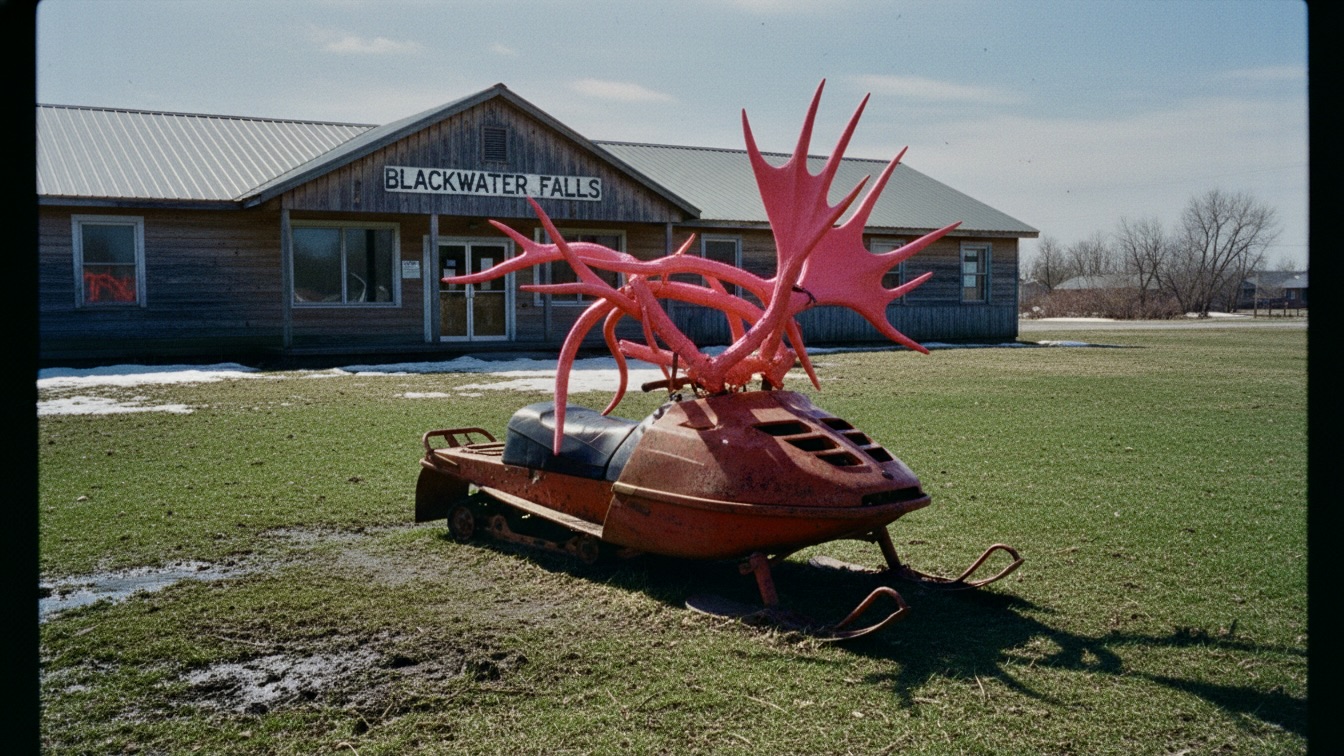
A bizarre sculpture of painted moose antlers and snowmobile parts appeared on the town hall lawn overnight.
"I am not signing off on a liability waiver for papier-mâché," Brenda said.
She pushed the clipboard across the folding table. The metal clip scraped against the cheap laminate. It sounded like someone dragging a key down the side of a car. My teeth hurt just listening to it.
"It is literally newspaper and flour, Brenda," Steve said. He was sitting next to me, picking at a loose thread on his Carhartt jacket. His leg was bouncing up and down. The whole table shook with it. "No one is going to die from looking at it."
"Fire codes are fire codes," Brenda said. She adjusted her glasses. They were thick, plastic, and smudged. "If you put those easels in the east hallway, you block the secondary exit. The fire marshal was very clear about the secondary exit in 2018."
I stared at the ceiling. The community center had those awful acoustic tiles with the little holes in them. One of them had a massive brown water stain shaped like a kidney. I had been staring at that kidney for two hours. It was Tuesday night. The air smelled like old floor wax and stale coffee. Outside, the snow was finally melting. Mud season in Melgund. The ugliest time of the year. Everything was brown, wet, and smelled like rotting leaves.
"Okay," I said. My voice sounded flat. I was too tired to fake enthusiasm. "We will move the easels to the main hall. Next to the radiator."
"The radiator leaks," Gary chimed in. He was sitting at the end of the table, organizing his zoning maps. He hadn't looked up in twenty minutes. "You put paper next to that radiator, you're going to get mold."
My stomach turned over. I hadn't eaten since noon. Just three cups of burnt drip coffee. I could feel the acid burning a hole in my stomach lining.
"Fine," Steve snapped. He stopped bouncing his leg. He leaned forward, planting his elbows on the table. "We will suspend the art from the ceiling using fishing line. Will that satisfy the safety committee?"
Brenda frowned. She actually thought about it. "I would need to check the load-bearing capacity of the drop ceiling."
I pulled my phone out of my pocket under the table. The screen was cracked in the top left corner. I had a text from my mom asking if I was coming home for dinner. I ignored it. I opened the group chat with Steve.
Me: I am going to walk into the woods and never come back.
Steve's phone buzzed on the table. He looked down at it, then looked at me. His eyes were bloodshot.
Steve: Take me with you.
"Look," I said, putting the phone face down. "This is the first youth art show Melgund has ever had. The kids have been working on this all winter. We just need the space for one weekend. Saturday and Sunday. We will clean everything up. We will mop the floors. We will not block the fire exits. Please."
Brenda sighed. It was a heavy, put-upon sigh. The sigh of a boomer who felt the weight of the entire municipal government resting on her shoulders. "I will tentatively approve the permit for the main hall. But I am capping the budget for refreshments at fifty dollars."
"Deal," Steve said instantly. He grabbed the clipboard and signed his name before she could change her mind.
We walked out of the community center ten minutes later. The cold air hit my face like a wet towel. It was dark, but the spring moon was bright. The parking lot was a swamp of half-melted slush and deep tire ruts. Steve's ancient Subaru was parked under the single working streetlight.
"Fifty dollars," Steve muttered, kicking a chunk of dirty ice. "What are we supposed to buy with fifty dollars? Two bags of chips and a case of store-brand soda?"
"We'll figure it out," I said. I pulled my beanie down over my ears. "We just needed the space. The kids are going to be stoked."
Steve unlocked his car. The door squeaked in protest. "Yeah. Sure. If they even show up. Half the town thinks art is just something you buy at a craft fair to hang over the toilet."
"Don't be cynical. It's bad for your skin."
He snorted and got in the car. I watched him pull out of the lot, the exhaust pipe rattling against the bumper. I lived three blocks away. I decided to walk. The cold felt good. It woke me up.
The town was completely silent. It was only nine o'clock, but in Melgund, everything shut down after the sun set. A few porch lights were on. A dog barked two streets over. I walked down Main Street, past the closed hardware store, the closed diner, the closed pharmacy. The storefronts looked tired. The paint was peeling. The whole town felt like it was holding its breath, waiting for something to happen.
I didn't know why I stayed. Most of my friends left for the city right after high school. They got jobs in marketing, or tech, or whatever. They posted photos of overpriced cocktails on Instagram. I stayed. I got a job at the local library. I tried to organize community events. I tried to convince myself that this place mattered.
I got home, ate a cold piece of toast, and fell asleep with my clothes on.
My phone rang at six in the morning.
I groaned, rolling over and burying my face in the pillow. The ringtone was loud and obnoxious. I fumbled for it, knocking a half-empty glass of water off the nightstand. It soaked into the carpet.
"What," I croaked.
"Get down to the community center," Steve's voice came through the speaker. He sounded out of breath.
"Steve, it's six in the morning. The meeting is over. Brenda can't hurt us anymore."
"Stacey, I'm serious. Get down here right now. You need to see this."
"See what?"
"Just hurry up."
He hung up. I stared at the screen. The battery was at twelve percent. I cursed, threw on the same boots I wore yesterday, and grabbed my coat.
The morning light was harsh. The sun was blindingly bright, reflecting off the remaining patches of snow. The sky was a clear, sharp blue. It was one of those spring mornings that felt aggressively optimistic. I walked fast, my boots squelching in the mud.
When I turned the corner onto the community center lawn, I stopped dead.
Steve was standing in the middle of the grass, staring at something.
It was a sculpture.
But that word didn't really cover it. It was a massive, tangled mess of metal and bone. At the base was the rusted front chassis of an old Ski-Doo snowmobile. Welded to the metal frame was a pair of massive moose antlers. But the antlers weren't brown. They were painted neon pink. Bright, synthetic, eye-bleeding pink. And woven through the antlers were strips of shredded rubber from snowmobile treads, tied in intricate knots.
It was bizarre. It was jarring. It looked like a glitch in reality.
I walked up to it slowly. The mud sucked at my boots.
"What the hell is that?" I asked. My voice barely worked.
"I don't know," Steve said. He didn't look away from it. "I came by to check the side door lock. It was just sitting here."
I walked around it. The welding job was crude but strong. The metal was still slightly warm to the touch. The pink paint was fresh. It smelled like aerosol and wet rust.
"Did Brenda put this here?" I asked, knowing how stupid it sounded.
Steve actually laughed. A short, sharp sound. "Yeah, Stacey. Brenda spent all night welding snowmobile parts in the mud to protest our liability waiver."
"Well, who did?"
"I have no idea."
I pulled out my phone and took a picture. I stepped back, trying to get the whole thing in the frame. The bright pink antlers against the drab, peeling siding of the community center. It was the best thing I had ever seen in this town.
I opened the group chat.
Me: [Image attachment] Me: Look what just spawned on the lawn.
Within seconds, the chat lit up.
Chloe: wtf is that. Mark: is that a ski-doo? Jenna: why is it pink. Steve: We don't know. It just appeared. Chloe: aliens. Mark: definitely aliens.
"We need to move it," Steve said suddenly. He looked panicked. "If Brenda sees this, she's going to freak out. She'll say it's a safety hazard. She'll cancel the show."
I shook my head. "No. We can't move it. It's too heavy. Look at the base. That's solid steel."
"We have to try."
He grabbed one of the pink antlers and pulled. It didn't budge. He pulled harder, his boots slipping in the mud. He ended up on his hands and knees, his jeans soaked in brown slush.
"Leave it," I said. I felt a weird protective urge over the thing. "It's art. We're having an art show. It's perfect."
"It's unpermitted," Steve argued, standing up and wiping mud off his hands. "It's rogue. It's illegal dumping."
"It's incredible," I corrected him. I touched the cold metal of the snowmobile chassis. "Look at the colors. It makes the rest of the town look dead."
By eight o'clock, half the town had driven by to look at it. Word traveled fast in Melgund. People slowed their trucks down, rolling down the windows. Some took photos. Some just stared.
Brenda arrived at nine. She parked her sedan in the lot and marched across the mud. She was wearing a beige trench coat. She looked like a very angry detective.
"What is the meaning of this?" she demanded, pointing a shaking finger at the pink antlers.
"We don't know," I said. I was sitting on the front steps of the center, drinking a coffee Steve had bought from the gas station. It tasted like burnt pennies.
"Is this part of your little exhibition?" Brenda asked, her voice shrill. "Because this is not on the permit. This is an eyesore. It is a hazard. A child could poke their eye out on those horns."
"They're antlers," Steve muttered.
"I don't care what they are! I want it removed immediately. Call public works."
"Public works is off today," I lied. I had no idea if they were off. "And it's too heavy to move without a forklift. I guess it just has to stay for the weekend."
Brenda's face turned a blotchy red. She glared at the sculpture, then at me. "This town is going to hell," she muttered, turning around and marching back to her car.
She drove away. I took a sip of my terrible coffee.
"She's going to try to shut us down," Steve said. He was pacing.
"Let her try," I said. I felt a strange surge of energy. The burnout was gone. Replaced by a buzzing, static thrill. "Whoever made this... we need to find them. We need to put them in the show."
"How?" Steve asked. "They're a phantom. They did this in the dead of night. They didn't leave a signature."
I looked at the mud around the sculpture. The ground was chewed up. Deep tire tracks led away from the lawn, heading toward the woods behind the center.
"They used an ATV to drag it here," I said, pointing at the tracks. "And they have to have a welding setup. You can't do this in a basement."
"So what? We knock on every barn door in the county?"
"No," I said. I pulled out my phone. The battery was at six percent. "We buy some trail cams."
That afternoon, we went to the hardware store. We bought three motion-activated trail cameras. They were expensive. I put them on my credit card. My checking account was already crying, but I didn't care.
The guy at the counter, a teenager named Kyle, looked at the cameras and then at us. "You guys hunting out of season?"
"We're hunting an artist," I said.
Kyle stared at me. "Okay, weirdo. That'll be a hundred and twenty bucks."
We spent the evening setting them up. The sun went down, and the temperature dropped fast. The mud started to freeze, turning into hard, jagged peaks. My toes were completely numb. We strapped the first camera to a telephone pole facing the community center lawn. We put the second one near the access road behind the building. The third one went near the old town dump, just on a hunch. If someone was scavenging for parts, they would go there.
"This is insane," Steve said, tightening the strap on the dump camera. He was shivering. His breath plumed in the cold air. "We are acting like insane people."
"We are organizers," I said, rubbing my arms. "We are curating."
"We are freezing to death for a prank."
"It's not a prank." I looked out over the piles of rusted metal and rotting wood in the dump. The moonlight made everything look sharp and dangerous. "It's a statement."
We went back to Steve's car and turned the heat on full blast. It smelled like wet dog and old french fries. We sat there in the dark, watching the dump through the windshield.
"You think they'll strike again tonight?" Steve asked. He opened a bag of stale tortilla chips and offered me one. I took it. It was chewy.
"I don't know. But I hope so."
We sat there for three hours. Nothing happened. Just a stray cat climbing over an old washing machine. My phone died at midnight. I felt a weird sense of relief. No texts. No emails. Just the hum of the car heater and the dark woods.
"I'm calling it," Steve said at one in the morning. His eyes were drooping. "I have to work tomorrow."
"Fine. Take me home."
The next morning, the town exploded.
I woke up to my mom pounding on my bedroom door.
"Stacey! Wake up! Get out here!"
I stumbled out of bed, my head throbbing. I walked into the kitchen. My mom was sitting at the table, her iPad propped up against a cereal box.
"Look at this," she said, pointing at the screen.
It was the local Facebook group. The Melgund Community Board. Usually, it was just people complaining about potholes or asking if anyone was missing a golden retriever. Today, it was a warzone.
There were photos. Three new sculptures had appeared overnight.
One was in front of the post office. It was a stack of old CRT televisions, their screens smashed out, filled with potting soil and dead winter grass. A single, bright yellow dandelion was painted onto the side of the plastic casing.
The second was in the park. A rusted tractor seat bolted to a massive, green-painted satellite dish. It looked like a weird, industrial lotus flower.
The third was right in the middle of the high school football field. A shopping cart welded to the hood of a Ford F-150, painted entirely in reflective silver.
The comments were a mess.
Gary (Zoning Board): This is vandalism. Plain and simple. The police need to get involved. Brenda: I warned everyone yesterday! This is what happens when you encourage deviant behavior! Chloe (Gen Z): okay but the tv planters kind of go hard. Mark: silver shopping cart is a mood. Mrs. Henderson: I think it's nice to see some color. The town has been so dreary.
I grabbed my jacket and ran out the door. I ran all the way to Steve's house. I didn't even knock. I just opened his front door and yelled his name.
He came out of the kitchen, holding a piece of toast in his mouth. He looked terrified.
"Did you see?" I asked, panting.
He nodded, taking the toast out of his mouth. "The trail cams. We need to check the trail cams."
We drove to the dump first. The mud had thawed again, making the road treacherous. Steve's car slid sideways twice before we parked. We ran to the tree where we hid the camera.
I popped the SD card out and shoved it into the reader attached to my phone. My hands were shaking.
"Come on, come on," I muttered.
The files loaded. Most of it was nothing. The stray cat. A raccoon.
And then, at 2:14 AM.
A truck pulled into the frame. An old, beat-up Chevy. The headlights were off. Two figures got out. They were wearing heavy winter coats and ski masks. They walked to the back of the truck and dragged out a massive metal object. The satellite dish.
"Can you zoom in?" Steve asked, leaning over my shoulder. He smelled like burnt toast and panic.
I pinched the screen. The resolution was terrible. The faces were completely obscured. But the truck...
"Look at the bumper," I said.
The truck's rear bumper was missing the left taillight. And there was a very specific, bright yellow bumper sticker on the tailgate. It was faded, but I could make out the shape. A cartoon bee.
"Save the Bees," Steve read aloud. He frowned. "Who has a Save the Bees bumper sticker?"
I stared at the screen. My brain clicked. The memory surfaced from deep in my childhood.
"Old Man Billings," I said.
Steve stared at me. "The former mayor? The guy who lives out on Route 9? He's like eighty years old. He hasn't left his property in five years."
"He has that truck. I remember it. He used to drive it in the Fourth of July parade."
"Stacey, you're telling me an eighty-year-old man is sneaking around town at 2 AM, welding satellite dishes to tractor seats?"
"There were two people in the video," I pointed out. "Let's go."
We drove out to Route 9. The road was a nightmare of potholes and washouts. The trees closed in around us, blocking out the sun. Billings' property was at the end of a long, dirt driveway marked by a rusted mailbox.
We parked near the edge of the property and walked the rest of the way. I didn't want him to hear the car.
The property was massive. A farmhouse, a huge red barn, and acres of junk. Old cars, farm equipment, piles of scrap metal. It was a graveyard of industrial waste.
As we got closer to the barn, we heard it.
A loud, crackling hiss.
I looked at the barn. Through the gaps in the wooden planks, bright blue light flashed. Sparks showered down onto the dirt floor inside. Someone was welding.
Steve grabbed my arm. "We shouldn't be here. He's crazy. Everyone says he's crazy."
"He's an artist," I whispered.
I walked up to the large sliding barn door. It was open a crack. I peeked inside.
The smell hit me first. Ozone, burning metal, and old oil. The barn was dimly lit, but the welding torch provided a harsh, stuttering strobe light.
In the center of the room was Old Man Billings. He was wearing a heavy leather apron and a welding mask. He was holding the torch, fusing a piece of rebar to a cast-iron bathtub.
But he wasn't alone.
Standing around him were three teenagers. I recognized them instantly. Toby, Sam, and Lila. They were kids from the indigenous youth center on the edge of town. They were wearing safety goggles, holding pieces of metal, watching Billings intently.
Billings flipped his mask up. His face was lined and weathered, covered in soot. He pointed at the weld.
"See that?" his voice was gravelly, carrying over the hum of the generator. "You hold the heat too long, you burn right through the base. You gotta move fast. Respect the metal, but don't let it push you around."
Toby nodded. He was holding a can of neon green spray paint. "Can I paint it now?"
"Let it cool first, kid. Unless you want it to catch fire."
I pushed the door open a little wider. It creaked loudly.
All four of them snapped their heads toward the door. Billings reached over and shut off the torch. The sudden silence was deafening.
"Who's there?" Billings barked.
I stepped into the barn. Steve hesitated, then followed me, hovering behind my shoulder.
"Hi, Mr. Billings," I said. My voice echoed in the large space.
He squinted at me. "Stacey Miller. Right? Used to buy comic books at the pharmacy."
"Yeah. That's me."
He crossed his arms. The leather apron creaked. "You're trespassing."
"We saw the truck on the trail cam," I said, pointing at the Chevy parked in the back corner of the barn. "We know it was you. With the sculptures."
Toby stepped forward. He looked defensive. "We didn't hurt anything. We just put them there."
"I know," I said quickly. "I'm not mad. I... I think they're amazing."
Billings stared at me. He didn't say anything for a long time. He just looked at me, his pale eyes piercing through the gloom of the barn.
"They're just junk," he said finally.
"They're not just junk," I said. I stepped closer. The heat from the freshly welded metal washed over me. "The pink antlers. The TV planters. The town is losing its mind. People are actually talking to each other. They're arguing, sure, but they're engaged. It's the most alive Melgund has felt in years."
Billings sighed. He walked over to a workbench and tossed his heavy leather gloves onto it.
"These kids," he gestured to Toby, Sam, and Lila. "They showed up a month ago. Looking for scrap for some project. I had plenty of scrap. Started showing them how to use a torch. They had the ideas. The pink paint. The weird shapes. I just did the heavy lifting."
"It's a collaboration," Lila said quietly.
"Why in the middle of the night?" Steve asked, finally speaking up.
Billings laughed. It was a dry, rusty sound. "Have you met the town council? You ask permission in this town, you get a committee. You get a permit application. You get Brenda telling you the paint is toxic. You don't ask. You just do it. Let them deal with the aftermath."
I smiled. I couldn't help it. He was completely right.
"We're hosting a youth art show this weekend," I said. "At the community center. We want you guys to be the centerpieces. All of it. We'll drag the sculptures into the main hall."
Billings shook his head. "I don't do crowds. I don't do shows."
"You don't have to show up," I said. "Just let us claim them. Let us put a plaque next to them. Let people know that art doesn't just happen in museums. It happens in barns on Route 9."
Toby looked at Billings. "Come on, old man. It'll make Brenda's head explode."
Billings looked at the kid. A slow, subtle smile crept onto his face.
"Fine," Billings said. "But I'm not helping you move the bathtub."
Saturday morning. The day of the show.
The weather had finally turned. The mud was drying up, hardening into solid earth. The sun was warm. The sky was a brilliant, unclouded blue.
The community center doors opened at ten.
We had moved the sculptures. It took Steve, me, Billings, the kids, and a rented pallet jack. We placed the neon pink antlers right in the center of the main hall. We put the TV planters by the windows. We put the satellite dish lotus near the stage.
The walls were lined with the kids' papier-mâché, watercolor paintings, and charcoal sketches. But the metal sculptures dominated the room. They looked massive, heavy, and undeniably real under the fluorescent lights.
At ten-fifteen, the first people walked in.
It was Mrs. Henderson and her husband. They walked slowly around the pink antlers, examining the welds.
"Well," Mrs. Henderson said, adjusting her glasses. "It's certainly vibrant."
By noon, the place was packed. I had never seen so many people inside the community center. Teenagers, boomers, little kids running around. People were drinking the cheap store-brand soda Steve bought. They were eating the stale chips. Nobody cared.
Brenda walked in at one o'clock.
She stopped in the doorway. She looked at the pink antlers. She looked at the crowd. She looked at me.
I braced myself for the yelling. The citations. The shutdown order.
Instead, she just stood there. She watched Toby explaining to a group of older men how they welded the snowmobile chassis without warping the metal. She watched the older men nodding, impressed by the technical skill.
Brenda walked over to me. She didn't look angry. She just looked confused.
"This was the phantom?" she asked, gesturing to the room.
"Yeah," I said. "A collaboration between generations."
She frowned. She looked at the TV planters. "I still think it's a safety hazard. Someone is going to trip over that cord."
"We taped it down, Brenda."
She sighed. "Fine. Just... make sure it's cleaned up by Monday."
She walked away, disappearing into the crowd.
Steve came up beside me. He handed me a cup of soda. He looked exhausted, dirty, and happier than I had ever seen him.
"We did it," he said over the noise of the room.
"Yeah," I said. I took a sip of the soda. It was flat. It tasted amazing.
I looked across the room. Old Man Billings hadn't come inside. But I saw him standing out in the parking lot, leaning against his Chevy. He was watching the building. He was smoking a cigarette.
I walked out the front doors. The spring air felt totally different now. The stagnation was gone. The weird, glitchy energy of the sculptures had somehow rewired the town's frequency.
I stood on the porch and looked at Billings. He raised his hand, a two-finger salute. I raised my cup back.
He got in his truck and drove away, the engine rumbling loud enough to rattle the windows.
I looked down at the lawn where the pink antlers had first appeared. The grass was crushed and dead where the heavy metal had rested. It left a perfect, rectangular scar in the earth.
The sun caught the edge of a discarded welding rod left in the dirt. It flared, bright and blinding, and I wondered what else was buried in the mud.
“The sun caught the edge of a discarded welding rod left in the dirt. It flared, bright and blinding, and I wondered what else was buried in the mud.”


