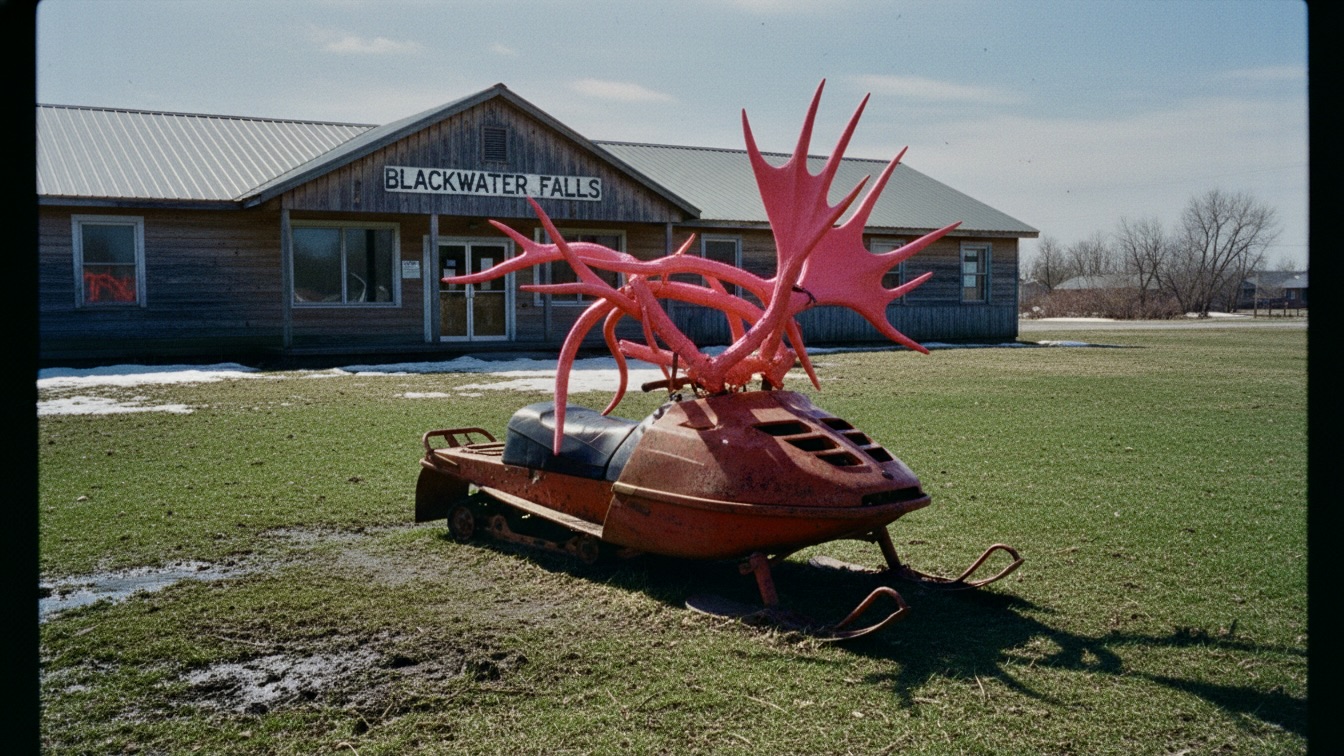
The story follows Stacey and Steve, two community organizers in the small, stagnant town of Melgund, as they attempt to navigate the stifling bureaucracy of the local safety committee. During a grueling meeting with Brenda, a rigid municipal official, they struggle to secure a permit for a youth art show. The atmosphere of the town is one of decay and seasonal depression, characterized by the "mud season" and a general sense of hopelessness. Stacey, who works at the local library, feels a profound sense of burnout and disconnection from her environment.
The narrative shifts when a bizarre, unauthorized sculpture made of a snowmobile chassis and neon pink antlers appears on the community center lawn. This "glitch in reality" sparks a series of similar artistic installations across the town, capturing the public’s attention and inciting both outrage and curiosity. Stacey and Steve decide to track down the "phantom" artist using trail cameras. Their investigation leads them to the property of Old Man Billings, a reclusive former mayor who has been teaching local indigenous teenagers the art of welding and metalwork.
The story concludes with the successful opening of the youth art show, which now features the large-scale metal sculptures as centerpieces. Despite the initial resistance from Brenda and the town council, the event draws a massive crowd and bridges generational divides. The town’s habitual stagnation is momentarily broken by the vibrant, aggressive energy of the art. Stacey finds her sense of purpose renewed as she realizes that the town is capable of change and engagement.
One of the primary themes explored in the text is the tension between bureaucratic stagnation and creative rebellion. Melgund is depicted as a place where "fire codes" and "liability waivers" are used as tools to suppress any form of novelty or communal growth. Brenda represents the psychological need for control in a dying environment, clinging to regulations to maintain a sense of order. The appearance of the neon pink antlers serves as a direct challenge to this rigidity, proving that art can be a disruptive, life-affirming force.
The narrative also delves deeply into the concept of generational bridge-building. Initially, the older generation (represented by Brenda and Gary) and the younger generation (represented by the youth center kids) seem to exist in separate, conflicting worlds. However, the collaboration between Old Man Billings and the teenagers suggests that wisdom and raw, modern energy can synthesize into something powerful. This partnership bypasses the traditional, failed structures of the town council to create something authentic and unpermitted.
Finally, the story examines the psychological impact of environmental aesthetics. The "mud season" in Melgund acts as a metaphor for the characters' internal states; everything is brown, wet, and stagnant. The introduction of "eye-bleeding pink" and "reflective silver" into this drab landscape acts as a sensory jolt. This color contrast symbolizes the spark of hope and the "static thrill" that Stacey feels, suggesting that the physical environment must be transformed before the collective psyche of the town can heal.
Stacey is the narrative’s emotional anchor, and she begins the story in a state of quiet, psychological exhaustion. She exhibits signs of burnout, such as a "flat" voice and a desire to "walk into the woods and never come back." Her attachment to the town is tenuous, as she constantly compares her life to friends who escaped to the city. She views herself as an organizer, but her efforts feel futile until the mystery of the sculptures provides her with a new sense of agency.
The psychologist’s perspective would suggest that Stacey is searching for a "sign of life" to justify her decision to stay in Melgund. When she encounters the pink antlers, her protective urge over the sculpture indicates a shift from apathy to advocacy. By the end of the chapter, her burnout is replaced by a "buzzing, static thrill." This transformation shows that her identity is deeply tied to the town’s potential for vibrancy rather than its current state of decay.
Steve serves as the pragmatic, though often cynical, foil to Stacey’s more internal struggle. He is physically restless, evidenced by his bouncing leg and bloodshot eyes, suggesting a man who is high-strung and perhaps equally trapped by the town’s limitations. While Stacey focuses on the emotional and artistic value of the sculptures, Steve is preoccupied with the logistics and the potential for trouble. He is the one who worries about "illegal dumping" and Brenda’s inevitable retaliation.
Despite his cynicism, Steve is a dedicated partner in Stacey's mission. He is willing to spend his limited funds and sleep on trail cameras to solve the mystery. His character arc is one of gradual conversion from skepticism to genuine pride. By the end of the show, he is "happier than he had ever seen him," indicating that the success of the event has provided him with a much-needed sense of accomplishment and belonging.
Brenda functions as the personification of the town’s "superego," enforcing rules and restrictions with a sense of self-imposed martyrdom. She views herself as the only thing standing between the community and total chaos, even when that "chaos" is merely papier-mâché. Her obsession with the 2018 fire marshal report shows a mind that is anchored in the past, unable to adapt to the present needs of the youth. She uses safety as a shield to avoid the discomfort of change.
Psychologically, Brenda’s behavior can be seen as a defense mechanism against the town’s decline. If she can control the fire exits and the budget for chips, she can pretend that Melgund is still a functioning, orderly municipality. Her reaction at the end of the story is particularly telling; she does not shut the show down. Instead, she looks "confused," suggesting that the sight of the community actually engaging with one another has momentarily bypassed her rigid mental framework.
Old Man Billings is the "shadow" of the town’s former self—a man who once held power as mayor but retreated into a "graveyard of industrial waste." His decision to work with the indigenous teenagers represents a rejection of the very bureaucracy he once led. He possesses the technical skills (welding) that the town has forgotten, and he uses them to give form to the teenagers' "weird shapes." He is a mentor who values "respecting the metal" and moving fast, a philosophy that stands in direct opposition to the town council’s slow decay.
Billings does not seek recognition or public approval, as evidenced by his refusal to enter the community center. He remains an outsider by choice, watching the results of his work from the parking lot. His "two-finger salute" to Stacey signifies a passing of the torch. He has provided the spark, but he leaves it to the younger generation to manage the "aftermath" and keep the town’s new frequency alive.
The pacing of the story mirrors the protagonist's psychological journey, moving from a slow, claustrophobic opening to a rapid, energetic conclusion. The initial scene at the community center is intentionally tedious, using sensory details like the "metal clip" scraping the table and the smell of "old floor wax" to create a sense of stagnation. This slow start makes the sudden appearance of the neon pink antlers feel even more jarring and significant. As the mystery unfolds, the narrative speed increases, reflecting the "surge of energy" Stacey feels.
The author makes excellent use of sharp, sensory contrasts to highlight the story's themes. The "drab, peeling siding" of the community center is set against "eye-bleeding pink," and the "burnt pennies" taste of the coffee is contrasted with the "brilliant, unclouded blue" of the spring sky. These details ground the story in a gritty realism while also allowing the "glitchy" art to stand out as something supernatural or alien. The use of the "mud season" as a recurring atmospheric element reinforces the feeling of being stuck in a transitional, ugly period of life.
The narrative voice is first-person and highly observational, allowing the reader to experience Stacey’s internal shift from cynicism to hope. The dialogue is snappy and realistic, particularly the exchanges between Stacey and Steve, which capture the shorthand of long-term friends facing a shared struggle. The story ends on a poignant note with the "rectangular scar" in the earth. This final image suggests that while the art show was a success, the impact it left on the town is permanent and perhaps just the beginning of a deeper excavation of the community's hidden potential.


