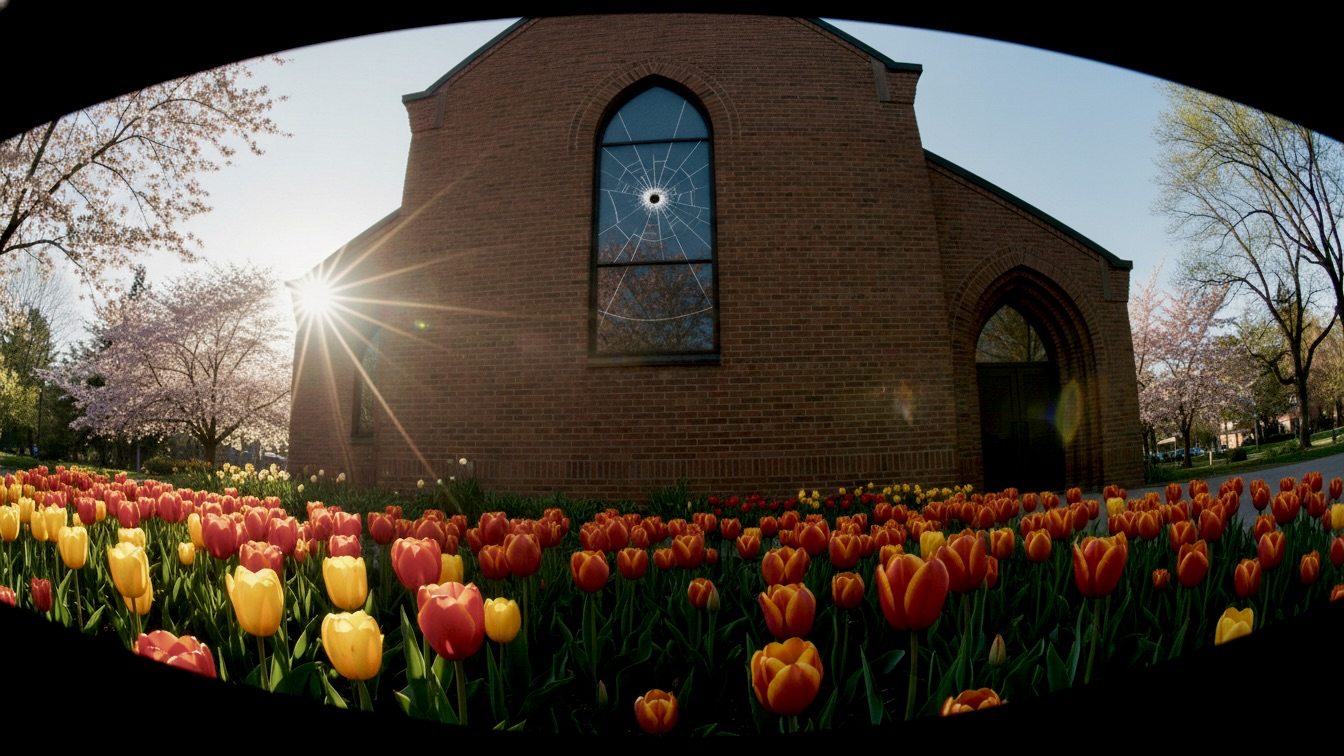
A caretaker finds bullet holes in a Toronto synagogue as spring blooms, triggering a desperate search for safety.
"The integrity of the structural glass is compromised," Mark said. He didn't touch it. He knew better than to mess with a crime scene. His voice sounded thin in the cold morning air. It wasn't just a crack. It was a puncture. A precise, small hole with a halo of white fractures radiating outward like a dead star.
Annette stood behind him. She was holding a stack of laminated programs for the afternoon's intercultural reconciliation event. Her hands were shaking. The paper made a soft, rhythmic clicking sound against her thighs. "Is it what I think it is?" she asked. Her tone was flat. She was already processing the logistics of a cancellation.
"It's a nine-millimeter entry point," Mark replied. He looked at the floor. He found the slug nestled in the carpet near the front pew. It looked like a spent bug. Small. Gray. Heavy. "They didn't just throw a rock this time. They used a tool."
High Park was waking up around them. Outside the heavy oak doors of the synagogue, the world was aggressively bright. It was late April in Toronto. The cherry blossoms were peaking. A pink fog of petals drifted over the sidewalks. Joggers in high-end compression gear moved in steady loops past the building. They didn't look at the synagogue. Why would they? It was a brick box in a sea of green. To them, the park was a reset button. A place to forget the news cycle and the rising cost of rent and the vague, vibrating anxiety of the 2026 election cycle.
Inside, the air was stagnant. It smelled of floor wax and old books. The light coming through the bullet hole hit a dust mote and turned it into a spark. Mark felt a cold pressure in his chest. It wasn't fear. It was more like a data point being confirmed. He had spent months monitoring the encrypted channels. He had seen the maps. He had read the threads where people talked about 'reclaiming the soil.' This was the physical manifestation of a digital ghost.
"We have eighty people coming in three hours," Annette said. She looked at her watch. It was a digital model, the screen slightly scratched. "The MP is supposed to speak. The Imam from the center on Bloor is already on his way. If I call the police now, they'll tape the whole block off. The event is dead."
"The event is a target, Annette," Mark said. He turned to face her. His eyes were tired. He hadn't slept more than four hours a night since the threats started appearing on the community board. "If we stay open, we're inviting them to finish the magazine. Look at the angle. They shot from the treeline. They were standing right where the kids play soccer."
He walked to the window. The shadow mass was there. It wasn't a ghost or a monster. It was a shift in the atmosphere. The way the light didn't quite reach the corners of the foyer. The way the birds in the park had suddenly gone quiet. It was an unnatural silence. A pocket of dead air in a city of noise. Mark could feel the eyes. Somewhere in the dense thicket of spring growth, someone was probably watching the reaction.
"We are not retreating," Annette said. Her theatricality was her shield. She stood tall, her chin tilted up. "To close the doors is to concede the narrative. We are hosting a dialogue on reconciliation. We cannot be silenced by a piece of lead."
"That’s a great quote for the press release," Mark snapped. "But I’m the one who has to stand at the door. I’m the one who has to explain to the parents why there’s yellow tape over the Ten Commandments."
He checked his phone. No new notifications. That was worse than a flood of them. The silence on the boards usually meant the coordination was moving to a direct-action phase. He thought about the military-grade equipment he’d seen in those blurry profile pictures. These weren't kids with spray paint. These were people who understood perimeter gaps.
Mark walked back to the bullet on the floor. He knelt. His knees popped. The sound was loud in the empty sanctuary. He thought about his grandfather. The man had survived the camps only to end up in a Toronto suburb, obsessively checking the locks every night at 9 PM. Mark used to think it was a trauma response. Now, he realized it was just a realistic assessment of the world’s baseline settings.
"Call the liaison," Mark said. "Tell them we need a physical presence. Not a cruiser driving by every thirty minutes. I want boots on the sidewalk. Now."
Annette nodded. She pulled out her phone. Her thumb swiped with practiced efficiency. "I'm messaging the group chat. We need the volunteers here early. We'll form a human chain if we have to."
"A human chain against a rifle?" Mark whispered. He didn't say it loud enough for her to hear. He didn't want to break her. She still believed that the moral arc of the universe was a real thing. Mark knew the universe didn't have an arc. It had a trajectory. And right now, the trajectory was pointed at the glass.
He moved to the security monitor in the small office. The hardware was outdated. The frame rate was choppy, making the joggers outside look like ghosts flickering through the trees. He rewound the footage. 3:14 AM. The screen was mostly black and green. Then, a flash. A small, suppressed spark near the edge of the frame. No person was visible. Just the signature of the discharge.
He zoomed in. The shadow moved. A dark shape, blurred by the low resolution, detached itself from a maple tree and melted back into the park. It was efficient. It was professional.
"They're testing us," Mark muttered.
He looked out at the tulips. They were a violent, saturated red. They looked like blood against the green grass. The park was too beautiful today. It felt like a lie. The sun was warm on his neck through the broken window, but he felt like he was standing in a freezer.
He heard the front doors open. He stiffened, his hand reaching for the heavy mag-lite on the desk.
It was Kareem. He was the youth coordinator from the mosque down the street. He was wearing a denim jacket and carrying a crate of bottled water. He stopped when he saw Mark’s face. He looked at the window.
"Again?" Kareem asked.
"Different caliber," Mark said. "Better aim."
Kareem set the water down. He walked over to the window and looked at the hole. He didn't look shocked. He looked exhausted. This was the common language of 2026. Not words, but the shared recognition of damage.
"We had a brick through the secondary entrance last night," Kareem said. "No note. Just the brick. They wrapped it in a printout of a forum post. Something about 'cleansing the soil.'"
"It’s the same group," Mark said. "The 'Northern Vanguard' or whatever they’re calling themselves this week. They’ve been pinging the geolocation of the park for days."
"Are we still doing this?" Kareem asked, gesturing to the empty chairs being set up in the hall.
"Annette says we are," Mark said.
"Annette is a romantic," Kareem replied. "But she’s right. If we don't show up, the park belongs to the shadows. I’ve got ten guys coming. They aren't security, but they’re big. We’ll sit in the front rows."
"Thanks," Mark said. He meant it. The interfaith alliance wasn't just a talking point for them. It was a survival strategy.
Mark spent the next hour doing a sweep of the exterior. He walked the perimeter of the synagogue, his eyes scanning the mulch and the bushes. He found two more casings. They were tucked neatly into the dirt, almost like they had been planted there to grow.
He looked up at the High Park canopy. The new leaves were translucent in the sun. It was a perfect spring morning. A golden-retriever ran past, chasing a ball. Its owner, a girl in her early twenties with neon-colored headphones, smiled at Mark. She had no idea. She was living in the Toronto that appeared in tourism brochures. Mark was living in the Toronto that existed in the dark fiber of the internet.
He felt the shadow mass again. A prickle on the back of his neck. He turned around quickly. Nothing. Just a lilac bush swaying in the breeze. But the silence was there. The birds had stopped again.
He went back inside. The lobby was starting to fill with people. There was the smell of coffee and the sound of nervous chatter. People were looking at the window. Someone had taped a piece of cardboard over the hole. It looked pathetic. A brown square of paper trying to hold back the tide of the world.
Mark stood by the door. He watched every person who entered. He looked at their hands. He looked at the bulk of their jackets. He was looking for the shape of a weapon, but he was also looking for the look in their eyes. The gaze that didn't land on anything. The flat, detached stare of a person who had decided that other people weren't people anymore.
An older woman approached him. She was carrying a plate of cookies wrapped in plastic. "Is it safe, Mark?" she asked.
He looked at the cardboard on the window. He looked at Kareem and his friends standing by the pews. He looked at Annette, who was currently laughing with the MP, her face a mask of professional confidence.
"It's as safe as it's ever going to be," Mark said.
He didn't tell her about the casings in the dirt. He didn't tell her about the flash on the security camera. He didn't tell her that he felt like they were all standing on a thin sheet of ice over a very deep, very cold lake.
The event started. The MP spoke about 'the fabric of our nation.' The Rabbi spoke about 'the light that pierces the dark.' The Imam spoke about 'the bridge we build together.' It was all very theatrical. It was all very formal. It was exactly what everyone needed to hear to keep from screaming.
Mark stayed at the back. He didn't listen to the words. He listened to the building. He listened for the sound of a car idling too long in the parking lot. He listened for the sound of a footstep on the gravel that didn't match the rhythm of a jogger.
His phone buzzed.
It was a private message on a burner app. No text. Just a photo.
It was a photo of the back of Mark's head. It had been taken five minutes ago, from the treeline.
Mark's heart hammered against his ribs. He felt the blood drain from his face. He looked at the cardboard on the window. It wasn't a shield. It was a target.
He looked at the crowd. There were children in the front row. They were eating cookies and drawing pictures of flowers. They were happy. They were safe in the bubble of the moment.
Mark stepped out of the sanctuary and into the hallway. He pulled his radio from his belt.
"Annette," he whispered. "We have a problem."
He walked toward the front doors. He didn't know what he was going to do. He just knew he couldn't stay inside. He pushed the heavy oak doors open and stepped out into the spring sun.
The park was still there. The tulips were still red. The people were still jogging.
But the shadow was moving.
He saw it. A man in a gray hoodie, sitting on a bench about fifty yards away. The man wasn't looking at a phone. He wasn't looking at the flowers. He was looking directly at the synagogue doors.
Mark started walking toward him. His legs felt heavy, like he was moving through water. Every step felt like a mistake, but he couldn't stop.
As he got closer, the man stood up. He didn't run. He didn't reach for a weapon. He just smiled. It was a small, knowing smile. The smile of someone who had already won because he had succeeded in making the other person move.
The man turned and started walking toward the deeper part of the park, where the trails wound through the thickets of oak and maple.
Mark followed. He knew it was a trap. He knew he was leaving his post. But he couldn't let the shadow just melt away again. He needed to see the face. He needed to make it real.
The air grew cooler as he entered the trees. The sound of the city faded. The vibrant pink of the cherry blossoms was replaced by the deep, tangled brown of the undergrowth.
"Hey!" Mark shouted.
The man didn't stop. He moved with a weird, fluid grace. He knew these paths.
Mark tripped over a root. He went down hard, his palms scraping against the dirt. He scrambled up, his breath coming in ragged gasps.
He reached a clearing. The man was gone.
Mark stood in the center of the clearing, turning in circles. The silence was absolute now. Even the wind had died down.
Then he saw it.
Nailed to a tree at eye level was a small, plastic bag. Inside was a single, unspent nine-millimeter round.
And a note.
'Spring is for planting,' it read. 'Summer is for the harvest.'
Mark looked back toward the synagogue. He could see the roof through the trees. He could hear the faint sound of the choir starting to sing. They were singing a song about peace.
He looked at the bullet in the bag.
He realized then that the bullet in the window wasn't the attack. It was the announcement. The real work was just beginning, and the people inside had no idea that the locks on the doors didn't matter anymore.
He reached for the bag, his fingers trembling.
Behind him, a twig snapped.
Mark didn't turn around. He didn't have to. He could feel the heat of someone standing just inches away.
"You should have stayed inside, Mark," a voice whispered. It was a young voice. Calm. Formal. Almost polite.
Mark closed his eyes. The scent of lilacs was overwhelming. It was the smell of a beautiful Toronto spring, and it was the last thing he wanted to remember.
"The community is watching," Mark said. He tried to make his voice sound steady. "You can't hide in the park forever."
"We aren't hiding," the voice replied. "We're just waiting for the flowers to die."
Mark felt a sharp, sudden pain at the base of his skull. The world tilted. The green of the trees blurred into the blue of the sky.
As he fell, he thought about the joggers. He thought about the tulips. He thought about how easy it was to break something that everyone assumed was permanent.
The last thing he heard was the sound of the choir, their voices rising in a beautiful, theatrical harmony that covered the sound of his body hitting the forest floor.
“As the darkness took him, he realized the shadow wasn't behind him anymore—it was everywhere.”


