I could hear the hammers hitting the stone downstairs, rhythmic and mean, like they were trying to kill time.
My lungs felt like they were filled with wet cardboard. Jason’s elbow was digging into my ribs, but I didn't move. Moving meant noise. Noise meant the guys in the white jumpsuits would find us. They weren't just contractors. You don't bring high-grade sensors and sound-dampening gear to a standard demo job. They were looking for the 'glitches.' That’s what they called the ghosts. Or us. Whatever was left of the old world that didn't fit into their clean, glass-and-steel future.
"You’re breathing like a pug," Jason whispered. His voice was a tiny vibration against my ear. It was the only thing that felt real in the dark.
"Shut up," I said. "Pugs are cute. I’m being iconic."
"You’re being loud. If they hear us, we aren't getting a second chance to see the sun. They’ll just pave over this whole crawlspace with us inside."
He wasn't lying. The 'New Order'—or whatever the PR firm was calling the developers this week—didn't do preservation. They did 'optimization.' And optimization meant removing anything that didn't have a QR code and a monthly subscription fee. This house, the Blackwood Estate, was a giant, rotting middle finger to their aesthetic. It was full of dark corners, creaky floorboards, and shadows that didn't behave. It was perfect. And now, it was being erased.
A heavy thud shook the floor joists. Dust rained down, coating my tongue in a chalky, bitter film. I coughed, or tried to, muffling it against the sleeve of my hoodie. My hoodie was a thrift store find, oversized and smelling like old laundry detergent and Jason’s weird clove cigarettes. It was the only thing keeping me from losing my mind in the claustrophobia of the wall.
"They’re in the library," I whispered. I could hear the high-pitched whine of a power saw. It tore through the air, a mechanical scream that made my teeth ache.
"They’re clearing the path for the data servers," Jason said. I could feel him shifting, trying to find a better angle. "They want the ground cleared by Monday. Apparently, the algorithm says this specific GPS coordinate is lucky for crypto mining or something equally stupid."
"Is everything a joke to you?" I asked, my heart hammering against my ribs like a trapped bird.
"Only the things that are actually funny," Jason replied. "Like the fact that we’re hiding in a wall to save a bunch of old journals and a weird-looking clock. We are literally the protagonists of a very bad indie movie."
"Those journals are the only proof my family existed, Jason. Before the digital wipe. Before they decided history was a liability."
He went quiet then. I felt his hand find mine in the dark. His grip was steady, his palm a little sweaty. It grounded me. Outside, the world was becoming a sanitized version of itself, but in here, in the dust and the dark, things were still messy and human. The house groaned, a deep, structural sound that felt like a moan. It was dying. They were killing it brick by brick.
"We need to move," Jason said. The playful tone was gone. "The saw is getting closer. If they hit this section of the wall, we’re toast."
"Where? The stairs are blocked. The windows are boarded up with that smart-glass stuff that won't break."
"The flue," he said. "The old chimney. It’s too small for them to care about, and they haven't started on the roof yet."
"Jason, I’m not a chimney sweep. This isn't Victorian London."
"Do you want to stay here and become part of a server rack?" he asked. "Because I hear the cooling fans are very loud. You’ll never get a good night's sleep."
I rolled my eyes, even though he couldn't see it. "Fine. Lead the way, Mary Poppins."
We crawled. It was a slow, agonizing process. The space between the studs was narrow, and every time my jacket snagged on a nail, I froze, waiting for a voice to shout, for a hand to reach through the drywall and grab me. The sound of the demolition was a constant, industrial roar now. It felt like being inside a giant’s stomach while he chewed on gravel. The air was thick with pulverized plaster and the smell of ancient, dry wood being shredded.
"Almost there," Jason grunted. He kicked out a loose board. A sliver of light cut through the dark, sharp as a razor. It hit the dust motes, making them look like sparks.
We squeezed through the opening into the base of the chimney. It was cold here, the air smelling of soot and damp stone. Looking up, I could see a tiny square of blue. It looked miles away. Spring. I could almost smell the fresh grass through the layers of grit.
"I'll go first," Jason said. "Brace your back against the side. It’s like a rock climbing wall, just... dirtier."
He started to climb, his boots scraping against the brick. I followed, my muscles screaming. Every inch felt like a mile. The sound of the saws stayed below us, but it didn't feel far enough. I looked down once and saw a flash of white—a jumpsuit—walking through the room we had just left. My breath hitched.
"Don't look down," Jason hissed. "Look at me."
I looked up. His face was silhouetted against the square of light. He looked like he belonged there, suspended in the air, caught between the falling past and the clinical future. He reached down and grabbed my hand, pulling me up the last few feet.
We scrambled onto the roof.
The transition was violent. One second, I was choking on dust in a dark tube, and the next, the world was wide and bright. The sun hit me like a physical weight, but it wasn't heavy. It was the opposite. It was like I had been underwater for a year and finally hit the surface. I took a breath, and it was cold, clear, and tasted like blooming lilacs. The claustrophobia that had been sitting on my chest for weeks—the fear of being erased, of being 'optimized' out of existence—just evaporated.
"Oxygen," I gasped, leaning back against the shingles. "Real oxygen."
Jason sat next to me, his face smeared with soot, his hair a mess of cobwebs. He looked ridiculous. He looked beautiful. He looked at the horizon, where the sleek, white towers of the city were creeping closer every day, their glass surfaces reflecting the sun like a warning.
"Look at that," he said, pointing down at the garden.
Below us, the developers had already started clearing the land. They had ripped out the old oaks, leaving raw, brown circles in the earth. But in the corners they hadn't reached yet, the spring was winning. Bright green shoots were pushing through the debris. Yellow flowers—weeds, probably, but they were the brightest things I'd ever seen—were blooming against the gray stone of the foundation.
"They can't stop it," I said. My voice felt stronger. Clearer.
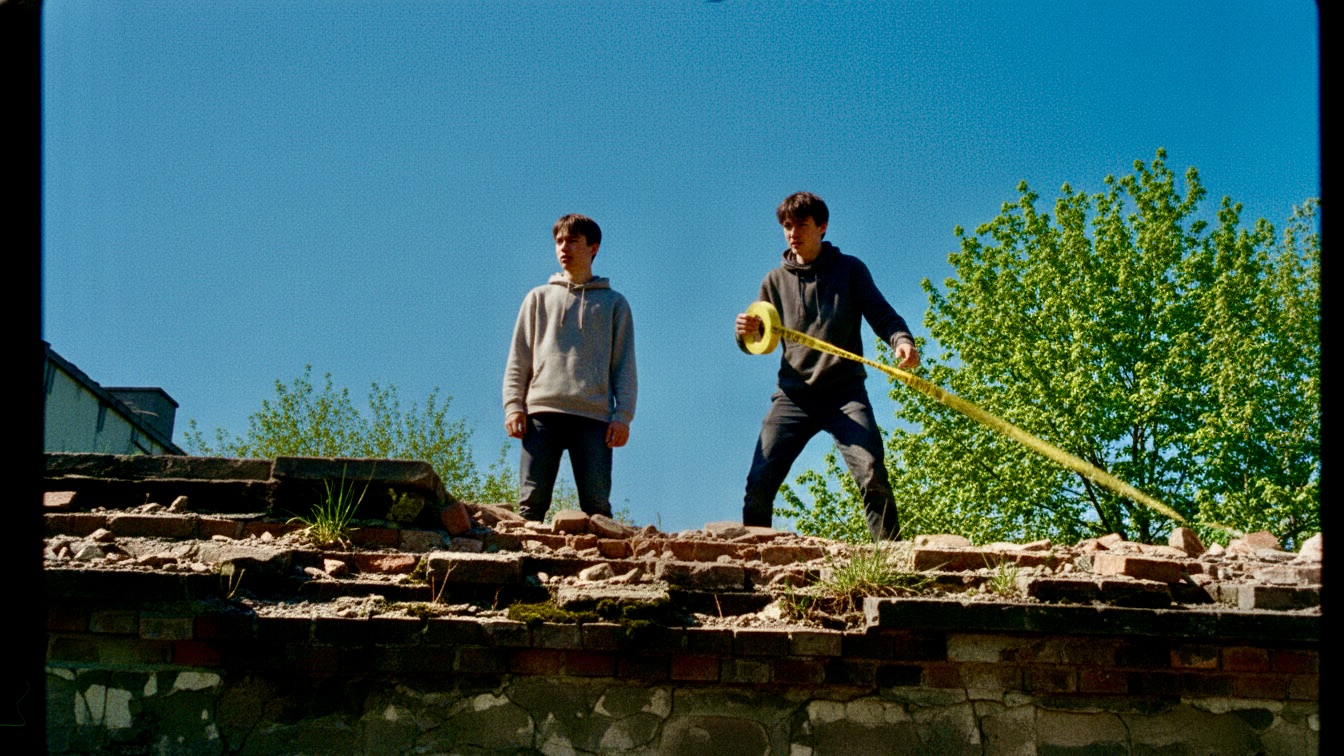
"They’ll try," Jason said. He reached into his pocket and pulled out a roll of bright yellow tape. Not the 'Caution' tape the workers used. This was different. It had his own tag on it, a messy, hand-drawn heart with a lightning bolt through it.
"What are you doing?" I asked.
He stood up, precariously balancing on the edge of the roof. He leaned over and stuck the tape to the side of the chimney, right where it would be visible from the street, from the drones, from the high-rises.
"Marking our territory," he said, grinning. "Let them build their servers. We’ll just keep being the glitch in the system."
I stood up next to him. The wind caught my hair, blowing the dust away. For the first time in a long time, the world didn't feel like a cage. It felt like a start. I looked at the yellow tape fluttering in the breeze. It was small. It was temporary. But it was there.
"We need to get the journals out of the bag," I said, patting my backpack. "And then we need to get out of here before they bring the cranes."
"I have a better idea," Jason said, looking down at the massive pile of discarded drywall and old furniture in the yard. "Let’s see if we can find the keys to that bulldozer before they come back from lunch."
I laughed. It was a sharp, honest sound. "You don't know how to drive a bulldozer."
"How hard can it be?" he asked, jumping down to the lower tier of the roof. "It’s basically just a giant iPad with treads, right?"
I followed him, the spring sun warm on my neck, the air filling my lungs until I felt like I could float. We were still in danger. The house was still falling. But as we slid down the drainpipe and hit the soft, muddy earth of the garden, I knew one thing for sure. They hadn't caught us yet.
“I watched him eye the ignition of the massive yellow machine, and for a second, I actually believed we could drive it right through the front gate.”


