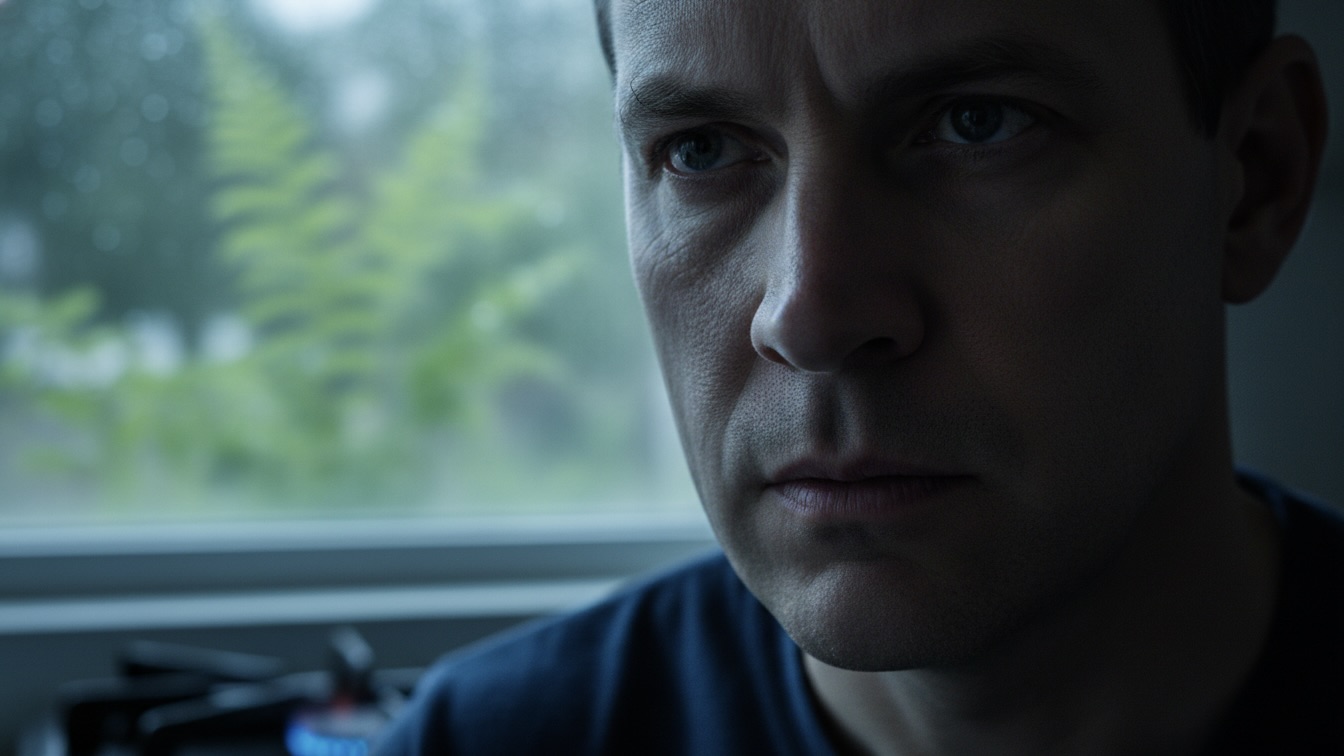
Len stares at a mortgage renewal notice while Winnipeg rain blurs the windows and the kitchen light flickers.
The rain didn't fall; it hung. A grey mist that smelled of wet asphalt and the rot of last year's leaves. Winnipeg in April is a wound that won't close. Outside the window, the ferns were pushing through the mud like green knuckles.
They looked fragile. Everything felt fragile. I stood in the kitchen and watched the light die. It didn't fade so much as retreat, pulling back from the corners of the room, leaving the shadows to claim the space where the sideboard used to be. We sold that in February. Now there was just a pale rectangle on the wallpaper, a ghost of a piece of furniture that once held our wedding china. The china was gone too. Sold to a guy on Marketplace who didn't even haggle.
The house was quiet, except for the hum of the fridge. It was an old hum, a dying hum. I looked at the kitchen table. It was scarred with water rings and a deep scratch from when the kids were small. Now it was covered in paper. White sheets, blue ink, red lines. The mortgage renewal notice sat on top, the font crisp and indifferent. It was just a number. But the number was a predator. Interest rate escalations. That’s what the news called it. A clean, clinical phrase for a slow-motion car crash. I felt it in my jaw, a tightness that wouldn't let go. Monetary policy tightening. It sounded like a noose.
I picked up a pen. It was a cheap ballpoint with a chewed cap. I started the math again, even though I knew the answer. The monthly payment was jumping by twelve hundred dollars. Twelve hundred. That was the grocery budget. That was the gas. That was the margin between breathing and drowning. I looked at the spot where the espresso machine used to sit. Now there was just a stained jar of instant coffee. The kitchen felt bigger now that it was emptier. It wasn't a good kind of big. It was the kind of big that an empty stomach feels.
Sandra walked in. She didn't turn on the light. She stood in the doorway, her silhouette sharp against the hallway glow. She was wearing my old hoodie, the one with the frayed cuffs. She looked tired. Not just 'long day' tired. 'Long decade' tired. She looked at the papers, then at me. Her eyes were dark, searching for a lie I couldn't tell.
'Len?'
'Yeah.'
'Is it bad?'
'It’s the number we thought.'
'Can we?'
'No.'
She sat down. The chair creaked. It was a cheap chair, part of a set we bought when we thought things would only ever get better. She reached out and touched the edge of the renewal notice. Her fingernails were bitten down to the quick. I watched her hand. It was shaking, just a little. Household debt burdens. Another phrase from the radio. It sounded like something you could carry. But you don't carry it. It carries you. It drags you under.
'We have the savings,' she said. Her voice was flat.
'For two months. Maybe three if we stop driving.'
'Inflationary pressures from abroad,' she whispered. It was a joke, but nobody laughed. We were living the ripple effects of a war three continents away and a policy shift in an office tower in Ottawa. It felt personal. It felt like someone had reached into our house and started taking things. First the sideboard. Then the coffee. Now the time. All the time we’d spend working extra shifts just to stand still.
I looked past her into the living room. The rug was gone. We’d sold that last week. The floorboards were bare and scuffed. The room looked like it was waiting for someone to move out. Maybe it was. The light was almost gone now. The rain tapped against the glass, a frantic, irregular rhythm. It sounded like teeth. I thought about the wildflowers in the yard. The ones Sandra planted. They were coming up, but the frost would probably kill them next week. That was Winnipeg. It gives you hope just to see what you’ll do when it takes it back.
'I talked to Lemillo today,' I said. My voice sounded strange in the dark. Brittle.
'The neighbor?'
'Yeah. He’s in the same boat. Worse, maybe. He’s got the variable rate.'
'What’s he doing?'
'Organizing. Some neighborhood group. Collective bargaining for the mortgage renewals. Talking to the credit union as a block.'
Sandra looked up. A spark. Just a small one. 'Does that work?'
'I don't know. But the bank won't listen to me alone. To them, I'm just a delinquency risk on a spreadsheet. A rounding error.'
I stood up and went to the stove. I turned on the burner. The blue flame hissed. I put the kettle on. We needed tea. We needed something hot to fill the space where the dinner should have been. The kitchen light flickered and died. I didn't try to fix it. We sat there in the blue glow of the stove. The mist outside turned into a downpour. It lashed the house, searching for leaks. I felt every crack in the foundation. I felt every dollar we didn't have.
'We aren't losing this place,' I said. It wasn't a promise. It was a threat. To the bank, to the rain, to the world.
Sandra didn't answer. She just reached across the table and took the pen. She started circling numbers. Her movements were fast, jagged. We weren't just parents anymore. We were accountants in a war zone. We were survivors. I watched her face. In the blue light, she looked like a stranger. A harder version of the woman I married. We were all becoming harder. The economy was a whetstone, and we were the blades.
I thought about the city. Thousands of kitchens just like this one. Thousands of people staring at the same red lines. The interest rate escalations weren't just numbers; they were a fever. And the city was burning up. I looked at the empty spot on the wall again. I missed that sideboard. It was solid oak. It felt like it could last forever. Nothing lasts forever. Not the house, not the light, not the peace.
'I’ll go to the meeting,' Sandra said. 'Lemillo’s meeting.'
'I’ll go with you.'
'No. You work the overtime. I’ll handle the bank.'
She looked at me then. Her eyes were hard. Cold. Like the rain outside. I realized then that the things missing from the room weren't the only things we'd lost. We'd lost the softness. The ease. We were down to the bone now. The kettle began to whistle. It was a high, thin sound. It sounded like a scream kept behind closed teeth. I reached for the handle. My hand was steady. That was the scary part. I wasn't shaking anymore. I was just cold.
We drank the tea in silence. It was weak and tasted like the pipes. But it was hot. I looked at the ferns through the window again. They were getting hammered by the rain, but they were still there. Green knuckles in the mud. I gripped my mug. We were still here too. For now.
I looked at the renewal notice one last time. I didn't see a debt anymore. I saw a target. I reached into the junk drawer—the one that used to have tools but now just had old batteries and rubber bands. I moved aside a pile of unpaid utility bills. My fingers brushed something cold and metal. I pulled it out. It was my old union card. It was dusty and the edges were curled. I hadn't looked at it in five years. I’d thought I didn't need it. I thought I was above it. I was wrong.
I laid the card on top of the mortgage papers. The blue plastic looked bright against the white paper. It was a different kind of power. Not the power of the market or the power of the bank. The power of people who have nothing left to sell but their time. I felt a surge of something. Not hope. Not yet. It was more like anger, but focused. Like a laser.
'Sandra,' I said.
'Yeah?'
'Call Lemillo. Tell him we're in. All the way in.'
She looked at the card. She nodded. There was no more fear in her face. Just the same cold focus. We stood up together. The kitchen was dark, the light was gone, and the rain was screaming against the walls. But I knew where the door was. I knew where we had to go. I grabbed my coat. It was damp and smelled of the mist, but I put it on anyway. There was work to do. Not the kind of work that pays by the hour. The kind of work that saves a life.
I stepped toward the back door. The floorboards groaned under my weight. I stopped by the empty space where the sideboard had been. I realized I didn't miss it anymore. It was just wood. It was just a thing. What mattered was the person standing next to me and the people on the other side of the fence. We were the ferns. We were the green knuckles in the mud. And the storm was just getting started.
“I reached for the door handle, my fingers locking around the cold metal as I prepared to step out into the drowning dark.”


