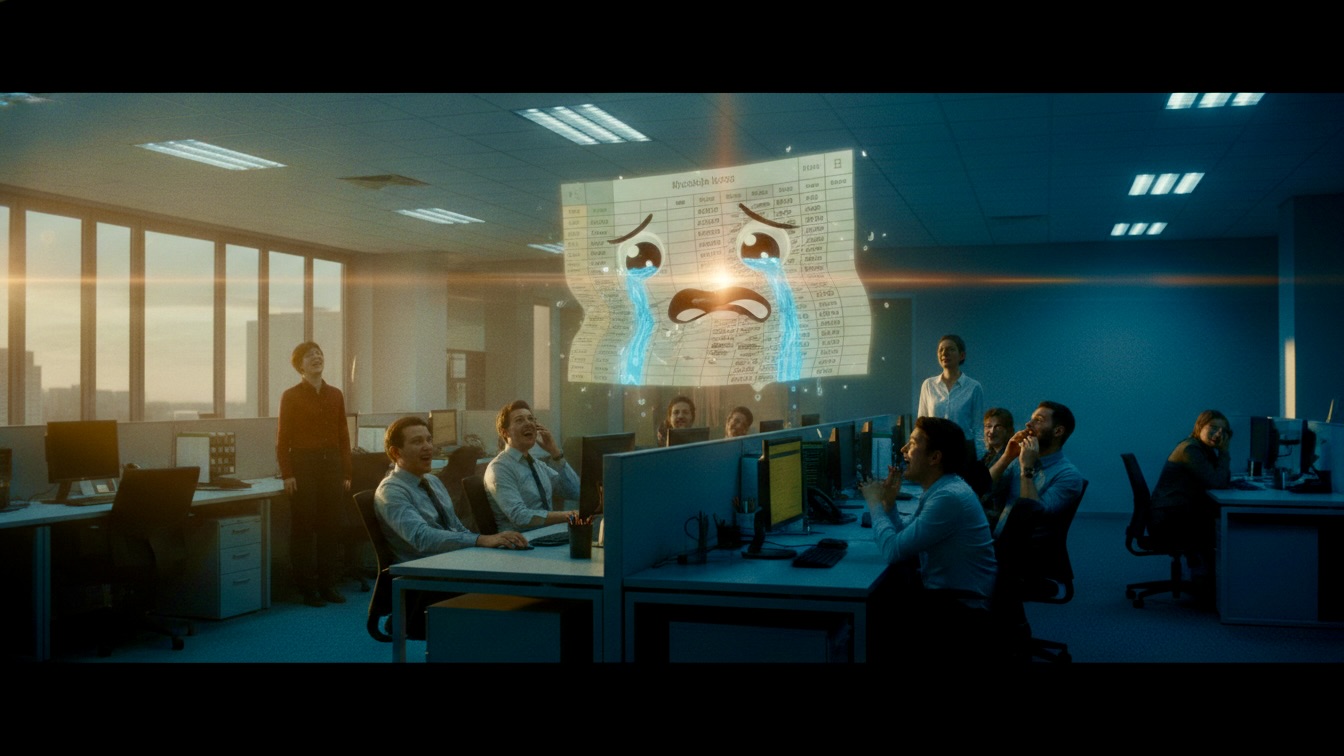
The story follows Tony, a junior accountant at Synergistic Solutions LLC, as he struggles to navigate a global crisis known as the Shift. Since the phenomenon began, human dreams have become public, holographic broadcasts that occur whenever a person falls asleep. Tony attempts to stay awake through sheer force of will, caffeine, and constant vigilance, hoping to avoid the humiliation of revealing his mundane subconscious. Tensions rise in the office as the department director, Senders, attempts to maintain professional decorum despite his own obvious exhaustion. After Senders inadvertently broadcasts a delusional dream of himself as a heroic centaur, the office atmosphere shifts from paralyzing fear to hysterical, shared vulnerability. Ultimately, Tony succumbs to exhaustion and broadcasts a dream of himself as a weeping, anthropomorphic spreadsheet, a moment of profound cringe that paradoxically fosters a sense of communal relief among his coworkers.
The narrative serves as a biting satire of modern corporate culture, where the performative nature of professional life is stripped away by the forced transparency of the Shift. By making the subconscious public, the story highlights the absurdity of workplace personas that rely on suppression and jargon to maintain a facade of competence. The contrast between the rigid, sterile environment of the accounting department and the chaotic, surreal content of the dream projections underscores the disconnect between the human soul and the capitalist machine.
Vulnerability emerges as the central transformative force within the story. While the characters initially fear the loss of privacy, the eventual revelation of their inner insecurities acts as a social leveler. The transition from Senders’ grandiose, ego-driven dream to Tony’s pathetic, self-deprecating one illustrates that authenticity is more effective at building community than the forced, aggressive mindfulness demanded by management. Through this, the text suggests that the true horror of the modern condition is not the loss of secrets, but the exhausting effort required to hide one's true, messy self.
Tony is defined by a deep-seated sense of inadequacy and a pervasive fear of being perceived as unremarkable. As a junior accountant, he views his own psyche through the lens of his professional failure, fearing that his subconscious will reveal him to be nothing more than an NPC. His internal conflict stems from the gap between his desperate need for professional approval and his underlying desire for human connection. When he finally broadcasts his dream, his transformation from a state of paralyzed shame to one of genuine acceptance marks a critical psychological breakthrough.
Senders represents the archetype of the fragile, insecure leader who uses corporate language as a defensive wall against reality. His obsession with synergy and professional distance is a direct symptom of his inability to cope with the loss of control brought on by the Shift. His dream of being a muscular centaur killing tax auditors reveals a desperate need to feel powerful and heroic, contrasting sharply with his actual physical decay and ineffective management style. By attempting to gaslight his team after his broadcast, he remains trapped in his own delusion, unable to embrace the communal vulnerability that Tony eventually finds.
Tracey serves as the grounded, cynical observer whose primary defense mechanism is detachment. Her constant focus on her phone and her smudged eyeliner signal a person who has already accepted the collapse of her professional boundaries. She acts as a catalyst for the office’s emotional release, demonstrating a surprising capacity for empathy when she chooses to comfort Tony rather than mock him. Her reaction to Tony’s broadcast signifies the transition from survival mode to a state of shared, albeit exhausted, humanity.
The narrative voice is claustrophobic and jittery, perfectly mirroring the protagonist’s sleep-deprived state. The author utilizes sensory details—such as the taste of battery acid from the Celsius, the smell of dust, and the harsh buzzing of fluorescent lights—to ground the surreal premise in a recognizable, gritty reality. These visceral descriptions create a sense of mounting tension that makes the reader feel as exhausted and on-edge as the characters themselves.
The pacing is expertly handled, moving from the slow, agonizing crawl of the workday to the frantic, explosive release of the dream broadcasts. The transition between the mundane reality of Excel spreadsheets and the high-fantasy absurdity of the holograms provides a rhythmic dissonance that highlights the central irony of the story. By maintaining a tone that balances dark humor with genuine existential dread, the narrative successfully captures the surreal tension of a world where the boundary between the private mind and the public sphere has been irrevocably shattered.


