Format: Short Film / Anthology Episode | Est. Length: 10-12 minutes
This episode serves as a window into "The Broadcast Era," an anthology series exploring a world where human dreams are no longer private, but public, semi-transparent holograms. Set in the immediate aftermath of a global consciousness shift, the series examines how corporate culture, intimacy, and social norms disintegrate when the subconscious is laid bare. Each episode follows a different demographic—from high-stakes boardrooms to suburban households—navigating the horrifying, hilarious, and deeply vulnerable reality of living in a world without mental privacy.
The morning sun glares off the pollen-coated windshields of Synergistic Solutions LLC, where a group of sleep-deprived employees struggle to keep their eyes open. They know the truth: if they drift off, their deepest, most embarrassing subconscious secrets will project as glowing, low-fidelity holograms for the entire office to witness.
In a world where dreams are broadcasted as public holograms, a junior accountant fights to stay awake to hide his pathetic subconscious. When his boss’s ego-driven dream is exposed, the office hierarchy collapses, forcing the accountant to embrace his own humiliating truth.
The episode explores the crushing weight of corporate performativity and the desperate, often futile, attempt to maintain a professional facade. It highlights the irony of a society that demands constant "transparency" and "synergy" while being terrified of the raw, unvarnished truth of the human psyche.
Beneath the humor, the story touches on the profound loneliness of the modern worker, whose identity is often reduced to data points and spreadsheets. The narrative suggests that true human connection only begins when the masks of professionalism are shattered by the absurdity of our own inner lives.
The stakes are both social and professional: if an employee broadcasts a "leaked" dream, they face immediate humiliation, potential termination, and the permanent loss of the respect of their peers. For the protagonist, Tony, the stakes are existential—he fears that his dream reveals him to be nothing more than a background character in his own life, a realization that would solidify his status as an invisible, replaceable cog.
The primary conflict is the internal battle against biological exhaustion, pitted against the external pressure of a toxic, jargon-heavy corporate environment. The antagonist is the department director, Senders, whose desperate attempt to maintain control and "professional distance" serves as a foil to the inevitable, chaotic reality of the human subconscious.
Tuesday morning at Synergistic Solutions is a battlefield of caffeinated anxiety as employees struggle to avoid the "Shift," a phenomenon that projects dreams into physical space. Under the gaze of their desperate, vest-wearing director, Senders, the team tries to conduct a mandatory wellness check-in via Zoom, hoping to avoid the humiliation of a public subconscious leak.
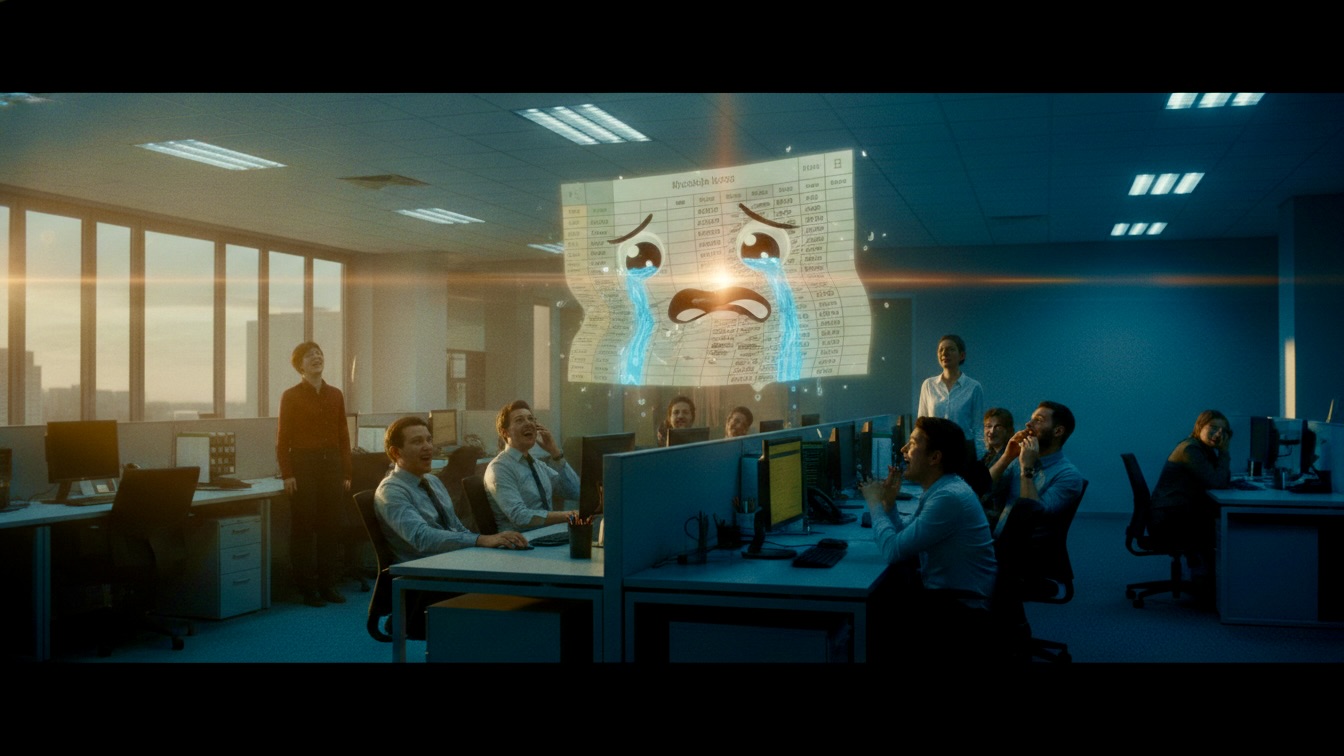
The tension breaks when Senders accidentally falls asleep, projecting a grandiose, ego-fueled vision of himself as a shirtless centaur-warrior battling tax-auditing goblins. The office erupts in hysterical, cathartic laughter, but the relief is short-lived for Tony, who succumbs to his own exhaustion and broadcasts a pathetic, crying Microsoft Excel spreadsheet. Instead of mockery, the office finds unity in the shared absurdity, finally shedding their corporate pretenses.
Tony: A junior accountant suffering from extreme imposter syndrome. He starts the episode terrified of being seen as a "background extra" and ends it by accepting his vulnerability, finding unexpected solidarity with his coworkers.
Tracey: A cynical, phone-addicted marketing employee who serves as the office's social barometer. She begins as a detached observer and ends as the catalyst for the office's collective acceptance of their shared flaws.
Senders: The department director, a man obsessed with corporate buzzwords and "horizontal synergy." He is a tragic figure of fragile ego, clinging to his authority until his own dream reveals the deep-seated insecurity he tries to hide behind expensive running shoes and vests.
The episode opens with the high-tension atmosphere of a cubicle farm, establishing the "no-sleep" rule through sharp, rhythmic dialogue and the sound of cracking energy drink cans. The midpoint arrives during the Zoom meeting, where Senders’ centaur-hologram provides a moment of absurd, high-stakes comedy that shatters the office's rigid professional veneer. The climax occurs when Tony, finally exhausted, broadcasts his crying spreadsheet, leading to a moment of total vulnerability that transforms the office's mockery into a communal, supportive celebration of their collective "cringe."
The episode begins with a tone of claustrophobic, high-octane anxiety, characterized by jittery pacing and harsh, sterile lighting. As the dream broadcasts occur, the mood shifts to surreal, dark comedy, eventually landing on a warm, cathartic, and surprisingly tender resolution that emphasizes human connection over corporate efficiency.
If expanded, the series would track the slow societal breakdown as "Dream Leaks" become a new form of currency and social leverage. Subsequent episodes could explore the rise of "Dream-Blocker" technology, the emergence of a black market for dream-suppressing drugs, and the eventual restructuring of human society into "Dream-Compatible" communities where people sleep in synchronized, curated environments.
The visual style mimics a sterile, gray-toned corporate thriller, utilizing tight, handheld camera work to emphasize the characters' exhaustion and lack of privacy. The dream sequences provide a jarring, low-fidelity contrast, utilizing PS2-era CGI and saturated, surreal color palettes to highlight the absurdity of the subconscious projections.
The target audience is young adults and professionals (ages 20-40) who have experienced the burnout of modern office culture. It is designed for viewers who appreciate dark, satirical humor and are drawn to speculative fiction that uses absurd premises to explore relatable, grounded human anxieties.
The pacing starts frantic and caffeine-fueled, mirroring the characters' internal states, before slowing down to a tense, rhythmic crawl during the Zoom meeting. The final act moves with a sense of release, allowing the characters—and the audience—to breathe as the tension dissipates into a lighter, more rhythmic tempo.
The dream holograms should be rendered with a "glitchy," semi-transparent aesthetic, using practical lighting effects to ensure they feel like they are physically occupying the office space. Special attention must be paid to the contrast between the "real world" office, which should feel cold and over-lit, and the "dream world" projections, which should feel like cheap, nostalgic, and intentionally low-quality digital artifacts.


