The narrative opens in a decaying community hall where Jay and Linda are engaged in a competitive game of pool. The environment is thick with a sense of stagnation, marked by the oppressive heat of radiators and the smell of old beer and wet wool. Jay, acting as a critic of Linda’s unconventional form, uses the game to mask a deeper, simmering attraction. Their banter is a familiar ritual, a protective layer of friction that has defined their relationship for months.
As the game reaches a climax, Linda raises the stakes by betting a date on her final shot. Just as she prepares to win, the mundane reality of the hall is interrupted by a terrifying atmospheric anomaly. Glowing purple sludge begins to leak from the ceiling, acting as a corrosive agent that disrupts the physical laws of the room. The building begins to vibrate with a low, bone-deep frequency, signaling a catastrophic shift in the environment.
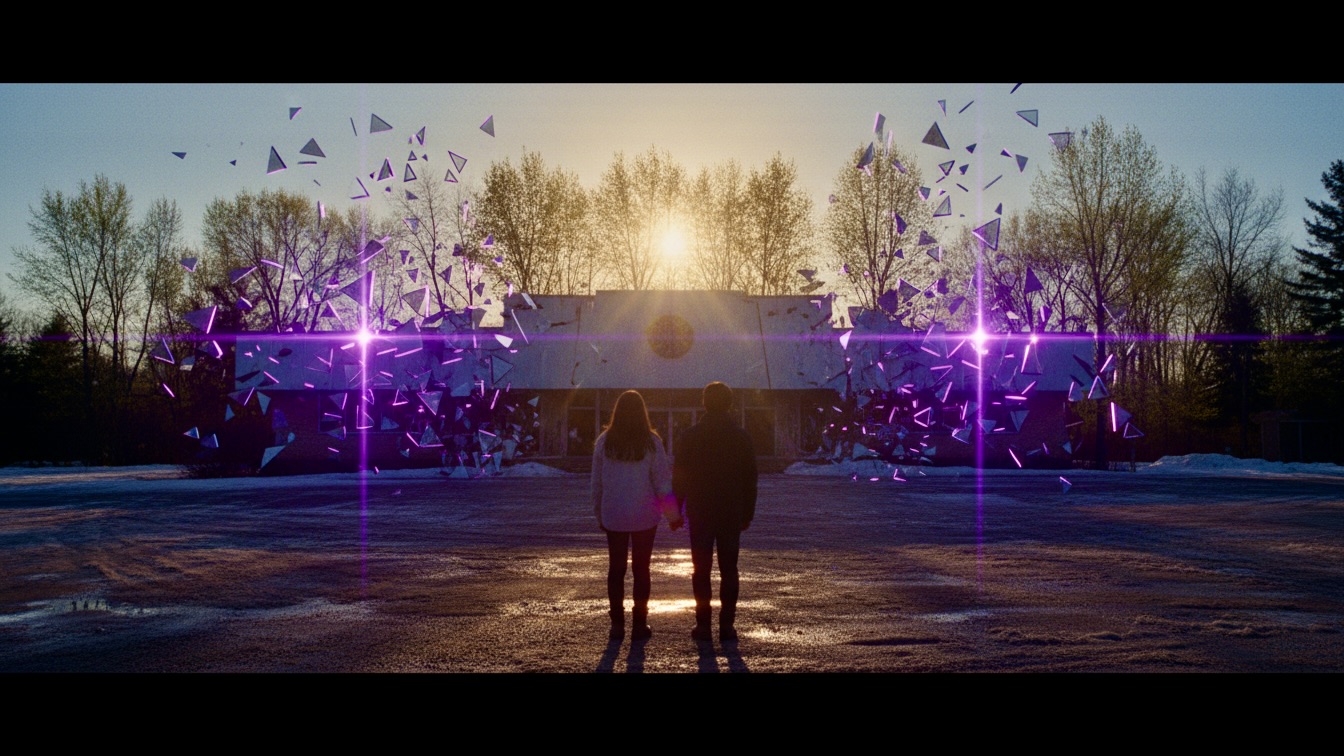
The situation rapidly escalates from a strange leak to a full-scale reality collapse. The pool table splits, the lights explode, and the very structure of the hall begins to phase out of existence. Jay and Linda are forced to abandon their game and flee for their lives as the building dissolves into geometric fragments. They escape into the freezing mud of the parking lot, where they watch the community center vanish entirely, leaving them alone in the dark.
One of the central themes of the text is the use of conflict as a surrogate for intimacy. Jay and Linda operate within a framework of "familiar, safe friction," where insults and bets serve as the primary language of their connection. They use the pool game to navigate the space between them, avoiding the vulnerability of a direct emotional encounter. The blue chalk and the "grating squeak" of the cue stick are physical manifestations of this tension, grounding their complex feelings in a gritty, tactile reality.
The story also explores the fragility of the mundane world in the face of cosmic indifference. The community hall is described with exhaustive detail—its rot, its peeling paint, and its dying lights—only for it to be revealed as a temporary, fragile construct. This theme of transience suggests that the structures humans inhabit, both physical and social, are easily erased by larger, incomprehensible forces. The "alien permafrost" represents an external reality that does not care about the characters' personal stakes or their pending date.
Finally, the narrative highlights the theme of survival and the fundamental shift from rivalry to partnership. When the building begins to dissolve, the petty arguments over pool form and betting stakes are instantly discarded. Jay’s internal state shifts from critical observation to a "raw, desperate need" to protect Linda. Their interlocked fingers at the conclusion of the story signify a new, more honest form of connection that has been forged by the trauma of the event.
Jay is a character defined by his hyper-fixated observation and his use of technical competence as a defensive shield. He catalogs the sensory details of his environment—the smell of Linda’s body spray, the squeak of her sneakers—to avoid confronting the emotional weight of his attraction. His criticism of Linda’s "garbage" form is a way for him to maintain a sense of control in a situation where he feels psychologically off-balance. He finds comfort in the "dead-end" nature of his surroundings because it mirrors his own lack of direction.
Psychologically, Jay is a protector who masks his vulnerability with a veneer of cynicism. When the anomaly begins, his focus shifts entirely from his own ego to Linda’s safety, demonstrating that his earlier condescension was merely a performance. The pain he takes in his shoulder when they hit the floor is a physical price he is willing to pay to keep her secure. By the end of the story, his internal walls have been forcibly dismantled by the external collapse of the world he knew.
Linda is characterized by her resilience and her willingness to challenge the status quo of her relationship with Jay. Unlike Jay, who hides behind technicalities, Linda is bold enough to name the tension between them by betting a date. She uses her "math" not just as a way to play pool, but as a way to navigate a world that feels increasingly unstable. Her terrible posture and tight grip on the cue suggest a person who fights for every inch of ground she gains, refusing to be intimidated by Jay’s supposed expertise.
Her psychological state is one of pragmatic survival blended with a hidden desire for connection. She is the one who initiates the shift from a professional rivalry to a personal engagement, showing a level of emotional courage that Jay lacks. Even as the building is phasing out of reality, her initial reaction is one of indignation at the "unfairness" of the ruined shot. This shows a mind that seeks order and logic, even when faced with the absolute chaos of a cosmic event.
The pacing of the narrative is meticulously crafted to mirror the escalation of the supernatural threat. It begins with a slow, rhythmic quality, focusing on the deliberate movements of the pool game and the dry sounds of the hall. This creates a sense of grounded realism that makes the subsequent shift into horror more impactful. As the purple sludge appears, the sentences become shorter and more frantic, reflecting the characters' rising panic and the rapid disintegration of their environment.
The tone is a sophisticated blend of gritty, blue-collar realism and high-concept science fiction. The author uses sensory details like "copper pennies," "rotting fruit," and "ozone" to create a visceral experience for the reader. These descriptions bridge the gap between the familiar and the alien, making the "glitching" of the building feel like a physical assault. The contrast between the "cheap vanilla body spray" and the "glowing purple sludge" emphasizes the intrusion of the extraordinary into the mundane.
Narratively, the voice is intimate and focused, staying close to Jay’s internal perspective while maintaining a descriptive distance. This allows the reader to feel the "cognitive static" and the "vibration in the jaw" alongside the protagonist. The use of atmospheric anomalies as a backdrop for a budding romance adds a layer of existential irony to the story. The characters find a way to finally connect, but only as the world they inhabit literally erases itself around them.


