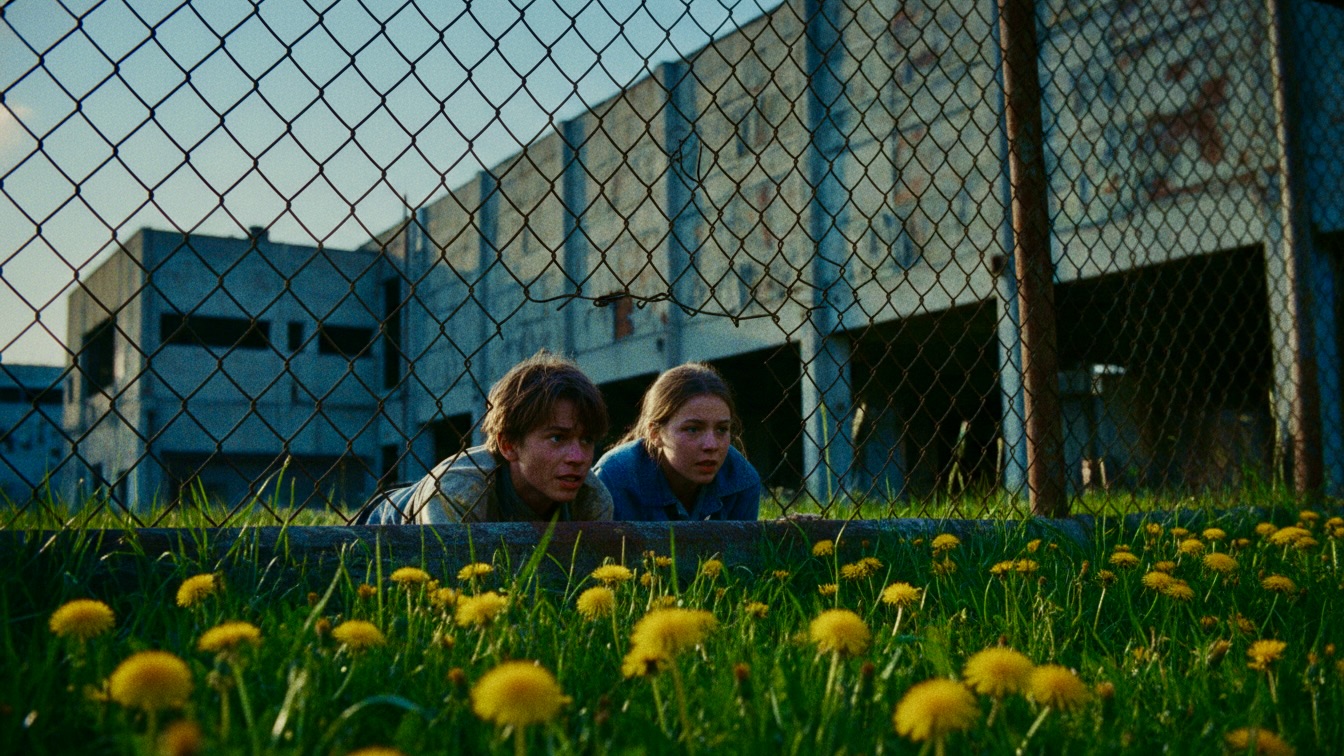
The chapter follows a young boy named Toby as he navigates a hyper-surveilled, dystopian city. After leaving a school that functions more like a prison, he meets his older sister, Mia, and the two travel to a derelict industrial district. They slip through a hidden hole in a fence into a secret garden where nature has reclaimed an old factory. In this sanctuary, they find a brief moment of peace with a man named Ben, experiencing the beauty of the natural world and human connection away from the watchful eyes of the state.
The tranquility is shattered when a surveillance drone or security force discovers their hiding place. Toby and Mia are forced to flee, leaving Ben behind to be apprehended by the authorities. They return to the oppressive atmosphere of the city, attempting to hide their tracks and maintain their compliance. The story concludes with Toby lying in bed, paralyzed by fear, as a heavy, authoritative knock sounds at their front door in the middle of the night.
One of the most prominent themes is the psychological toll of a panoptic society where surveillance is total and inescapable. The city functions as a psychological prison where the "eye" is always watching, leading to the internalisation of control. Toby’s anxiety over a simple candy bar illustrates how the state monitors not just actions, but the very concept of private possession. The constant presence of cameras and drones creates a world where spontaneity is a crime and "big waves" are dangerous. This environment forces characters to look at their feet, effectively erasing their humanity and individuality.
The tension between nature and industrialization serves as a powerful metaphor for resistance. The "tiny weed" in the concrete and the trees "winning" against the factory walls suggest that organic life possesses a slow, inevitable power that can dismantle rigid structures. While the city is described as plastic, metal, and grey, the garden is a riot of color and scent. This contrast highlights the idea that the state’s control is artificial and fragile compared to the "messy" and "loud" reality of a bird’s song. Nature represents a reality that ignores human-made rules, offering the only true space for freedom.
The illusion of safety versus the reality of state control is explored through the character of the man on the screen. He uses familial language, calling the city a "family," yet his smile is described as a mask and his eyes are cold. This propaganda seeks to redefine surveillance as a form of protection, but Toby recognizes the falsehood. True safety is found not in the "golf-ball eyes" of the cameras, but in the "quiet feeling" of being in a place where no one is watching. The chapter suggests that the state’s version of safety is actually a form of existential suffocation.
Toby serves as the emotional anchor of the story, experiencing the dystopia through his physical senses. His body reacts to the environment with leaden feet and a tightening chest, showing how trauma and fear are stored physically. He is young enough to still appreciate the wonder of a ladybug, yet old enough to understand the existential threat of the surveillance state. His perspective highlights the tragedy of a childhood where "staying low" is a vital survival skill. He longs for a world where the soft can break the hard, seeking hope in the resilience of nature.
Mia occupies a difficult position as both a child and a protector for her younger brother. She is visibly weary, her messy hair and ripped jacket signaling the exhaustion of living under constant scrutiny. Unlike Toby, she is hyper-aware of the technicalities of surveillance, such as the danger of making large gestures that might draw attention. Her warmth is the only solace Toby has in the grey city, making her a maternal surrogate in the absence of their parents. She understands the stakes of their rebellion and carries the heavy burden of Ben’s sacrifice at the end of the chapter.
Ben represents the spirit of the resistance and the connection to a forgotten, organic world. His presence in the garden, away from the digital masks of the city, offers Toby a glimpse of authentic human connection. He does not rely on the "white teeth" of the propaganda screens but instead offers small, tangible tokens of affection like rocks or string. By staying behind to face the authorities, he transitions from a mentor to a martyr for the siblings' safety. His belief that "plants don't care about the rules" serves as the ideological heart of the garden.
The author uses stark sensory contrasts to define the two worlds Toby inhabits. The city is described through cold, metallic metaphors, such as air that tastes like "old pennies" and machines that "breathe" with a low hum. In contrast, the garden is a landscape of organic color and texture, described with vivid similes like "lime popsicle" grass and "yellow suns." These descriptions allow the reader to feel the literal expansion of Toby's lungs as he moves from the "box" of the city to the open sky. The shift in sensory input mirrors the psychological shift from fear to fleeting joy.
The tone of the piece is one of pervasive dread interrupted by a fragile, doomed beauty. The pacing mirrors Toby's heartbeat, starting with a slow, rhythmic oppression before accelerating into the frantic escape from the factory. The ending returns to a suffocating stillness, emphasizing that the "safety" promised by the state is actually a form of burial. The final knock on the door serves as a rhythmic echo of the school gate’s click, bringing the narrative full circle. This structural symmetry suggests that for these characters, there is no true escape from the system’s reach.
The narrative voice is deceptive in its simplicity, using short, punchy sentences to reflect Toby's youthful but traumatized perspective. This style strips away complex political jargon to focus on the raw, emotional reality of living under totalitarianism. By focusing on small details like a ladybug or a rip in a jacket, the author makes the vast, cold system feel intensely personal. The use of "golf balls" and "eyes" to describe cameras dehumanizes the technology, making it feel like a predatory species. This creates a haunting atmosphere where even the sky feels like a "lid" on a box.


