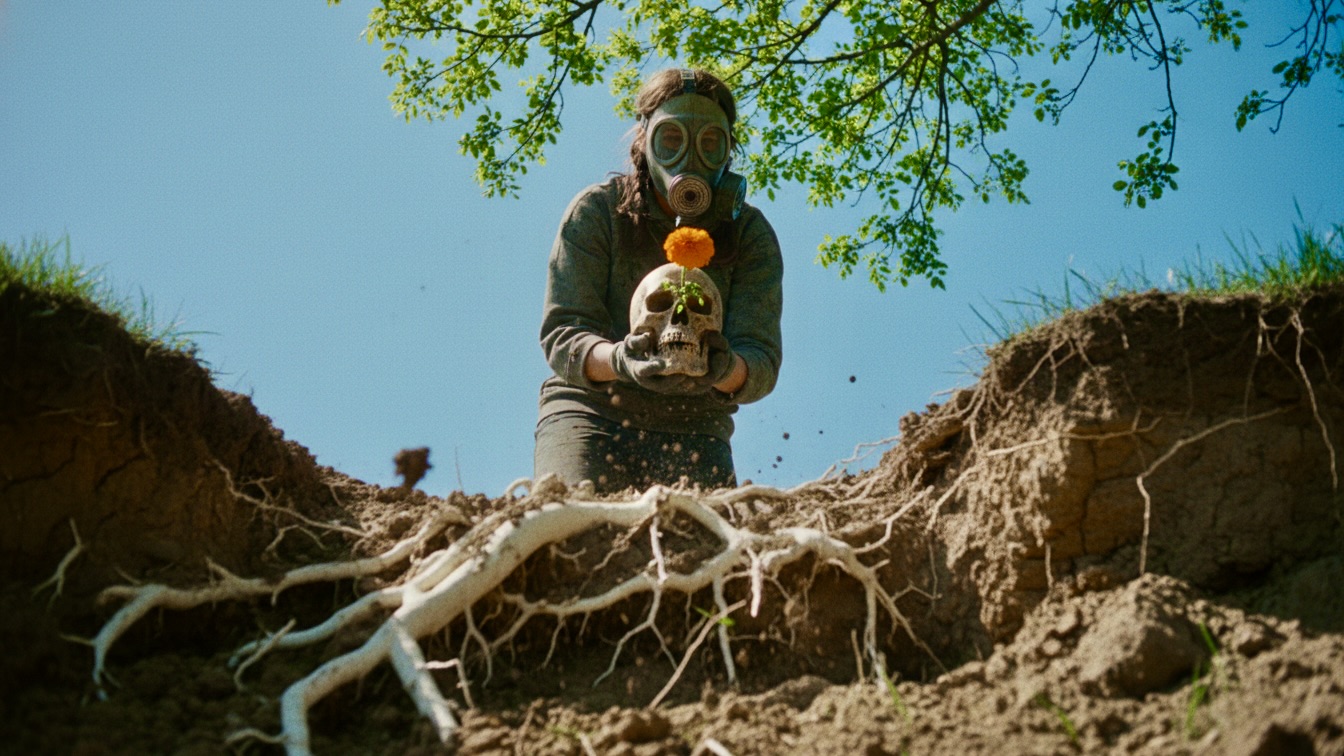
The chapter follows a lone survivor, referred to throughout as the bone planter, as he attempts to navigate a violent "bloom event" within a sprawling, ruined cemetery. He carries a singular, precious object: a human skull containing a scoop of dirt and a vibrant, living marigold. As the ground begins to heave with the awakening of a massive fungal network known as the Vined, he is pursued by Silas, a scavenger leader who is rapidly succumbing to a fungal infection.
The confrontation between the two men intensifies when they both fall into a collapsing underground family vault. Inside the dark, pulsing heart of the fungal mass, Silas attempts to seize the marigold, driven by the hive mind's desire to consume uninfected life. The protagonist manages to fight him off using his gas mask as a weapon and climbs out of the disintegrating crypt just as it caved in, burying Silas beneath tons of stone and mycelium.
Emerging onto a cracked asphalt road, he witnesses the total transformation of the graveyard into a horrific, alien garden of giant mushrooms and toxic spores. Despite the physical toll and the near-loss of his prize, he finds the marigold is still intact, though slightly damaged. The chapter concludes with him continuing his journey toward an elevated highway, noticing that he is likely not as alone as he had hoped.
The central theme of the story is the conflict between sterile preservation and aggressive, transformative growth. The Vined represents a form of life that is terrifying because it is collective and mindless, erasing the boundaries between the individual and the environment. In contrast, the marigold represents a fragile, traditional form of life that requires specific care and individual attention. The protagonist’s struggle to keep the flower "clean" and separate from the fungal mass highlights the human desire to maintain order in a world that has descended into biological chaos.
Another prominent theme is the use of intellectualization as a psychological defense mechanism. The protagonist speaks in a highly clinical, detached manner, referring to the flower as a "significant biological investment" rather than a source of beauty or hope. By framing his survival and his care for the plant in mathematical and logical terms, he protects himself from the overwhelming emotional weight of the apocalypse. This detachment allows him to function in horrific circumstances, but it also reveals a deep-seated fear of vulnerability.
The story also explores the irony of life springing from death. The marigold is literally planted in the remains of a human being, using a skull as its vessel. This imagery suggests that in this new world, the only way for the "old" life to survive is by repurposing the remnants of the fallen civilization. The cemetery, once a place of quiet rest for the dead, becomes a violent engine of rebirth for the fungus, showing that nature has no respect for human rituals of mourning or memory.
Finally, the narrative touches upon the loss of humanity through the character of Silas. His transformation into a "puppet" of the Vined illustrates the horror of losing one's agency to a biological imperative. The transition from a man motivated by greed and revenge to a creature driven by the hive mind's hunger serves as a grim warning of the world's ultimate goal. It suggests that the greatest threat is not death itself, but the loss of the individual self to the overwhelming "noise" of the collective.
The protagonist is a man defined by his rigorous adherence to logic and his rejection of emotional narratives. From a psychological perspective, he appears to be practicing extreme compartmentalization to survive the trauma of a three-year-long apocalypse. He uses complex vocabulary and a sardonic tone to distance himself from the visceral reality of his situation, such as when he describes his flight as a "horizontal departure." This linguistic shield prevents him from succumbing to the panic that clearly bubbles beneath the surface of his internal monologue.
His attachment to the marigold is the most significant contradiction in his character. While he claims the plant is a resource or an investment, his actions reveal a desperate, almost spiritual need to protect something beautiful and untainted. He risks his life multiple times for a flower that provides no caloric value or practical utility, suggesting that he is more "human" than he is willing to admit. He is a man who wants to keep one thing "warm" in a world that has turned cold and fungal, showing a buried capacity for hope.
Silas serves as a tragic foil to the protagonist, representing the inevitable fate of those who cannot maintain their boundaries against the Vined. Initially motivated by a very human desire for resources and revenge, he is slowly stripped of his personality as the infection takes hold of his nervous system. His physical degradation—the missing shoe, the broken leg, and the mushroom replacing his eye—mirrors his internal loss of self. By the end of his life, he is no longer a man but a biological extension of the fungus.
His fixation on the marigold, which he calls the "clean thing," indicates that even the fungus recognizes the value of uninfected life, though only as something to be assimilated. Silas’s laughter and his claim that he no longer feels pain suggest a terrifying kind of peace that comes with the loss of individuality. He represents the ultimate end-point of the world's current trajectory, acting as a physical manifestation of the protagonist's greatest fears regarding infection and loss of control.
The pacing of the chapter is kinetic and relentless, mimicking the "thud, thud" of the awakening fungal heart. The author uses short, punchy sentences to convey the urgency of the protagonist’s movements and the sudden shifts in the environment. This creates a sense of constant motion, where the reader feels the same breathlessness and physical strain as the narrator. The transition from the open cemetery to the claustrophobic vault further heightens the tension, narrowing the scope of the action until it becomes a desperate, close-quarters struggle.
Sensory details are used effectively to create a world that feels both alien and uncomfortably tactile. The protagonist’s descriptions focus heavily on the "old copper" taste of the air, the "hissing" slime of the roots, and the "bubbly, wet" sounds of the infected. These details emphasize the biological horror of the setting, making the Vined feel like a living, breathing antagonist. The contrast between the "screaming orange" of the marigold and the gray, toxic haze of the cemetery provides a visual anchor for the story’s central conflict.
The narrative voice is a standout element, characterized by a unique blend of high-register academic language and gritty survivalist pragmatism. This voice establishes the protagonist's personality without the need for extensive backstory, showing rather than telling his psychological state. The use of dark humor, such as the protagonist’s comments on the scavenger's "persistence," provides a necessary reprieve from the grim subject matter while reinforcing his detached persona. This stylistic choice makes the narrator's final moment of emotional honesty more impactful.
Finally, the author employs powerful imagery to reinforce the themes of the story. The "marble angel" being swallowed by the earth serves as a potent symbol for the death of traditional religion and morality in the face of a primal biological force. The image of the protagonist sitting on a cracked asphalt road, cradling a skull-flower while the world transforms behind him, perfectly encapsulates the "absurdity" he frequently mentions. The ending, with the shifting shadows on the overpass, successfully shifts the tone from survival horror to a lingering, suspenseful dread.


