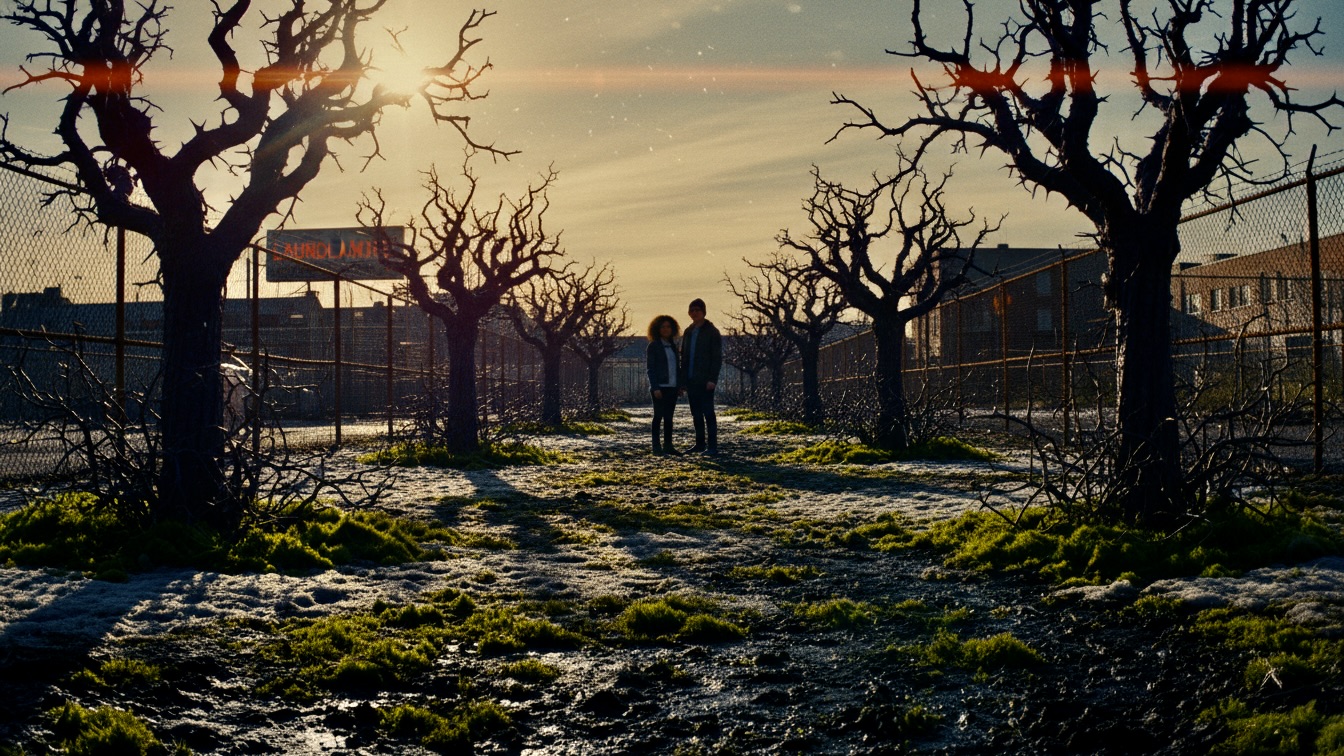
The story opens in a bleak, post-winter landscape where Heather and Tony are preparing to transplant young pippin trees from their garden to a local park. The atmosphere is heavy with a sense of urban decay and personal exhaustion, set against the backdrop of a cynical 2026 reality. Heather feels a deep-seated unease about the project, noticing the unnatural, pulsing purple roots of the saplings, while Tony remains focused on the "investment" of their time and resources. He views the act of planting in the park as a way to bypass city bureaucracy and ensure the survival of their work.
As they begin the illegal planting in a neglected corner of the park, the environment takes on a predatory quality. Heather discovers a bone in the soil, which Tony dismisses as a pet, though it bears strange, intentional markings. Once the trees are placed in the ground, they undergo a terrifying, accelerated growth spurt, transforming into thorned, predatory structures. The physical reality of the park distorts as the trees aggressively reclaim the space, eventually consuming their equipment. The chapter concludes with Heather realizing that a purple root has burrowed under her skin, suggesting that the "transaction" of planting has now turned into a parasitic debt.
The central theme of the narrative revolves around the concept of transactional existence in a collapsing society. Every interaction, whether between humans or between humanity and nature, is framed as a deal or an investment. Heather views her very movement through the mud as a transaction with the earth, while Tony’s entire worldview is dictated by the ratio of input to output. This reflects a psychological state where the characters have been so hollowed out by their environment that they can no longer perceive value outside of a balance sheet.
Nature is presented not as a healing force, but as a corrupt and vengeful entity that mirrors the decay of the city. The trees are described as skeletal fingers and refrigerated meat, stripping away any pastoral romanticism. This "new" nature is a biological glitch that has adapted to the sulfur and copper of the urban waste. It suggests that when humanity treats the world as a series of cold extractions, the world eventually responds with a violent, predatory logic of its own.
The idea of the "glitch" serves as a metaphor for the systemic failure of the characters' world. Tony believes that if something isn't reported to the authorities, it doesn't exist, highlighting a profound disconnection from communal reality. They operate in the margins of a society that has become indifferent to everything except survival. This thematic focus on invisibility and neglect creates a fertile ground for the supernatural horror to take root, as the characters’ attempts to exploit the "glitch" lead them into a trap they cannot report or escape.
Finally, the story explores the theme of inevitable debt. The "Root Ball" represents a burden that cannot be discarded once it has been moved. Heather’s final realization that the tree has entered her body signifies that the "investment" Tony spoke of has come due in a literal, physical sense. They sought to plant life to escape their circumstances, but they instead invited a parasite that views their very bodies as the next source of fertilizer.
Heather functions as the emotional and sensory anchor of the story, possessing a heightened sensitivity to the "wrongness" of her surroundings. She is deeply alienated, viewing the spring not as a renewal but as a hangover, which suggests a character suffering from chronic psychological fatigue. Her internal monologue reveals a woman who is going through the motions of survival while remaining acutely aware of the existential dread lurking beneath the surface. She notices the pulsing roots and the "knuckle" on the stem, indicating that her intuition is screaming for her to stop, yet she lacks the agency to challenge Tony’s momentum.
Her conflict is defined by a tension between her survival instinct and her exhaustion. She flinches at the coldness of the trees but refuses to let Tony see her "being weird," showing a desperate need to maintain a facade of competence. This suppression of her own perceptions makes her vulnerable to the eventual infection. By the end of the chapter, her transformation from an observer to a host is complete. The purple line under her skin represents the ultimate loss of her autonomy, as the very thing she feared has now become a part of her biology.
Tony represents a specific type of modern desperation, one that masks fear with a clinical, hyper-rational obsession with efficiency. He is the driver of the narrative, pushing the transplanting forward despite the obvious red flags. His reliance on words like "investment" and "pH" serves as a psychological shield against the chaos of their world. He needs the trees to grow because he cannot face the possibility that his two years of effort were a waste. For him, the trees are not living things but assets that must be managed and relocated to maximize their value.
Beneath his gruff, cynical exterior lies a profound fear of failure and invisibility. He dismisses Heather’s concerns as "cringe" or "poetic" because acknowledging the horror would require him to admit that his logic has failed. When the trees begin their violent growth, Tony’s skepticism cracks, revealing the terrified teenager underneath the hardened survivor. His obsession with his lost phone at the end of the encounter highlights his inability to process the magnitude of what has happened. He is still trying to cling to the tools of his old life even as a new, predatory reality has already swallowed his future.
The pacing of the story is masterfully handled, transitioning from a sluggish, muddy opening to a frantic, high-tension climax. The initial descriptions of the "wet, sucking sound" of the boots and the "gray slush" create a sense of lethargy and heavy effort. This slow build mirrors the characters' own exhaustion, making the sudden, violent eruption of the trees even more jarring. The narrative voice is cynical and detached, reflecting the "lower resolution" world the characters inhabit, where beauty has been replaced by grit and copper.
Sensory details are used to evoke a sense of biological horror and urban decay. The author frequently uses metallic and chemical descriptions, such as the smell of sulfur and old copper or the "oily" puddles, to blur the line between the natural and the industrial. The description of the roots as "bruised, dark purple" and "pulsing" creates a visceral feeling of revulsion. These details ensure that the reader feels the same physical "wrongness" that Heather experiences, grounding the supernatural elements in a tangible, unpleasant reality.
The narrative voice effectively utilizes the setting of 2026 to create a "near-future" atmosphere that feels uncomfortably close to the present. By referencing "buffering videos" and "low resolution," the prose connects the characters' psychological states to their technological environment. This stylistic choice reinforces the theme of the "glitch," suggesting that the world itself is a failing piece of software. The final image of the purple root twitching in Heather’s hand provides a chilling closure, shifting the tone from atmospheric dread to a definitive, body-horror conclusion.


