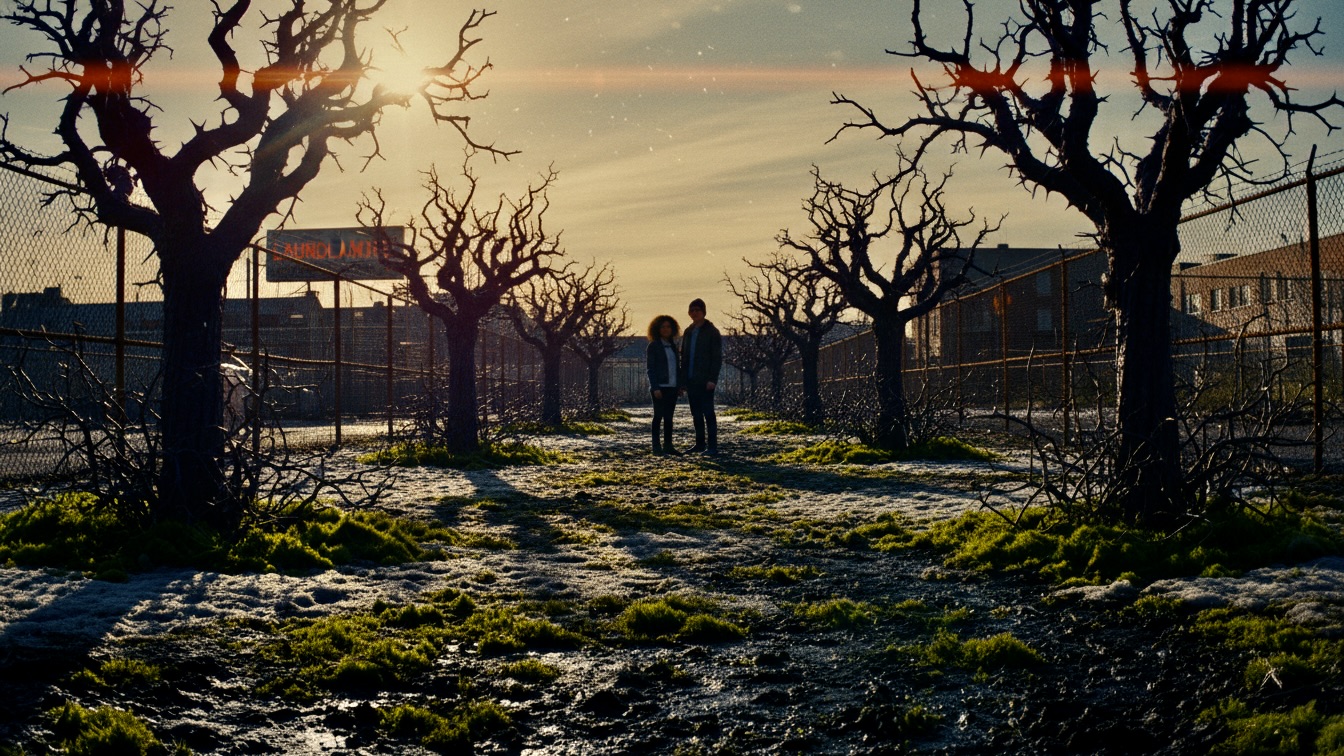
Heather and Tony dig through the gray slush to relocate seedlings that feel a little too much like flesh.
The snow was not melting so much as it was retreating, leaving behind a crime scene of gray slush and flattened, yellow grass. It was the kind of spring that felt like a hangover.
Heather stood at the edge of the garden bed, her boots sinking into the muck with a wet, sucking sound. Every step was a transaction. Give the earth your weight, and it tried to keep your shoe. That was the deal. She looked at the young pippins. They had survived their first winter in the raised beds, huddled under layers of burlap and cheap mulch. Now, they looked like skeletal fingers reaching out of the dirt, black and slick with moisture. They were supposed to be the start of something. An orchard. A legacy. Whatever. To Heather, they just looked like more work.
Tony came out of the back door, dragging a plastic sled filled with empty buckets and a rusted spade. He looked like he hadn't slept since 2024. His hoodie was stained with something dark—probably oil or old coffee. He didn't say hello. People didn't really do that anymore. You just started the conversation in the middle, like a video that was already buffering when you clicked on it. "The park board didn't send the email back," he said, dropping the sled. The plastic hit the mud with a dull thud. "So we’re just doing it?" Heather asked. She didn't look at him. She was focused on a single seedling that seemed to have grown a weird, bulbous knot near its base. It didn't look like wood. It looked like a knuckle. "They’re not going to notice three more trees in that back corner by the drainage pipe," Tony said. He spat into the mud. "Everything in this city is a glitch anyway. If you don't report it, it doesn't exist. We move them today or they get root-bound. Then they die. Then we wasted two years of fertilizer and water. I’m not losing the investment."
Investment. That was Tony’s favorite word. Everything was an input for an output. You put in the time, you get the fruit. You put in the effort, you get the escape. Heather reached down and touched the stem of the nearest pippin. It was cold. Too cold. It felt like touching a piece of refrigerated meat. She flinched, but didn't pull away. She couldn't let Tony see her being weird about it. "The dirt is still half-frozen," she said. "We’re going to break the taproots." Tony knelt down next to her. His knees hit the mud, and he didn't even winced as the cold soaked through his jeans. "Then we dig wider. Stop overthinking it. It’s just biology. You dig, you move, you plant. Simple."
Heather took the spade. The handle was cracked, a jagged piece of wood threatening to slice her palm. She pushed the blade into the earth. It resisted. The ground was a slurry of ice crystals and grit. She jumped on the shoulder of the shovel, forcing it down. A sickening pop echoed from beneath the soil. It wasn't the sound of a rock moving. It was the sound of something snapping. Something wet. "Watch it," Tony snapped. "That was too close to the center." Heather ignored him. She pried the shovel back, lifting a heavy clod of earth. The roots were exposed now. They weren't white or pale brown like the diagrams in the books they’d found. They were a bruised, dark purple. They pulsed. Heather blinked, the gray light of the overcast sky playing tricks on her eyes. The roots weren't moving. They couldn't be. It was just the way the water was draining off them. "Look at the color," she whispered. Tony leaned in. He squinted. "Mineral deficiency. Probably phosphorus. We’ll add some bone meal at the site. Keep digging."
They worked in silence for the next hour. The task was repetitive and exhausting. Dig a circle. Pry. Lift. Place in a bucket. The seedlings were heavier than they should have been. Each one felt like it weighed fifty pounds, despite being barely three feet tall. Heather’s lower back began to ache with a dull, throbbing heat. Her fingers were numb, the skin pruned and red. She watched Tony. He was relentless. He handled the trees with a rough, clinical efficiency, tossing them into the buckets like they were scrap metal. He didn't seem to notice the way the purple roots curled slightly when they hit the air. He didn't notice the way the mud seemed to be turning darker, almost black, where the saplings had been removed. It looked like ink bleeding into a wet paper towel.
"Why the park?" Heather asked, leaning on the shovel to catch her breath. Her lungs felt tight, the damp air sticking to the inside of her throat. "Because it’s neutral ground," Tony said, not looking up. He was wrestling with a particularly stubborn seedling. "Nobody owns the park. Not really. If we plant them there, they’re off the books. No taxes. No permits. Just growth." He gave a violent heave, and the tree came free. A spray of black mud hit Heather’s cheek. It smelled like sulfur and old copper. She wiped it off with the back of her hand, leaving a smear of filth across her face. "It feels like we’re burying bodies," she said. Tony paused. He looked at her then, his eyes flat and weary. "We’re planting life, Heather. Get your head straight. Life is just a slower version of rot. It’s all the same cycle. Don't get poetic on me. It’s cringe."
Heather looked down at the empty hole where the tree had been. The water was already filling it, a dark, oily puddle reflecting the gray clouds above. She felt a sudden, sharp spike of anxiety. It wasn't about the trees or the park. It was the feeling that they were participating in something they didn't understand. The trees felt wrong. The spring felt wrong. Even Tony felt like a version of himself that had been compressed into a lower resolution. "Let’s just get it over with," she said. They loaded the buckets onto the sled. The plastic groaned under the weight. They began the trek toward the park, three blocks of cracked sidewalk and boarded-up storefronts. The neighborhood was quiet, the kind of silence that felt like it was waiting for a jump scare. A few cars passed, their tires splashing through the slush, drivers staring ahead with dead-eyed indifference. Nobody cared about two kids dragging a sled full of buckets. In 2026, if you weren't screaming or on fire, you were invisible.
The park was a square of neglected land between a flickering laundromat and a chain-link fence that guarded a vacant lot. The grass was long and matted, studded with old soda cans and shredded plastic bags. The trees that were already there looked tired—stunted oaks and maples that had given up on trying to look like nature and settled for looking like debris. "Over there," Tony pointed to a dip in the ground near the back fence. The soil there was soft, almost spongy. They dragged the sled across the uneven terrain. Heather’s heart was drumming against her ribs, a fast, syncopated rhythm. She felt watched. Not by people, but by the space itself. The park felt like an empty room that was actually full of people holding their breath.
They started digging the new holes. The dirt here was different. It was sandy, mixed with bits of broken glass and cigarette butts. But as they went deeper, the sand gave way to that same black, ink-like mud. Heather hit something hard. A rock? She scraped at it with the spade. It was white. Smooth. She cleared more dirt away. It was a bone. A long, thin bone, like a deer’s leg, or maybe something else. "Tony," she said, her voice dropping an octave. He didn't even look. "It’s a dog, Heather. People bury their pets in parks all the time. It’s free fertilizer. Keep digging." She stared at the bone. It didn't look like a dog's bone. It had strange, rhythmic notches carved into the side. Like someone had been counting something. She covered it back up with a handful of black muck. She didn't want to know. She couldn't afford to know.
They placed the first seedling into the hole. As soon as the purple roots touched the black mud of the park, they seemed to relax. The tension Heather had felt in the plant all morning evaporated. The branches, previously stiff and skeletal, sagged slightly. It looked like the tree was exhaling. "See?" Tony said, his voice sounding hollow in the open air. "They like it here. It’s the right pH." He started shoveling dirt back in, tamping it down with his boots. Heather moved to the second hole. She felt a strange buzzing in her ears, a low-frequency hum that made her teeth ache. It was coming from the ground. She looked at the third seedling, still sitting in its bucket. It was shaking. Just a little. A fine, high-speed vibration that sent ripples through the muddy water at its base. "Tony, the tree is moving."
"It’s the wind," he said. There was no wind. The air was dead, heavy with the weight of the coming rain. "It’s not the wind. Look at it." Tony stopped digging. He looked at the bucket. The seedling was definitely vibrating. Then, with a soft, wet sound, a new shoot erupted from the main stem. It grew three inches in seconds, a pale, translucent green spike that hardened into a dark thorn right before their eyes. Tony stepped back. For the first time, his expression of weary skepticism cracked. "That’s... fast," he muttered. "It’s not supposed to do that. Pippins don't have thorns like that."
"We need to go," Heather said. Her fight-or-flight response was screaming, a loud, distorted signal in the back of her brain. "We should just leave them and go." Tony looked at the trees, then at the hole he’d just filled. The first tree they’d planted was already different. Its bark was darkening, turning the color of a fresh bruise. The branches were thickening, twisting into shapes that felt predatory. "No," Tony said, his voice regaining its edge. "We spent two years on these. If they’re growing fast, that’s good. That’s a return on the time. We just need to finish." He grabbed the vibrating seedling and shoved it into the second hole. He didn't use the shovel; he used his hands, frantically piling dirt over the roots. Heather watched him, her stomach turning over. He looked desperate. Not for the trees, but for the idea that he hadn't failed. In a world of bad transactions, he needed this one to be a win.
Suddenly, the ground beneath them shifted. Not like an earthquake, but like a muscle tensing. A crack opened in the mud between the two newly planted trees. A thick, purple root, the size of a human arm, breached the surface. It wasn't seeking water. It was seeking leverage. It curled around the base of the chain-link fence and pulled. The metal groaned, the sound of a thousand screaming violins. "Tony!" Heather yelled. She grabbed his jacket and yanked him backward. He fell into the mud, his eyes wide, reflecting the twisted, darkening shapes of the orchard they were creating. The three trees were now growing with a violent, audible speed—the sound of wood snapping and stretching, like a house settling in a hurricane. They weren't just trees anymore. They were a structure. A trap.
"It’s the soil," Tony whispered, his face pale. "Something was already here. We just gave it a body." He scrambled to his feet, his hands shaking. The trees were now ten feet tall, their branches interlacing to form a canopy that blocked out what little light was left in the sky. The thorns were the size of steak knives, glinting with a dark, oily sap. Heather looked toward the street. The laundromat was still there. The cars were still passing. The world was still normal, just fifty feet away. But inside the park, the air was getting colder. The hum in her teeth was now a roar. "We have to leave the sled," Heather said. "We have to leave everything." Tony looked at the third bucket, the one they hadn't planted yet. It was empty. The seedling had crawled out. It was a few feet away, dragging its root ball through the mud like a wounded animal, heading toward the drainage pipe.
Heather didn't wait for him. She ran. Her boots slipped on the slush, her lungs burning with every breath. She didn't look back until she reached the sidewalk. The park looked exactly the same from the outside—a gray, neglected square of land. But she could see the tops of the new trees, higher than the others, their dark, thorned branches swaying even though there was no breeze. Tony caught up to her, gasping for air. He looked back at the fence. The sled was gone, swallowed by the mud. "My phone was in the sled," he panted. "I left my phone."
"Forget the phone," Heather said. She was looking at her hands. There was a thin, purple line running under the skin of her palm, right where the cracked shovel handle had pressed. It pulsed. A slow, rhythmic throb that matched the heartbeat of the thing in the park. She tucked her hand into her pocket, her skin crawling. "What do we do?" Tony asked. He looked small. The skepticism was gone, replaced by a raw, naked fear that made him look like the teenager he actually was. Heather looked at the park, then at the gray, indifferent street. Life was a series of transactions. They had planted the trees. Now, the trees were going to start collecting. "We go home," she said, her voice flat and cold. "And we wait for the next move."
They walked away in the fading light. The spring thaw continued around them, the world melting into a dirty, unrecognizable version of itself. Behind them, in the dark corner of the park, something wet and heavy began to climb out of the drainage pipe, following the scent of the blood on Heather’s palm. The orchard was just the beginning. The debt was only starting to accrue. Heather felt the purple line in her hand twitch. It wasn't a bruise. It was a root. And it was hungry.
“Heather felt the purple line in her hand twitch; it wasn't a bruise, it was a root, and it was hungry.”


