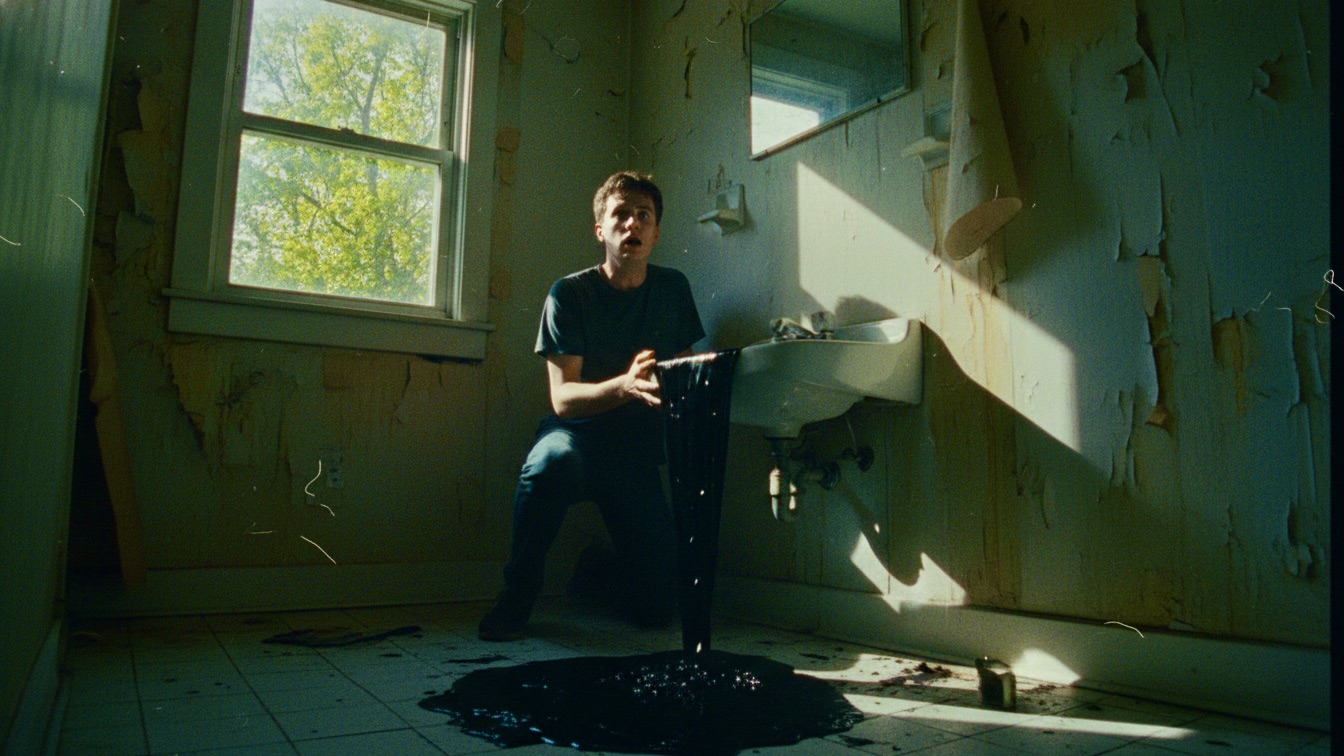
The narrative follows a young man named Emmond who finds himself trapped within a distorted, surrealist version of his childhood home in Ohio. The architecture of the house is predatory and warped, with walls that lean in to listen and doors that lead back to a bathroom regardless of the direction he travels. Inside this bathroom, he discovers a sink flowing with black, oil-like ink and human molars that transform into aggressive hornets. These manifestations of trauma and guilt eventually drive him back into the hallway, where the house begins to whisper his old car's license plate number, a direct reference to a hit-and-run accident he committed on 4th Street.
As Emmond attempts to escape toward the sunlight of the front door, he encounters a monstrous version of his mother, whose head is a whirring security camera. She speaks to him in a jarring mixture of modern internet slang and accusations about a hidden body, framing his moral failure as a matter of "bad optics." The floor of the house dissolves into a swamp of wet receipts and black ink, symbolizing the mundane paper trail of his life and his attempts to flee his crime. The chapter concludes with him back at the sink, where he is forced to face the reflection of the man he hit with his car, who demands that he finally acknowledge the reality of his actions.
The central theme of the story is the inescapable nature of guilt and the way it transmutes the familiar into the grotesque. The house acts as a psychological map of Emmond’s mind, where the "old house smell" is replaced by the metallic scent of blood and copper. This transformation suggests that his past trauma has overwritten his foundational memories, making it impossible for him to return to a state of innocence. The house is not merely a setting but an active interrogator, using his own history—symbolized by the license plate—to dismantle his denial.
Another prominent theme is the intersection of modern surveillance and the performative nature of morality. The "Camera Mother" represents the internal and external eyes that judge the protagonist, but she does so using the hollow language of social media. By using terms like "mid" and "lagging," the narrative highlights how Emmond has tried to process his horrific crime through a lens of superficiality. This suggests a critique of a culture where the "optics" of an action are considered more important than the inherent morality of the act itself.
Finally, the story explores the weight of consumption and the physical residue of a life lived in flight. The marsh of receipts represents the "paper trail" of Emmond's existence after the accident—the gas, the car washes, and the oil changes required to keep moving away from the scene of the crime. These mundane items become a literal trap, dragging him down and cutting his skin. It emphasizes that his attempts to "consume" his way out of his feelings or simply drive away have only created a heavier burden that eventually anchors him to his guilt.
Emmond is a character defined by profound psychological avoidance and a crumbling sense of self. He is twenty-four years old, yet his first instinct in the face of horror is to regress, calling out for his mother to tell him his reality is merely a "bad trip." This highlights a significant developmental arrest; he is a man who has committed an adult crime but lacks the moral maturity to face the consequences. He views his life through a digital filter, using phrases like "what the actual hell" to distance himself from the visceral, bloody reality of the teeth in the sink.
His internal conflict is a battle between the desire for "fresh and green" exterior reality and the "rotting" interior of his conscience. He is a man in constant motion, as evidenced by his history of trading in cars and driving incessantly, yet he is paradoxically stuck in the "bathroom" of his own mind. He wants to be a "good person," but he defines goodness as not getting caught or keeping the "files" of his life clean. This shallow self-perception is his primary defense mechanism against the weight of the man he killed or injured.
By the end of the chapter, Emmond’s defenses have been completely eroded by the house’s relentless manifestations. When he looks into the sink and sees the victim instead of his own reflection, his identity is effectively replaced by his crime. He is no longer the protagonist of his own story; he is the perpetrator defined by the person he harmed. His silence at the end of the text suggests a moment of peak vulnerability where he can no longer "delete the file" of his memory.
The author utilizes a visceral, sensory-heavy style to create an atmosphere of "loud" horror. The use of synesthesia, such as a smell that "is screaming," forces the reader into the protagonist's heightened state of panic. The descriptions are tactile and repulsive, focusing on the weight of the ink and the "hot needles" of the hornet stings. These details ground the surreal elements in a physical reality that makes the psychological torment feel more immediate and inescapable.
Pacing in the chapter is expertly handled through the use of architectural distortion. The "stretching" hallway and the "looping" rooms create a sense of frantic, breathless movement that ultimately leads nowhere. This mirrors the futility of the protagonist’s life since the accident, as he has been running without making any actual progress. The transition from the domestic safety of a "yellow apron" to the cold, clicking lens of a security camera provides a sharp, rhythmic jolt to the narrative flow.
The narrative voice is particularly distinct due to its juxtaposition of traditional Gothic tropes with contemporary "Gen Z" vernacular. This linguistic choice serves to alienate the reader and underscore the protagonist's psychological state. By having the mother speak in terms of "coward energy" and "lagging," the author creates a sense of cognitive dissonance. It suggests that for Emmond, even his deepest fears are filtered through a modern, detached vocabulary that fails to capture the true gravity of his situation.


