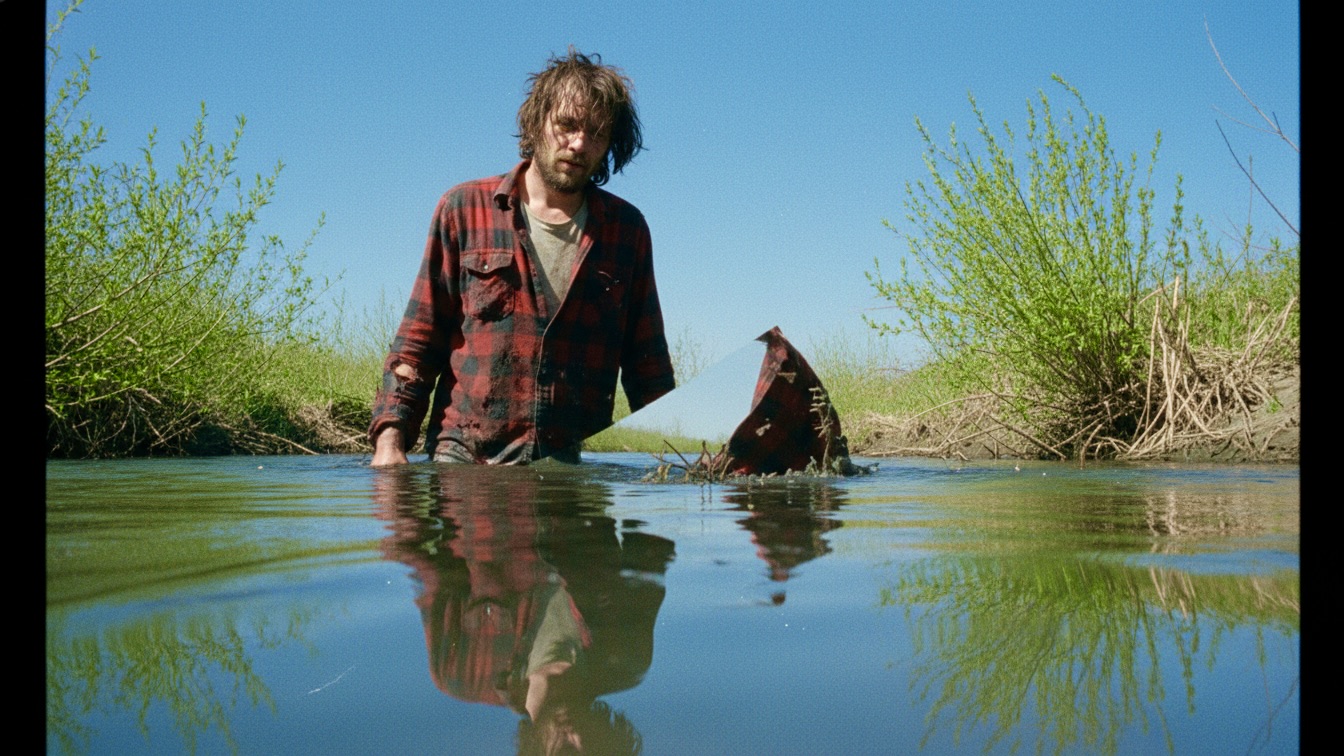
The narrative unfolds in the damp, industrial-scarred wilderness of the Kenora bush, where a man named Marrow engages in a disturbing ritual with a mutated, three-eyed doe. He attempts to "cleanse" the animal using industrial solvent, driven by a hallucinatory connection to the metallic voices he hears within the polluted landscape. His isolation is interrupted by Sarah, a corporate representative from a nearby extraction site, who attempts to bribe him into silence regarding a massive mercury leak that is poisoning the local watershed.
As the confrontation escalates, Marrow reveals he has recorded Sarah’s admission of the containment failure on an old cassette recorder. However, the sheer density of the environmental toxins has destroyed the magnetic tape, rendering his evidence useless. Marrow’s own community, led by Elder Kenneth and Marrow's brothers, arrives not to support him, but to coerce him into accepting the corporate settlement for the sake of the town's economic survival. Refusing to succumb to their pragmatism or Sarah's clinical manipulation, Marrow flees into the freezing, mercury-laden river, perceiving his impending drowning as a spiritual union with a "silver god."
The narrative explores the devastating intersection of environmental catastrophe and the erosion of human morality. The central theme is the transmutation of nature into something unrecognizable and "heavy," where the traditional beauty of the spring is replaced by the smell of a mechanic’s shop and the sight of bruised, metallic mud. This shift suggests that the environment has not just been damaged but fundamentally rewritten by industrial byproduct, creating a new, toxic reality that the characters must navigate.
Another prominent theme is the conflict between economic survival and spiritual or ethical truth. Sarah represents a corporate entity that views ecological destruction as a manageable "genetic fluke," while Kenneth and Marrow's brothers represent a community so desperate for resources that they are willing to consume the very poison that kills them. They choose the "meds for the poison" over the cessation of the poisoning itself, highlighting a tragic cycle of dependency where the destroyer also becomes the provider.
Finally, the story examines the thin veil between madness and prophetic insight. Marrow’s psychosis is presented as a direct physiological response to the heavy metals in his system, yet his "madness" allows him to see the reality of the situation more clearly than those who are blinded by neon jackets and corporate jargon. His descent into the river is a rejection of a world where truth can be bought or erased by magnetism, opting instead for a fatalistic immersion in the "silver blood" of the earth.
Marrow functions as a modern-day mystic whose psyche has been fractured by environmental trauma. He exhibits symptoms of toxic encephalopathy or a similar mercury-induced psychosis, characterized by his auditory hallucinations and his obsessive, ritualistic behavior toward the doe. His internal world is governed by a private mythology where the pollution is a "god" and the silver is a "spirit," suggesting he has created a religious framework to process a reality that is otherwise too horrific to endure.
His motivation is not rooted in traditional activism but in a desperate need for purity and recognition of the "truth." When his tape recorder fails, his grip on the physical world snaps because his only tool for objective proof has been swallowed by the very environment he sought to save. His decision to enter the river is an act of ultimate surrender; he chooses to become one with the silver god rather than live as a victim of the corporate and familial betrayal that surrounds him on the bank.
Sarah is the embodiment of clinical, corporate detachment. She is described through sharp, artificial imagery—neon orange jackets and filtered water voices—which contrasts sharply with the "bruised peach" mud of the bush. She utilizes "practiced empathy" as a weapon, attempting to manipulate Marrow not through force, but through a condescending performance of care and the promise of a sterile, urban life in Winnipeg.
Her character represents the banality of industrial evil, as she frankly admits to the catastrophic leak while simultaneously dismissing it as a biological fascination. She does not see the three-eyed doe as a tragedy, but as a "genetically expressive adaptation." To her, the world is a series of data points and liability settlements, and her only goal is to ensure that the "oxide" of the truth is wiped clean so the machinery of extraction can continue.
Kenneth serves as the tragic figure of the compromised patriarch. As an elder, he should be the protector of the land and its people, yet he has been forced into a position where he must advocate for the very forces destroying his community. His canyon-mapped face suggests a long history of endurance, but his spirit is broken by the pragmatic necessity of "bills" and "roofs."
He views Marrow’s resistance as a threat to the collective survival of the town, illustrating how poverty can turn victims against one another. Kenneth’s betrayal is perhaps the most painful for Marrow, as it signifies that the traditional wisdom of the elders has been supplanted by the cold logic of the extraction site. He chooses the survival of the body over the integrity of the soul, standing by as Marrow’s own brothers use physical intimidation to protect a corporate secret.
The prose is marked by a visceral, sensory-heavy style that mirrors the "weight" of the mercury-laden environment. The author uses unsettling metaphors—poplar buds like "zits" and mud the color of a "bruised peach"—to establish a tone of biological decay. This creates a sense of "eco-horror" where the natural world is not a victim, but a mutating, aggressive force that is actively reclaiming the human characters through its "silver skin."
Pacing in the chapter begins with a slow, meditative focus on Marrow’s ritual, creating an atmosphere of heavy, stagnant dread. This stillness is shattered by the arrival of Sarah and the subsequent confrontation, where the dialogue becomes sharp and transactional. The climax of the story shifts into a more lyrical, hallucinatory rhythm as Marrow enters the water, with the language becoming increasingly fluid and rhythmic to match the flow of the river.
The narrative voice remains in a close third-person perspective, heavily influenced by Marrow’s distorted perceptions. This allows the reader to experience the "humming" of the deer and the "silver" of the water as if they were real, rather than mere symptoms of poisoning. By grounding the supernatural or surreal elements in the physical reality of industrial discharge, the author creates a hauntingly plausible vision of a world where the line between chemistry and divinity has completely dissolved.


