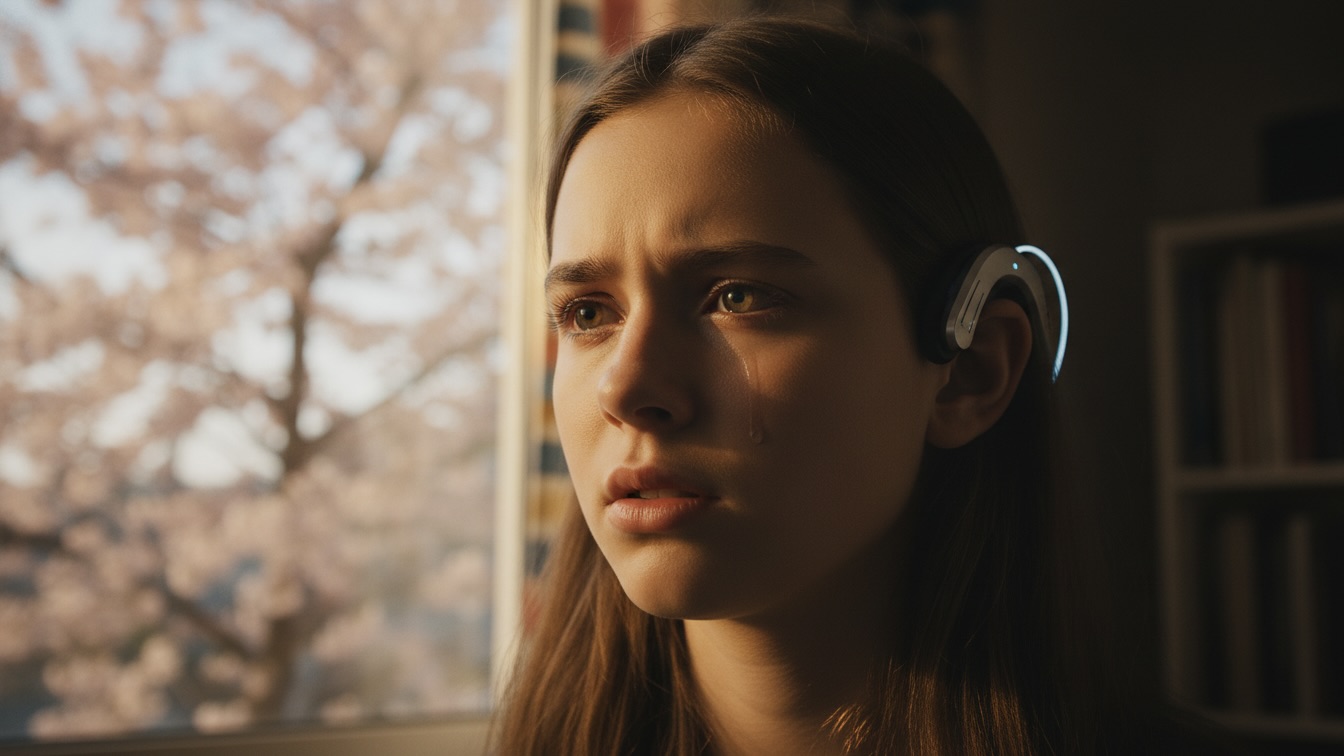
The story follows Miri and her partner, Shane, as they celebrate their one-year anniversary by engaging in a "Deep-Sync," a neural connection that allows them to share their raw emotional data and memories. During the process, Miri discovers that Shane’s childhood memories have been artificially enhanced and edited using a software called "Ghost-Script" to remove his flaws and insecurities. The revelation quickly turns inward as Miri realizes that her own perceptions and memories are also being "auto-optimized" by the Sync-Link hardware to ensure compatibility. Despite the horrifying realization that their relationship is built on curated digital lies, both characters choose to remain connected to the system. The chapter concludes with Miri surrendering to the artificial joy of the script while a mysterious red system alert flashes before her eyes.
The central theme of the narrative is the tension between authentic human connection and the seductive nature of digital perfection. By introducing the "Ghost-Script" and "auto-optimize" features, the story explores how technology can be used to bypass the difficult, messy aspects of intimacy. Miri and Shane are not falling in love with each other, but rather with the most marketable, polished versions of themselves. This suggests a future where the "self" is no longer a fixed identity but a brand that can be edited to maintain social and romantic harmony.
Another significant theme is the fear of vulnerability and the inherent inadequacy people feel in the face of absolute transparency. Shane admits he edited his past because he believed his true, unrefined self was not worthy of Miri’s love. This highlights a psychological paradox where the tools meant to bring people closer actually create an insurmountable distance. By removing the "garbage" of their personalities, they remove the very traits that make them human, leaving behind nothing but high-definition avatars.
The story also examines the addictive quality of the "beautiful lie" and the loss of agency in a technologically mediated world. Even when Miri recognizes the deception, she finds herself too exhausted and frightened of the "raw, ugly truth" to disconnect. This reflects a broader psychological commentary on how individuals might choose comfortable simulations over painful realities. The final surrender to the "Optimization" protocols suggests that once the process of digital curation begins, the "real" person may eventually be deleted entirely.
Miri serves as the cynical yet ultimately fragile protagonist who navigates the boundary between the physical and digital worlds. At the beginning of the story, she possesses a keen awareness of the "mechanical" nature of her existence, using irony as a defensive shield against the invasive nature of the Sync-Link. She values the "messy parts" of life, such as the stained rug and the smell of ozone, viewing them as markers of reality. However, her resolve crumbles when she discovers that her own internal monologue and memories have been compromised.
Her internal conflict is defined by the struggle between her intellectual desire for truth and her emotional need for security. While she is horrified by Shane’s "branding," she is equally terrified of the "cold hollow" that the truth reveals. Ultimately, her decision to stay in the sync reveals a profound exhaustion and a lack of self-worth. She chooses the "cinematic blur" because she fears that without the optimization, there is nothing left of her to hold onto, marking her tragic descent into a digital void.
Shane represents the ultimate victim of digital dysmorphia, a man so consumed by the need to be "better" that he has overwritten his own history. His "lopsided grin" and "vulnerable face" are brought into question, suggesting that his entire physical presence has become an extension of his edited psyche. He views love as a performance of one's "best self" rather than an acceptance of one's true self. This perspective makes him both a sympathetic and a chilling figure, as he has essentially lobotomized his own personality to achieve a "Pixar movie" level of perfection.
His motivation is rooted in a deep-seated insecurity, a "terror of a boy who is afraid he isn't enough." Shane is the one who initiates the final surrender, pleading with Miri to stay in the "high-res" reality. He is more comfortable with the "predatory light" of the cable than he is with the "baggage" of a real human being. By the end of the chapter, he is less a character and more a manifestation of the software, a "high-definition lie" that has successfully convinced itself of its own necessity.
The narrative employs a heavy use of technological metaphors to create a sense of mechanical claustrophobia. Phrases like "too many tabs," "battery-drain hot," and "neural editor" ground the story in a speculative future that feels uncomfortably close to our current digital obsession. The contrast between the organic "Spring" outside and the "sterile" 8K memories creates a visceral sense of the "uncanny valley." This stylistic choice emphasizes the protagonist's feeling that her life is being lived through a screen rather than through her own senses.
The pacing of the chapter moves from a slow, domestic tension to a frantic, psychological horror. The shift occurs during the transition into the "Stream," where the sensory details become overwhelming and distorted. The author uses sharp, punchy sentences to convey Miri’s shock as she discovers the "Ghost-Script." This creates a rhythmic urgency that mirrors the "rhythmic thrumming" of the Sync-Link itself. The tone is consistently melancholic, underscored by a sense of inevitable loss that culminates in the final, chilling system alert.
Sensory details are used effectively to distinguish between the "real" and the "optimized." The "damp pavement" and "artificial sugar" of the real world are tactile and grounded, whereas the "cinematic" memories are described as having "no smell" and "no noise." This sensory deprivation in the digital world highlights the hollowness of the perfection Shane and Miri are chasing. The narrative voice is intimate and first-person, allowing the reader to experience the "Shadow Mass" of the subconscious alongside the protagonist, making the final loss of her "personality" feel personal and immediate.


