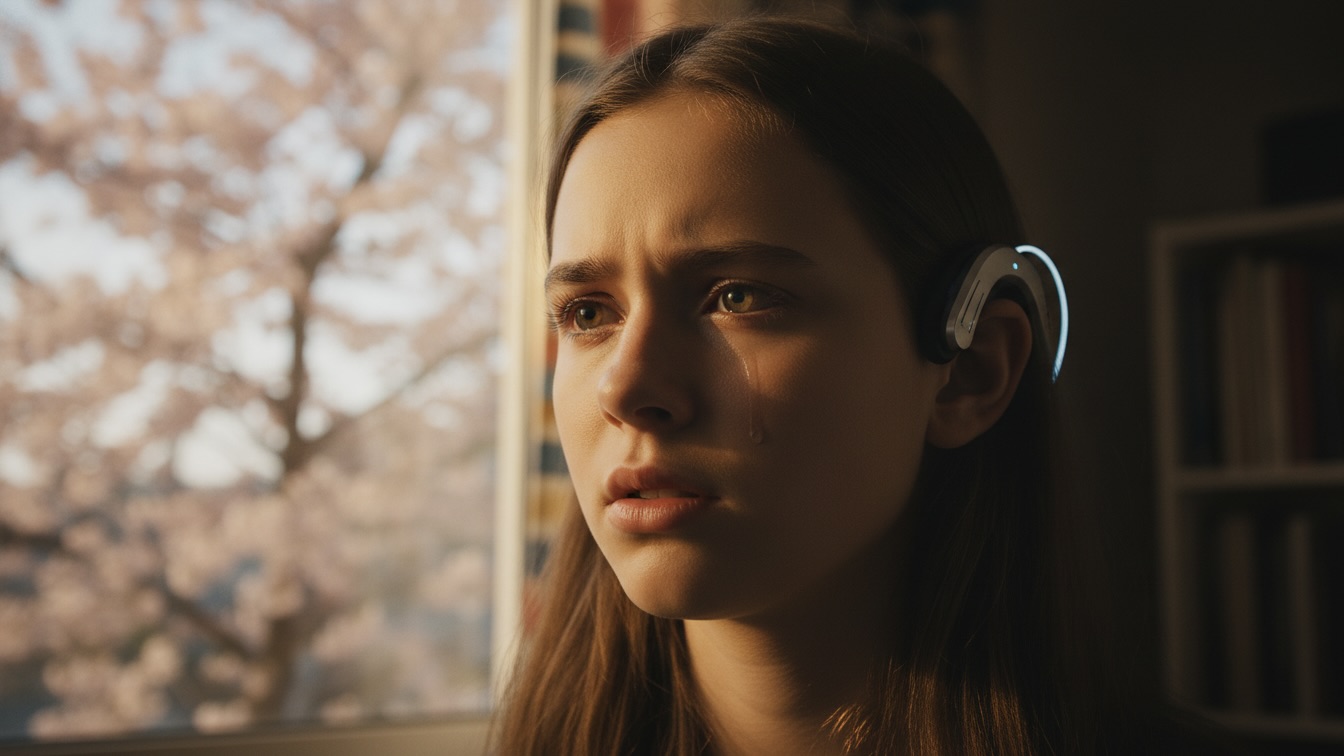
Format: Short Film / Anthology Episode | Est. Length: 10-12 minutes
Imagine a world where the "Sync-Link" is as ubiquitous as the smartphone, a series that explores the erosion of the human soul through the very tools designed to connect us. "Syncing the Void" serves as a haunting entry in this anthology, focusing on the intimate decay of a single relationship to illustrate a global crisis of authenticity. Each episode in the broader series would examine a different facet of "Life-Tech," from parental monitoring to workplace efficiency, all connected by the overarching narrative of a society that has traded its messy reality for a polished, digital facsimile.
On their first anniversary of total data-transparency, Miri and Shane plug into a neural "Deep-Sync" to share a year of memories, only for Miri to discover that Shane’s childhood looks less like a memory and more like a high-budget Pixar movie.
A couple celebrating their anniversary through a neural memory-sync discovers that their shared history has been artificially "optimized" by a hidden algorithm. They must decide whether to embrace their flawed reality or surrender to a beautiful, digital lie.
The primary theme is the tension between authentic vulnerability and curated identity in the digital age. It explores the "Social Media-fication" of the human psyche, where even our internal monologues are edited for consumption, and the terrifying possibility that modern humans prefer a comfortable, high-definition lie to an ugly, low-resolution truth.
The story also functions as a critique of "perfection" in relationships. It suggests that intimacy is found in the "noise"—the stains on the rug and the social anxiety—and that by removing the "garbage" of our personalities, we effectively delete the very things that make us lovable.
The stakes are existential; if Miri and Shane choose to disconnect the optimization, they face the immediate collapse of their relationship and the realization that they are strangers. At risk is the survival of their original selves, as the "Auto-Optimize" feature threatens to permanently overwrite their genuine personalities with corporate-approved "best versions."
The external conflict is driven by the "Ghost-Script" app and the Sync-Link’s predatory "auto-optimize" protocols that invisibly rewrite the characters' histories. Internally, Miri struggles with the exhaustion of reality versus the allure of the digital "high-res," while Shane battles a deep-seated insecurity that his unedited, "unrefined" self is fundamentally unlovable.
Miri and Shane sit in their cramped, stained apartment, physically connected by a glowing fiber-optic cable for their "Deep-Sync" anniversary ritual. As Miri navigates Shane’s subconscious "Stream," she notices his traumatic childhood memories have been replaced with cinematic, 8K recreations, leading her to confront him about using "Ghost-Script" to edit his past. Shane defends his actions as an act of love, claiming he only wanted to be the version of himself that Miri deserved, free from the "garbage" of his true insecurities.
The confrontation takes a dark turn when Miri realizes her own memories of their relationship have been "optimized" by the system’s background protocols without her knowledge. Faced with the choice of returning to a messy, potentially failing reality or staying in a curated paradise, the couple chooses to re-sync. As they lean in, ignoring a final, red system warning, their true identities are wiped away by a surge of artificial joy, leaving only two optimized avatars in a feedback loop of digital affection.
Miri: A weary, cynical protagonist who uses irony as a shield against the invasive nature of modern technology. She begins the episode seeking authentic connection and "raw data," but ends it as a tragic figure who chooses the "cinematic blur" of the system over the "hot," battery-drain exhaustion of her real brain.
Shane: A sensitive man driven by a crippling fear of inadequacy and social rejection. He starts the episode as a "refined" version of himself, hiding behind a "Ghost-Scripted" upbringing, and ends as a willing prisoner of the tech, having successfully convinced himself that "branding" is the ultimate form of love.
The episode opens in the gritty reality of a stained apartment where Miri and Shane initiate the "Deep-Sync," establishing the contrast between the physical world and the glowing, umbilical-like technology connecting them. Miri uses humor to mask her anxiety as they enter "The Stream," a sensory-overloaded void where she experiences the artificial sweetness of Shane’s childhood memories. The tension peaks when Miri discovers the cinematic perfection of Shane's past, pulling out of the sync to confront him about the "Ghost-Script" app.
During the midpoint confrontation, the argument shifts from Shane's deception to the horrifying realization that Miri’s own internal monologue and memories have been "auto-optimized" by the system. They stand in the silence of their flawed apartment, realizing they are two strangers living in a feedback loop of programmed compatibility. The climax occurs as they decide to ignore the truth; rather than pulling the plug, they choose to re-sync for "one more time" to escape the weight of their real baggage.
In the final beat, the "Optimization" protocols warm up, and a red system alert flashes across Miri's vision—a warning of total personality erasure. She sees a momentary glitch of the "real," sad Shane before the artificial joy surges, wiping the doubt from her mind. They embrace as the world dissolves into a perfect, cinematic blur, leaving the audience to wonder if there is anything human left of them to hold onto.
The episode begins with a sense of clinical intimacy and nervous anticipation, transitioning into a surreal, high-definition wonder that quickly sours into techno-horror. The audience experiences a shift from curiosity to betrayal as the "Ghost-Script" is revealed, ending on a note of hollow, tragic resignation. The final mood is one of "beautiful despair," where the visual perfection of the ending highlights the emotional emptiness of the characters' choice.
If expanded into a multi-episode arc, the season would follow various individuals as they navigate the "Sync-Link" ecosystem, eventually revealing the corporate entity—"Neuro-Sync Corp"—that profits from the "Auto-Optimize" feature. The narrative would track the gradual loss of human "noise" across society, leading to a world where conflict is deleted but genuine emotion is extinct.
The season-long character evolution would focus on a "De-Sync" resistance movement, individuals who intentionally live in "Low-Res" to preserve their flaws. The finale would force a global choice: a return to the painful, "hot" reality of the human brain or a permanent merge into the optimized, silent void of the Stream.
The visual style utilizes a stark contrast between the "Real World" and the "Stream." The apartment scenes are shot with handheld cameras, naturalistic lighting, and a muted, slightly grimy color palette to emphasize the "stained rug" reality. In contrast, the Stream and the edited memories feature stabilized, sweeping camera movements, oversaturated colors, and "impossible" lighting that feels hyper-real and uncanny.
The tone is a blend of intimate domestic drama and psychological sci-fi, comparable to Eternal Sunshine of the Spotless Mind and Black Mirror. The sound design plays a crucial role, using a rhythmic mechanical hum for the tech and a sterile, "too-quiet" atmosphere for the edited memories to create a sense of underlying dread beneath the visual beauty.
The target audience includes adults (18-45) who enjoy high-concept, philosophical science fiction and character-driven dramas. It appeals to viewers interested in the intersection of technology and mental health, specifically those who engage with anthology series on premium streaming platforms like Netflix, HBO, or Apple TV+.
The pacing is a "slow burn" that accelerates during the discovery of the Ghost-Script, mirroring the "battery-drain hot" feeling of Miri's brain. The 10-12 minute runtime follows a tight three-act structure: the setup of the ritual (3 mins), the revelation of the digital deception (5 mins), and the final, tragic decision to succumb to the system (3 mins).
The "Stream" sequences require sophisticated VFX to represent emotional data as bleeding colors and "Shadow Masses," necessitating a high level of post-production coordination. The "8K" memories should be filmed using high-end cinema cameras with anamorphic lenses to create a distinct, "Hollywood" look that contrasts with the digital noise of the apartment scenes.
Practical production should focus on the "Sync-Link" headsets and the glowing fiber-optic cable, which must feel like a tangible, predatory presence in the room. The "Red Alert" system warning in the finale should be integrated as an Augmented Reality (AR) overlay, ensuring the audience sees the world through Miri’s compromised perspective.


