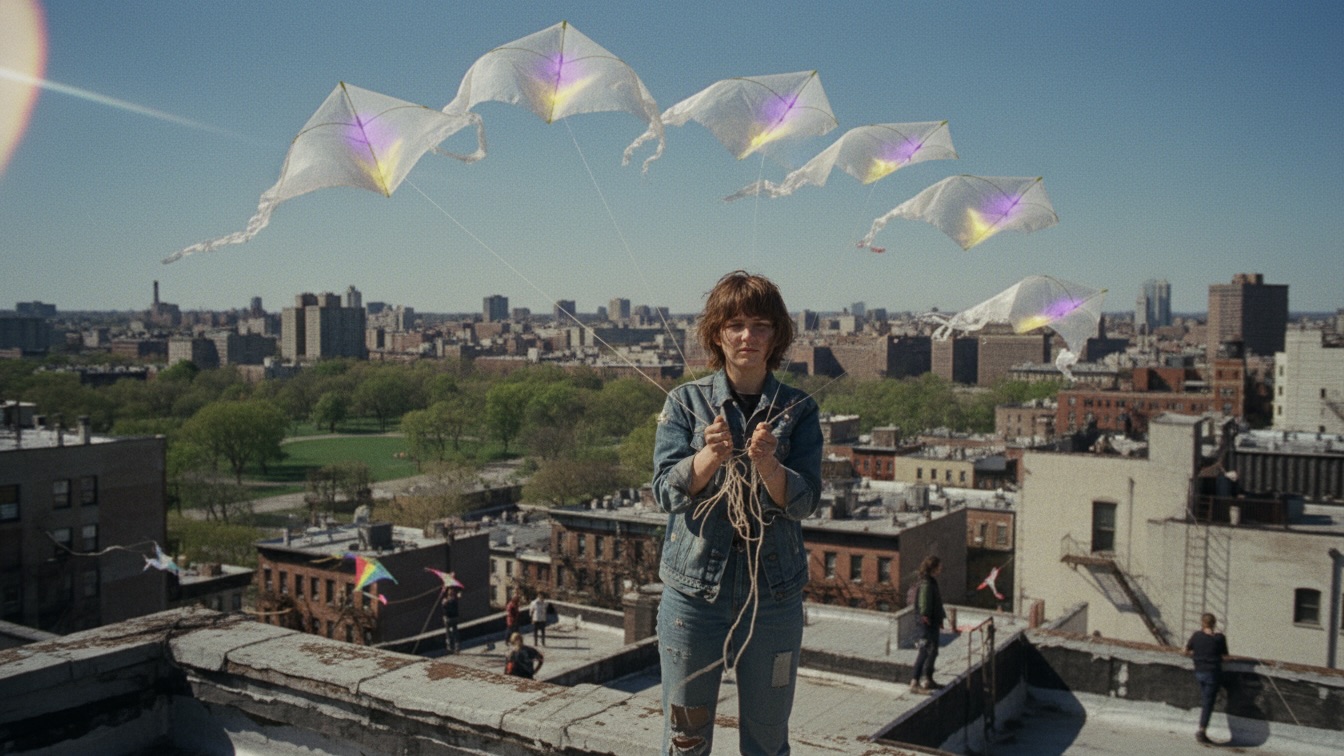
Clara lives in a self-imposed digital exile following a traumatic neural-link glitch that left her unable to speak or tolerate electronic frequencies. Her friend Theo visits her apartment, bringing primitive kite-building materials as a way for her to participate in the upcoming Spring Festival without the noise of modern technology. Clara embraces the project, using specialized light-reactive paints to create a series of seven kites that represent her internal vocabulary.
The two friends spend the day in quiet, tactile labor, constructing the kites from bamboo and silk. On the morning of the festival, they take the kites to the rooftop, where the sun activates the pigments and signals Clara's presence to the city. This analog display inspires neighbors to abandon their digital devices and launch their own physical kites. By the end of the day, Clara experiences a profound sense of connection and peace, realizing that her voice can exist through mediums other than speech.
The narrative explores the tension between the digital and the physical, positioning the "glitch" not just as a medical failure but as a catalyst for returning to tangible reality. Clara’s apartment is described as a tomb for electronics, a sanctuary where the "dial-up hum" of her injury is mitigated by the removal of smart-technology. The kites serve as a bridge between these two worlds, utilizing the most basic hardware available to achieve a connection that the neural-link ultimately failed to sustain.
Communication serves as a central pillar of the story, redefined here as something that transcends verbal language. Clara’s inability to speak is portrayed as a physical blockage, yet she finds a way to bypass her scorched wires through color and wind. The seven kites act as a new syntax, allowing her to broadcast her state of being—"Here," "Wait," "Safe"—to a world that she previously felt alienated from. This suggests that authentic expression is not dependent on the tools of the modern age but on the intent of the individual.
Furthermore, the story examines the concept of community and the performative nature of modern social interaction. While the city below focuses on streaming and AR glasses, Clara’s kites spark a spontaneous, unmediated collective experience. The glitch in the perfect digital interface created by the neighborhood’s kites highlights a deep-seated human desire for physical presence. The kites represent a rejection of the cloud in favor of the string, emphasizing that true connection is a felt, vibrating tension between people.
Clara is a character defined by her sensory vulnerability and her profound sense of internal fracture. A psychological evaluation would note that her withdrawal from society is a defense mechanism against the high-contrast light and glitchy shadows that have come to define her perception. She views herself as a broken toy or a ghost in the machine, indicating a loss of agency and identity following her technological trauma. Her journey is one of reclaiming that agency by finding a medium that does not trigger her neurological pain.
Her decision to use light-reactive pigments is a significant step in her psychological recovery, as it turns her sensory sensitivity into a creative tool. By painting her broken brain patterns onto the silk, she externalizes her internal chaos and transforms it into something beautiful and communicative. The physical act of flying the kites allows her to feel the vibration of joy through her body, bypassing the damaged neural pathways. By the end of the story, she accepts her silence, finding peace in the realization that her value is not tied to her ability to function within the digital status quo.
Theo serves as the emotional anchor and the safe presence in Clara’s life, demonstrating a high degree of empathy and patience. He understands the rules of her environment, respecting her need for silence and the absence of electronics without making her feel like a burden. Unlike others who look at her with pity, he treats her as a collaborator, providing the physical framework—the bamboo and string—upon which she can build her new voice. His presence is characterized by organic smells and quiet competence, contrasting sharply with the sterile, noisy world Clara fears.
He acts as a bridge between Clara's isolation and the external world, facilitating her return to the community on her own terms. By suggesting the kites, he offers her a way to be there without being there, showing a sophisticated understanding of her psychological boundaries. His laughter at the end of the story, as he watches the riot of kites, signals his success in helping her reconnect. He does not try to fix her vocal cords; instead, he helps her find a different way to be heard, validating her existence in its current form.
The author employs a sensory-rich narrative style that emphasizes the contrast between the organic and the electronic. Descriptions of scorched wires and dial-up hums create a visceral sense of Clara’s neurological distress, while the scent of linseed oil and woodsmoke provide a grounding, earthy counterpoint. This focus on texture and smell reinforces the theme of returning to a physical reality. The use of color, particularly the bruised purple and neon yellow, serves as a visual metaphor for Clara’s emotional state.
Pacing in the chapter moves from the static, claustrophobic atmosphere of the apartment to the expansive, airy freedom of the rooftop. The middle section, detailing the construction of the kites, is slow and methodical, mirroring the patient rebuilding of Clara’s confidence. As the kites take flight, the sentences become more rhythmic and fluid, capturing the physical sensation of the wind. This acceleration mimics the loosening Clara feels in her chest, moving from the tomb of her silence to the screaming colors of the sky.
The narrative voice is intimate and first-person, allowing the reader to experience the world through Clara’s heightened and sometimes distorted perception. This choice is crucial for establishing empathy, as it places the reader directly within the static of her mind. The tone is initially one of weary resignation but shifts toward a quiet triumph as the kites successfully bridge the gap between Clara and her neighbors. The final imagery of the collection of strings provides a powerful closing metaphor for human connection that is both fragile and enduring.


