Format: Short Film / Anthology Episode | Est. Length: 10-12 minutes
Imagine a near-future world where the digital "cloud" has become a literal atmosphere, and those who suffer from technological trauma are forced into the shadows of an increasingly loud society. This story serves as a poignant entry in The Static Age, an anthology series exploring the friction between hyper-connectivity and the raw, analog human experience. Each episode follows a different "glitched" individual finding a way to bypass the digital noise of the city to reclaim a lost piece of their humanity through tactile, physical mediums.
Clara lives in a lead-lined apartment to escape the agonizing digital static in her head, until her friend Theo arrives with a bundle of silk and bamboo that offers a way to speak without making a sound.
After a neural-link malfunction leaves her non-verbal and hypersensitive to technology, a young artist uses light-reactive kites to broadcast her voice across a high-tech city. She must overcome her sensory trauma to turn a digital glitch into a physical signal of hope.
The central theme explores the distinction between digital connectivity and genuine human connection, highlighting how technology can become a barrier to true intimacy and self-expression. It functions as a "Solar-punk" narrative, emphasizing the healing power of tactile creation and the resilience of the human spirit when stripped of modern conveniences.
The story also delves into the concept of "Analog Recovery," suggesting that in a world of infinite data, the most profound messages are those carried by the wind and the sun. It challenges the audience to consider what is lost when we prioritize the capture of a moment over the visceral experience of living within it.
For Clara, the stakes are her sanity and her fundamental ability to exist as a social being; if she cannot find a way to communicate, she remains a "ghost in the machine," permanently isolated in her silent apartment. On a communal level, the neighborhood risks losing its last vestige of physical presence to performative digital streams, potentially forgetting the joy of shared, unmediated reality.
The primary conflict is internal, manifesting as Clara’s "Neural-Static Syndrome," which turns every digital frequency and spoken word into physical pain. Externally, she faces a society obsessed with AR-enhanced festivals and streaming, creating an urban environment that is literally too "loud" for her to inhabit. The tension is driven by the struggle to bridge the gap between her broken internal wiring and the high-frequency world outside her door.
Three months after a neural-link glitch destroyed her ability to speak and process digital frequencies, Clara lives in a strictly analog sanctuary, hiding from a world that vibrates with painful static. Her friend Theo disrupts her isolation by bringing seven silk kites, suggesting they participate in the city's Spring Festival using the "physics of the wind" rather than Wi-Fi. Clara uses light-reactive pigments—invisible in the shade but vibrant in the sun—to paint a non-verbal vocabulary onto the kites, transforming her sensory pain into a visual language.
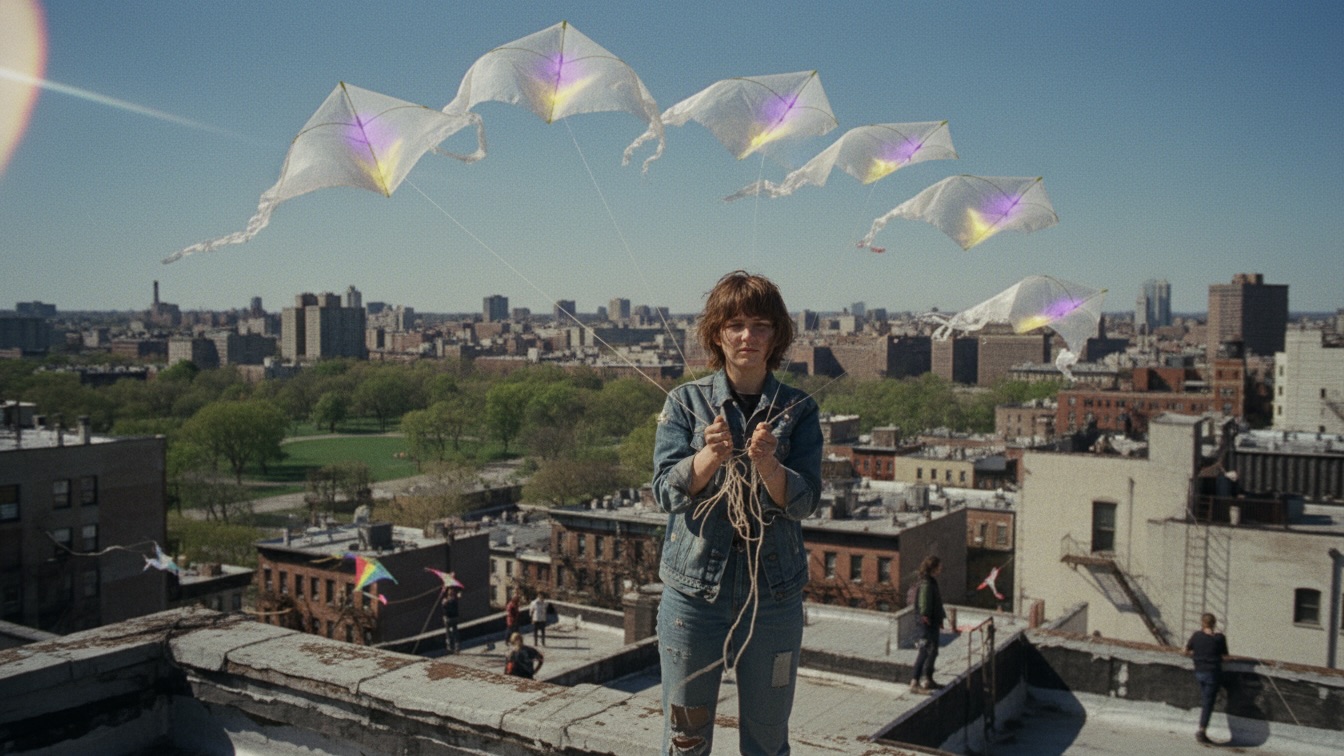
On the day of the festival, Clara and Theo launch the kites from their rooftop, their shifting colors cutting through the sea of drones and AR projections. The neighborhood, noticing the physical beauty of the kites, begins to put down their devices and join in with their own makeshift flyers, creating a low-tech "riot" of color. Clara finds that while her neural-link remains broken, her connection to the world is restored through the simple tension of a string and the steady pull of the wind.
Clara: A former digital artist now living with severe sensory processing issues, Clara begins the story as a shut-in defined by her limitations and fear of the "loud" world. Her psychological arc moves from a state of fractured isolation to one of empowered communication, as she learns to use her "broken" brain to create a new, analog language. By the end, she is no longer a victim of the glitch but a pioneer of a quieter, more intentional way of being.
Theo: A patient, grounded "Analog-Enthusiast" who serves as Clara’s bridge to the outside world, Theo is motivated by genuine empathy rather than pity. He remains a steady, non-judgmental presence, providing the physical tools Clara needs to rediscover her agency without forcing her back into the digital fold. His arc is one of steadfast support, proving that true connection doesn't require a high-speed interface.
Theo enters Clara’s tech-free sanctuary with a bundle of bamboo and silk, breaking her silence with the promise of a "dead hobby" that requires no Wi-Fi. Clara, initially hesitant, touches the real silk and finds a rare moment of sensory peace in its organic texture and lack of electronic frequency. They agree to build seven kites, a number Clara chooses to represent a new, non-verbal vocabulary she intends to broadcast to the city.
In a montage of tactile labor, Theo assembles the frames while Clara uses her fingers to apply light-reactive pigments that only reveal their true colors under direct UV light. The room fills with the scents of linseed oil and woodsmoke, grounding the narrative in a physical reality that contrasts with the digital "static" buzzing in Clara's head. As the sun sets, the seven kites stand like silent sentinels against the wall, ready to carry Clara's voice into the sky the following morning.
On the morning of the festival, Clara and Theo haul the kites to the roof, where the city below is a chaotic mess of drones and AR headsets. As Clara releases the first kite, the sun hits the pigment and a deep purple circle flares to life, signaling her presence to a world she thought she’d lost. The sight of the physical kites triggers a chain reaction as neighbors abandon their screens to launch their own low-tech flyers, creating a "glitch" of pure, human joy in the digital landscape.
The episode moves from a claustrophobic, muted atmosphere of isolation and sensory dread to a soaring, vibrant climax of communal connection. The audience experiences Clara’s internal "static" as a source of high-frequency tension, which gradually resolves into the rhythmic, meditative "hum" of the wind and the physical tug of the kite string. The final emotional state is one of "quiet triumph," where the silence is no longer a prison but a space for genuine connection.
If expanded, the season would follow Clara and Theo as they form an "Analog Underground," helping other "glitched" individuals find alternative ways to exist in a society that demands constant connectivity. They would travel to different sectors of the city, using their kites and other low-tech tools to create "Quiet Zones" where people can disconnect and heal.
The narrative would escalate as the corporation behind the Neural-Links views this low-tech movement as a threat to their data-harvesting ecosystem and social control. This leads to a clash between the "Connected," who rely on the corporate cloud, and the "Glitched," who have found a new kind of freedom in the physical world, culminating in a city-wide choice between digital perfection and analog truth.
The visual style utilizes high-contrast lighting and a shallow depth of field to mimic Clara’s sensory experience, with digital elements appearing as distorted, over-saturated "glitches" that feel invasive. The apartment scenes are shot with warm, amber tones and a grainy texture to emphasize the comfort of the analog world, while the rooftop scenes transition into a bright, "Solar-punk" aesthetic where the colors of the kites are the most vivid elements on screen.
The tone is a blend of "Analog-Futurism" and "Quiet Drama," drawing comparisons to the tactile world-building of Tales from the Loop and the emotional intimacy of Sound of Metal. It prioritizes visual storytelling and environmental sound over dialogue, creating an immersive experience that mirrors the protagonist's non-verbal journey.
This story targets young adults and adults (18-45) who are interested in speculative fiction that explores the intersection of technology and mental health. It appeals to viewers who enjoy "Black Mirror" but seek a more hopeful, human-centric resolution, as well as audiences interested in themes of digital burnout, minimalism, and the "Slow Movement."
The episode follows a three-act structure with a slow, deliberate pace in the first half to establish Clara’s sensory world and the weight of her isolation. The pacing becomes more rhythmic during the kite construction, mimicking the steady work of the hands, before reaching a breathless, visual crescendo during the rooftop launch. The 10-12 minute runtime ensures that the focus remains on the emotional transformation and the striking visual metaphor of the kites.
The "light-reactive" effect on the kites should be achieved through a combination of practical UV-reactive paints and subtle post-production color grading to ensure the transition feels magical yet grounded in physics. The kites themselves must be high-quality practical props made of bamboo and silk to capture the specific "organic thud" and "vibrating line" described in the story.
Sound design is the most critical production element, requiring a sophisticated contrast between the harsh, digital "static" of the city and the clean, low-frequency "thrum" of the wind. The absence of dialogue for the protagonist necessitates a highly expressive performance and a score that utilizes acoustic instruments—like a solo cello or tactile percussion—to represent Clara's internal voice.


