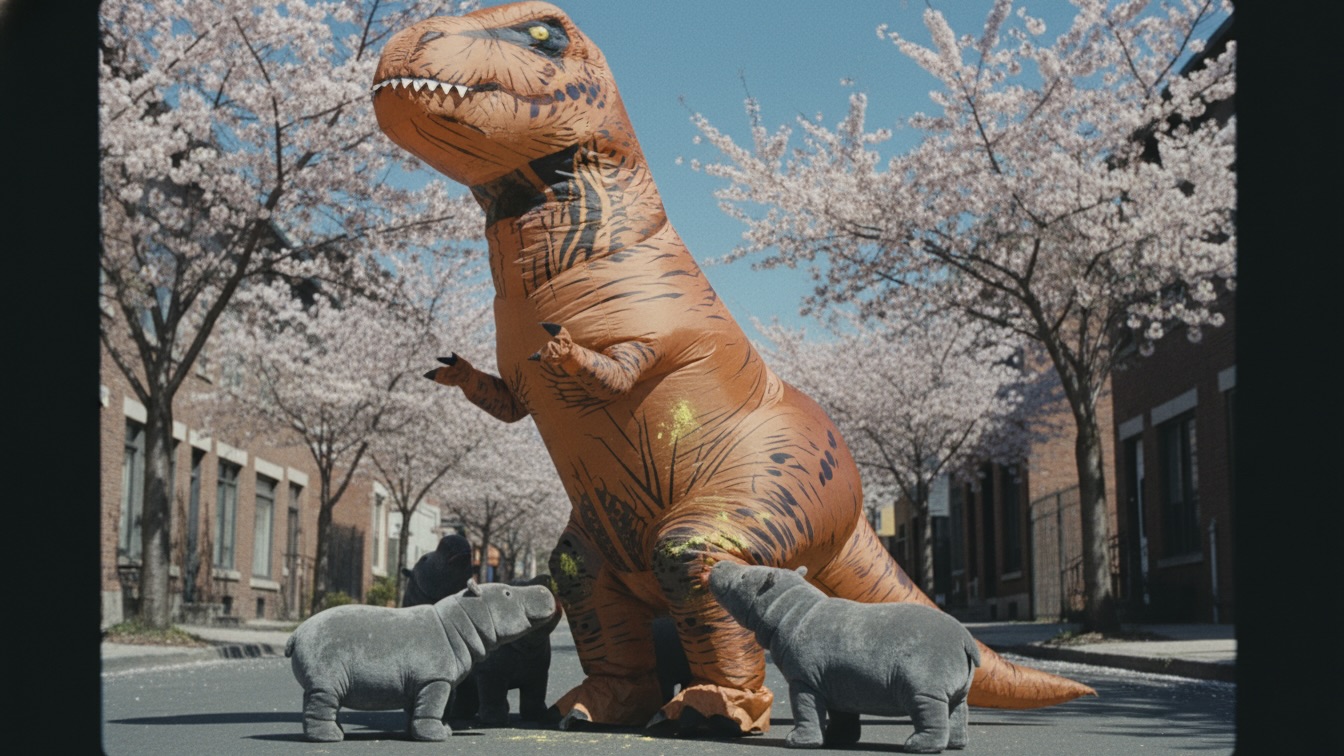
The narrative follows Jay and his friend Wanda as they participate in a surreal and increasingly horrific "Dino-Spring Parade." Initially appearing as a mundane student event involving cheap plastic costumes and bright colors, the atmosphere shifts as Jay realizes his T-Rex suit is physically merging with his body. This transformation is catalyzed by a thick, ubiquitous yellow pollen and a sedative "maple syrup" handed out at checkpoints. While Wanda embraces her metamorphosis into a neon-green Triceratops, Jay watches in terror as the "House Hippos"—supposedly animatronic attractions—evolve into predatory, muscular beasts.
The parade's direction shifts away from the town square toward a long-abandoned tulip garden, which has been transformed into a massive pit of black, car-sized flowers. A monstrous entity known as the Grand Hippo oversees the procession, using its influence to command the marchers. Jay finds himself unable to control his own limbs, which have become heavy and pebbled like dinosaur skin. The story concludes with the mutated participants marching rhythmically into the dark pit, trapped within their own changing bodies as the hippos seal the exit.
The central theme of the story is the terrifying loss of bodily autonomy and the dissolution of the self. Jay’s transition from a person wearing a costume to a creature becoming the costume serves as a visceral metaphor for the loss of identity. He is no longer a man in control of his movements; instead, his muscles are pulled by the "orange skin" and a collective "rhythm." This loss of agency is both physical and psychological, as the characters are coerced into their roles by environmental factors and chemical sedatives.
Another significant theme is the deceptive nature of the "spectacle" and the consumption of the individual by the collective. The parade is marketed as a fun, vibrant event, yet it functions as a biological trap designed to harvest or transform the participants. The bright, neon colors and "high-contrast fever dream" aesthetic mask a predatory reality where the "House Hippos" wait to consume the very people who once found them cute. This suggests a critique of how society can be lulled into dangerous situations by the promise of entertainment and sensory pleasure.
Finally, the story explores the concept of the "Grotesque" through the blurring of lines between the artificial and the biological. The plastic of the suits does not just cover the skin; it becomes a "pigment" and a "second skin" that pulses with veins. The smell of the environment shifts from industrial plastic to a "floral and rotting" scent, indicating a perversion of nature. This fusion of the synthetic and the organic creates a sense of uncanny horror, where the familiar world of a student parade is replaced by a nightmare of biological reconfiguration.
Jay functions as the story’s rational but increasingly desperate anchor, representing the human struggle against inevitable change. From the beginning, he is uncomfortable and observant, noticing the heat and the smell of the plastic, which highlights his lingering connection to reality. His psychological state shifts from mild annoyance to profound existential dread as he realizes he can no longer unzip his suit. This realization marks the point where his internal identity begins to clash violently with his changing external form.
His fear is rooted in the loss of boundaries, both between himself and the suit, and between himself and the environment. He attempts to maintain his humanity by warning Wanda and investigating the "syrup," but his efforts are hindered by his own transforming biology. By the end of the narrative, Jay is a prisoner within his own flesh, experiencing the ultimate horror of being conscious while losing the ability to act. His "permanent, toothy grin" serves as a tragic mask that hides his internal scream of defiance.
Wanda serves as a psychological foil to Jay, representing the seductive and dangerous allure of total surrender. Unlike Jay, she does not resist the transformation; she finds delight in her new, vibrant green skin and the "quiet" brought on by the syrup. Her character suggests a desire to escape the mundane self, as evidenced by her comment about always wanting to be "this bright." This willingness to lose her humanity makes her an agent of the parade's dark purpose, as she encourages Jay to embrace the pollen.
Her descent into a "dreamy sigh" and a rhythmic sway indicates a complete psychological break from her former identity. She no longer views the suit as a garment but as her true self, stating, "The suit is me." This total identification with the monster highlights the power of the collective rhythm to erase individual consciousness. Wanda’s transformation is not just physical but spiritual, as she becomes a herald for the very force that is leading them to their doom in the tulip pit.
The author employs a sensory-heavy narrative style that effectively mirrors the protagonist's disorientation and rising panic. Descriptions of the "neon-orange" and "highlighter" colors create a visual landscape that feels artificial and overwhelming, almost like a "fever dream." The tactile details, such as the "thick yellow pollen" that sticks to everything and the "sizzling" of the plastic, ground the surreal events in a visceral reality. These sensory cues transition from the mundane to the macabre, guiding the reader through the story's tonal shift.
Pacing is handled through a slow, rhythmic buildup that mimics the "biological clockwork" of the parade itself. The story begins with the internal discomfort of a hot suit and gradually escalates to the appearance of the "Grand Hippo" and the black tulips. This steady progression creates a sense of inevitability, making the final march into the pit feel like a foregone conclusion. The use of short, punchy sentences during moments of realization, such as "I’m green," contrasts with the more descriptive passages to emphasize the characters' psychological states.
The narrative voice is deeply subjective, filtered through Jay’s increasingly frantic perspective. This allows the reader to experience the horror of the "House Hippos" mutating from "bread-loaf-sized" creatures into muscular predators in real-time. The use of clinical and industrial metaphors—like "hospital corridors" and "old pennies"—to describe organic smells and tastes enhances the theme of the Grotesque. Ultimately, the style succeeds in making a patently absurd situation feel deeply claustrophobic and terrifyingly plausible within its own internal logic.


