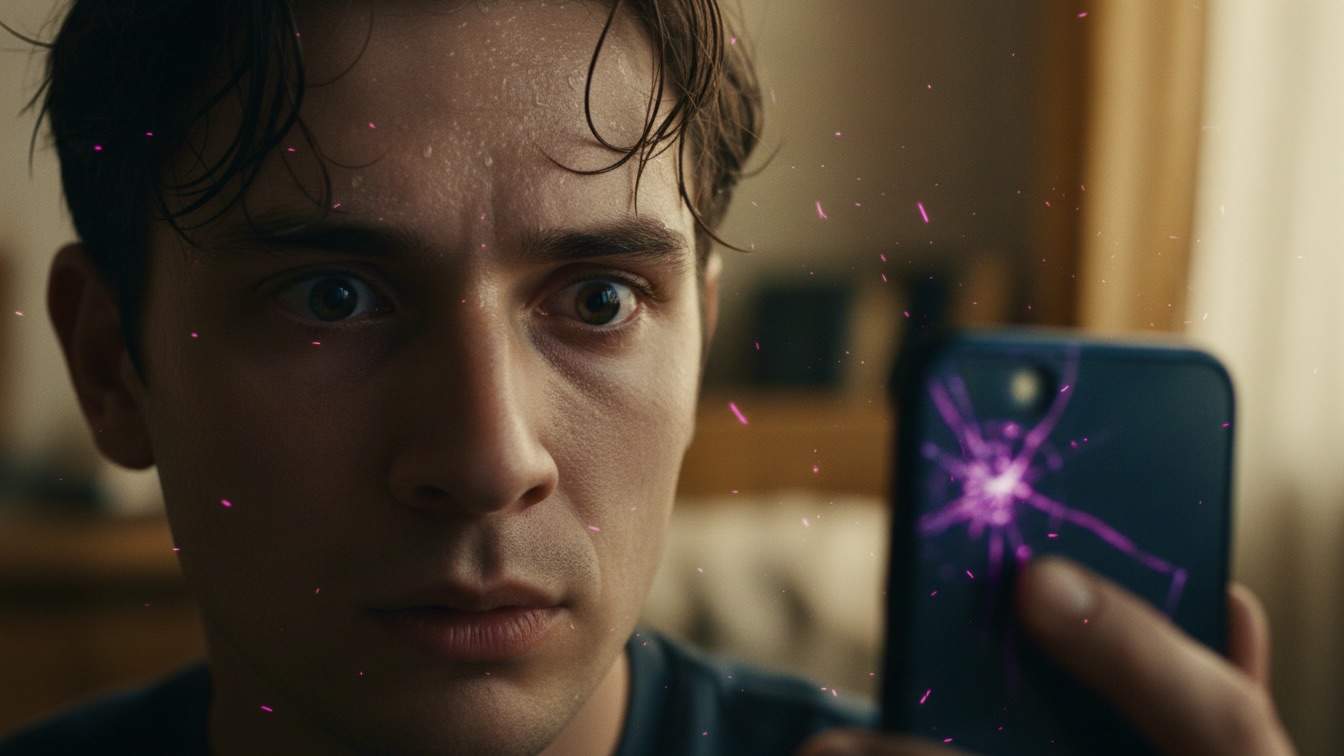
The narrative opens in a cramped, oppressive apartment where the protagonist, Leo, is struggling with the sensory overload of his environment and the presence of his brother, Toby. The world outside is blanketed in a toxic "Pink Dust" marketed as ecological restoration, which serves as a constant reminder of the government's intrusive and deceptive control. Leo’s anxiety reaches a breaking point when his Bio-Pinger app, a tool used by the state to monitor social and biological worth, issues a terminal deficit notice. This notification signifies that Leo has been deemed inefficient and is scheduled for "recycling," a euphemism for state-sanctioned death.
As the reality of the situation sets in, the tension between the siblings erupts into a cold, transactional confrontation. Toby reveals that he has systematically manipulated their shared household metrics to ensure his own survival, effectively stealing Leo’s credits to secure a "High-Value" status for himself. He justifies this betrayal with the cold logic of the state, viewing Leo as a weak link and a drain on resources. The chapter concludes with Toby locking Leo inside the apartment to await the collection team, leaving Leo to contemplate his imminent demise amidst the clicking of the radiator and the pervasive pink dust.
One of the most prominent themes in the text is the dehumanization of the individual through technological and bureaucratic metrics. The Bio-Pinger app transforms the complexity of human life into a series of "social contribution metrics," where a person's right to exist is contingent upon their perceived efficiency. This creates a world where empathy is a liability and survival is a mathematical equation. Leo’s lungs are no longer seen as vital organs for his own life, but as "assets" that can be harvested and redistributed to more "efficient" citizens.
The story also explores the corruption of the natural world and the irony of "Ecological Restoration." The Pink Dust, which should symbolize life and growth, is instead a toxic, copper-smelling film that heralds death and decay. This environmental decay mirrors the moral decay of the society, where even the air one breathes is a tool for state monitoring and culling. The "Bloom" is not a time of rebirth but a period of "recycling," suggesting that in this dystopia, nature has been fully co-opted by a predatory government.
Furthermore, the narrative delves into the dark side of Social Darwinism and the erosion of familial bonds. Toby’s betrayal is the ultimate expression of a "survival of the fittest" mentality, where he views his own brother as a competitor for limited resources rather than a loved one. He adopts the language of the oppressor, using terms like "optimization" and "discrepancy" to distance himself from the horror of his actions. This suggests that under extreme systemic pressure, the most intimate human connections are the first to be sacrificed for the sake of self-preservation.
Leo is a man defined by his acute sensitivity and his growing sense of obsolescence in a world that demands constant productivity. He is physically and emotionally fragile, evidenced by his "sand-like" voice and his inability to cope with the sensory irritants of his environment. His focus on the moth beating against the light reflects his own futile struggle against a system that is designed to consume him. He possesses a poetic, albeit morbid, perspective, noticing the beauty in the dust even as it signifies his end.
Psychologically, Leo is paralyzed by a combination of chronic illness and systemic gaslighting. He has tried to follow the rules by working at the filtration plant and taking his suppressants, yet he still finds himself discarded by the algorithm. His reaction to Toby’s betrayal is one of profound shock followed by a quiet, cynical realization of his own powerlessness. By the end of the chapter, he has transitioned from a state of frantic anxiety to a strange, hysterical acceptance of his fate, acknowledging the absurdity of human concerns in the face of death.
Toby is the psychological foil to Leo, representing a man who has fully adapted to the predatory logic of his society. He is cold, calculating, and seemingly devoid of traditional empathy, viewing his environment and his brother through a lens of utility. His "calculated kind of tired" suggests that even his emotions are performed to manipulate those around him. He does not see himself as a villain, but as a pragmatist who has "secured the future" by eliminating a weak link in his family unit.
His cruelty is expressed through a clinical detachment that is more chilling than outright rage. When he tells Leo that he was "always halfway there," he is reinforcing the state’s message that Leo’s life had no intrinsic value. Toby’s smirk as he checks his watch highlights his eagerness for the "collection team" to arrive, showing that he has completely detached himself from his brother's humanity. He is a man who has traded his soul for a green screen, finding comfort in the digital approval of a murderous system.
The narrative employs a claustrophobic and visceral tone that effectively mirrors the protagonist's internal state. The use of sensory details—the metallic clicking of the radiator, the smell of wet copper, and the "sour milk" scent of Toby—creates a sense of physical revulsion. These details ground the dystopian elements in a gritty, tangible reality, making the abstract concept of "recycling" feel like an imminent physical threat. The pacing is masterful, beginning with a slow, grinding irritation that rapidly accelerates into a sharp, jagged panic once the phone vibrates.
The author uses color symbolism to great effect, particularly the contrast between the "mocking green" of Toby’s phone and the "bruised purple" of Leo’s terminal status. The pink dust itself acts as a recurring motif that links the environment to the theme of death, coating everything in a "rosy film" that is both beautiful and lethal. This juxtaposition of beauty and horror is a hallmark of the story’s style, forcing the reader to find the "poetry" in Leo’s destruction alongside him.
The narrative voice is intimate and weary, providing a first-person perspective that heightens the sense of betrayal. By keeping the focus on the small, four-hundred-square-foot apartment, the author creates a pressure cooker environment where every sound and movement is magnified. The dialogue is sharp and sparse, particularly Toby’s corrections of Leo’s language, which emphasize the linguistic shift from human life to "assets." This stylistic choice underscores the theme of dehumanization, as even the way the characters speak to each other has been colonized by the logic of the system.


