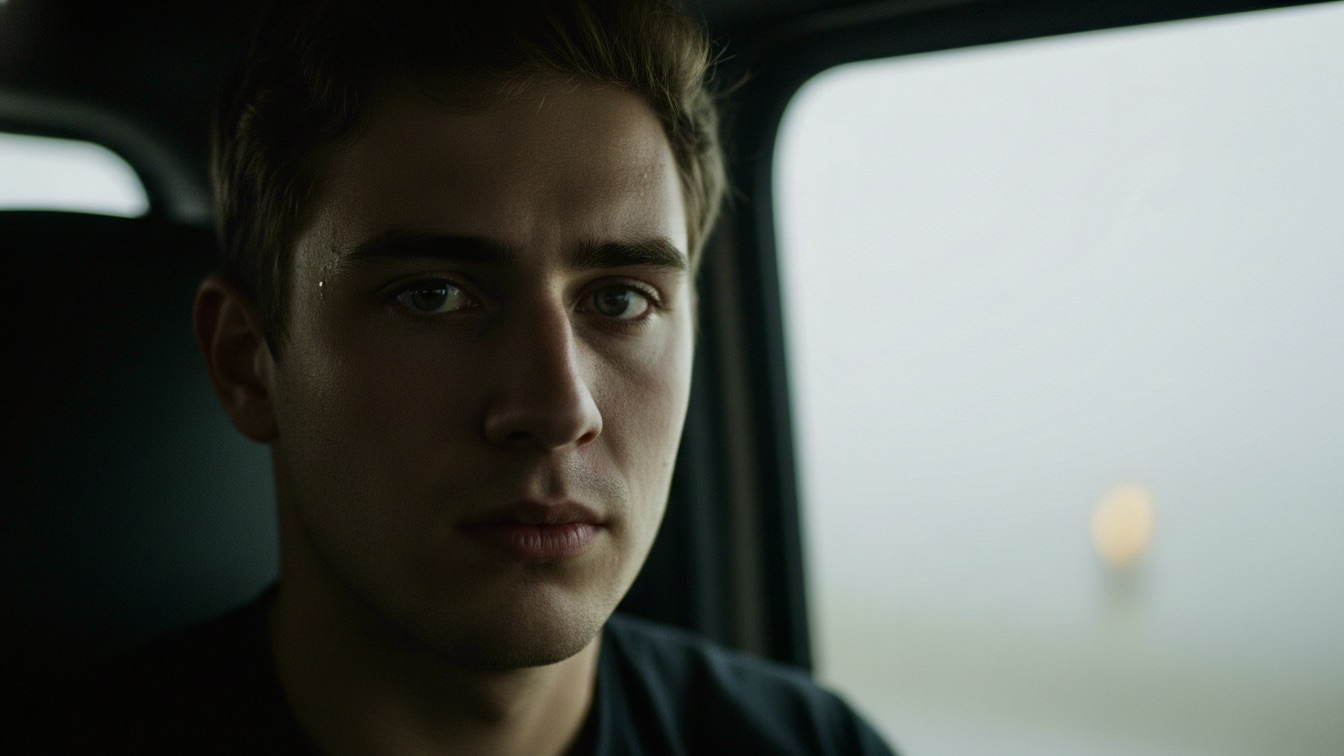
Dylan fights a blinding mountain fog at three in the morning, nearly losing everything on a sharp, dangerous turn.
The clock on the dashboard said 3:02 AM. It was a bright green color, the kind that hurts your eyes when everything else is black. My truck, Old Blue, smelled like stale coffee and the dirt from a hundred flower pots. I was hauling 'Dylan’s Dash'—that is what I call my business. It is just me and this truck. I had four hundred baby apple trees in the back, all tucked into their plastic sleeves, waiting to get to the valley before the sun got too hot. The radio was making a fuzzy noise. Then a lady with a voice like a robot came on.
"Heavy fog warning for the pass," she said. "Visibility near zero. Drivers are advised to stay off the roads until dawn."
I looked out at the stars. They were big and sharp, like someone had poked holes in a black blanket. "Yeah, okay," I muttered. I tapped the steering wheel. My fingers were cold. "Sure thing, robot lady. You do not have a delivery deadline. I do."
I liked the mountain at night. It felt like I was the only person left in the world. The trees were giant shadows, and the road was a gray ribbon that Old Blue followed without even trying. I felt smart. I felt like I knew a secret that everyone else was sleeping through. I had lived in the same town my whole life. I went to the same school my dad went to. I even worked at the same grocery store for three years before I bought this truck. People said I was 'reliable.' Reliable is just a nice word for boring. It means you never take a turn that might be bumpy. But tonight, I was a mountain driver. I was a businessman. I was fast.
Then the world disappeared.
It did not happen slowly. It was not like the fog I saw at the park sometimes, the kind that hangs over the grass like a thin ghost. This was different. I rounded a sharp corner, the one they call the Devil’s Elbow, and it was like I drove straight into a giant bowl of milk. The stars were gone. The trees were gone. Even the hood of my truck looked fuzzy and far away.
"Whoa," I said. My voice sounded flat in the small cab. I hit the brakes. Not hard, but enough to feel the weight of the apple trees shift in the back. Thump-thump.
I leaned forward until my nose almost touched the glass. I turned on the high beams. Bad move. The light just hit the white wall and bounced back into my eyes. It was like someone was holding a flashlight against a white sheet right in front of my face. I turned them back to low. It did not help much. I could see maybe two feet of gray asphalt. Beyond that, there was nothing. No lines. No signs. Just white.
My heart started to do this weird thing. It felt like a little bird was trapped inside my ribs, beating its wings against the bone. Flap, flap, flap. My jaw felt tight, like I had been chewing on a rock. I gripped the wheel so hard my knuckles looked like white marbles.
"Okay," I whispered. "Just stay in the lines. Just find the lines."
I crawled forward. Five miles per hour. Three. I was holding my breath. My foot was hovering over the brake pedal, trembling. The world was so quiet. Usually, Old Blue makes a lot of noise—rattles and hums—but the fog seemed to soak up all the sound. It was like the mountain had gone deaf.
Suddenly, a flash of brown.
It was right there. A deer. It was standing in the middle of the road, its eyes reflecting the yellow of my headlights like two gold coins. It did not move. It just stared at me, frozen in the milk.
"Move!" I yelled.
I slammed on the brakes. My foot hit the floor. The truck groaned. The tires screamed as they lost their grip on the wet road. I felt the back end of the truck swing out to the right. It was a slow-motion slide. I turned the wheel into the skid, just like my dad taught me, but it felt like I was steering a boat through mud.
Crr-ack!
The side of the truck clipped a branch. I felt the vibration go all the way up my arms. The truck kept spinning. I shut my eyes for a second. I thought about the ravine. I knew it was there, just past the shoulder. A drop that went down forever into the pine trees.
The truck stopped with a bone-jarring jolt.
Silence.
I opened my eyes. I could see nothing. The engine had stalled. The headlights were still on, but they were just dim yellow blurs in the soup. I reached out and touched the door handle. My hand was shaking so much I could barely grab it. I pushed the door open a crack. Cold, wet air rushed in. It smelled like wet rocks and old ice.
I looked down.
The front left tire was inches from the edge. Not a foot. Not a yard. Inches. Below it, there was only white mist. I could hear a small pebble roll off the edge. It took a long time to hit the bottom.
I pulled the door shut and locked it. I did not know why I locked it. It was not like the fog was going to try to get in. But I felt small. I felt like a little kid who had wandered into the deep end of the pool. I leaned my head against the steering wheel.
"I can't do this," I said. I was talking to the dashboard. "I'm just a kid from the grocery store. I shouldn't be here. This was a bad idea. Starting a business is for people who aren't scared. I'm scared."
I thought about all the safe turns I had taken. I stayed in my bedroom instead of going to the big bonfire parties. I took the job that paid less because I knew the boss wouldn't yell at me. I was the king of safe. And now, the one time I tried to be brave, the mountain was going to swallow me whole.
My breath was coming in short, shallow puffs. It felt like there wasn't enough air in the truck. I tried to roll down the window, but my fingers wouldn't work right. They felt like sausages. I felt a tear run down my nose. It was hot, and then it got cold fast.
"You're cooked, Dylan," I whispered. "You're absolutely cooked."
I sat there for what felt like hours. It might have been five minutes. The fog didn't move. It didn't lift. It just sat there, heavy and wet, pressing against the glass. I looked at the little plastic photo I had taped to the dash. It was a picture of the first apple tree I ever grew from a seed. It was just a twig then, with two tiny green leaves. I remember thinking how tough that little thing was. It had pushed through the dirt and the cold to find the sun.
It didn't have a choice. It just grew.
I took a deep breath. I forced my jaw to relax. It hurt. My teeth felt sore from clenching them. I reached out and turned the key.
Old Blue coughed. She sputtered. She didn't want to wake up.
"Come on, girl," I said. "Don't do this to me. We have trees to deliver. People are waiting for their spring. You can't let them down."
I turned the key again. The engine roared to life, a loud, beautiful sound that broke the silence. I shifted into reverse. I moved the truck back, inch by inch, away from the edge of the ravine. I could feel the gravel crunching under the tires. It was the best sound I had ever heard.
Once I was back in the middle of the road, I stopped. I looked out into the white. I couldn't see the road, but I knew what was there. Every few yards, the highway department had put up yellow reflector poles. They were skinny and ugly, but they were tall.
I looked for the first one. There. A faint, golden glimmer in the mist. It was like a tiny lighthouse.
"Okay," I said. "Just one pole. That's all I need. Just the next one."
I put the truck in gear. I didn't look at the road anymore. I didn't look at the ravine. I just looked for the yellow. I found the first pole and crawled past it. Then I looked for the next one. It was hard to see. I had to squint until my eyes ached. But there it was. Another glint of gold.
I realized that life wasn't about seeing the whole road. It was just about seeing the next yellow pole. If I could do that, I wouldn't fall off the mountain. I wouldn't be 'safe' Dylan anymore. I would be the guy who made it through the fog.
I started to hum a song. It was a silly song from a cartoon I liked when I was six. It made the truck feel less lonely. The fog was still there, thick and scary, but it didn't feel like a wall anymore. It felt like a challenge.
"I'm coming for you, valley," I said.
I passed the third pole. The fourth. The fifth. My hands weren't shaking as much. I felt a weird kind of heat in my chest, a good heat. It was the feeling of not giving up. It was better than being safe. It was better than anything.
I kept driving, slow and steady, guided by the tiny yellow lights that pierced the dark. The trees in the back rustled as I took a curve. They were waiting for the sun, and so was I. I knew the morning was coming. I just had to keep moving until I found it.
I leaned into the wheel, my eyes locked on the white void, waiting for that next flash of gold. The mountain was big, but I was the one with the keys. I was the one moving. And for the first time in my life, I didn't want to be anywhere else.
The road began to dip. The fog felt thinner, like it was being stretched out. I could see the faint outline of a pine tree. Then another. I was doing it. I was really doing it. I gripped the wheel, not out of fear, but out of a new kind of strength. I was Dylan, and I was a driver.
But as I rounded the final bend of the pass, the yellow poles suddenly stopped.
“The first yellow pole appeared, but behind it, the road seemed to simply drop into nothing.”


