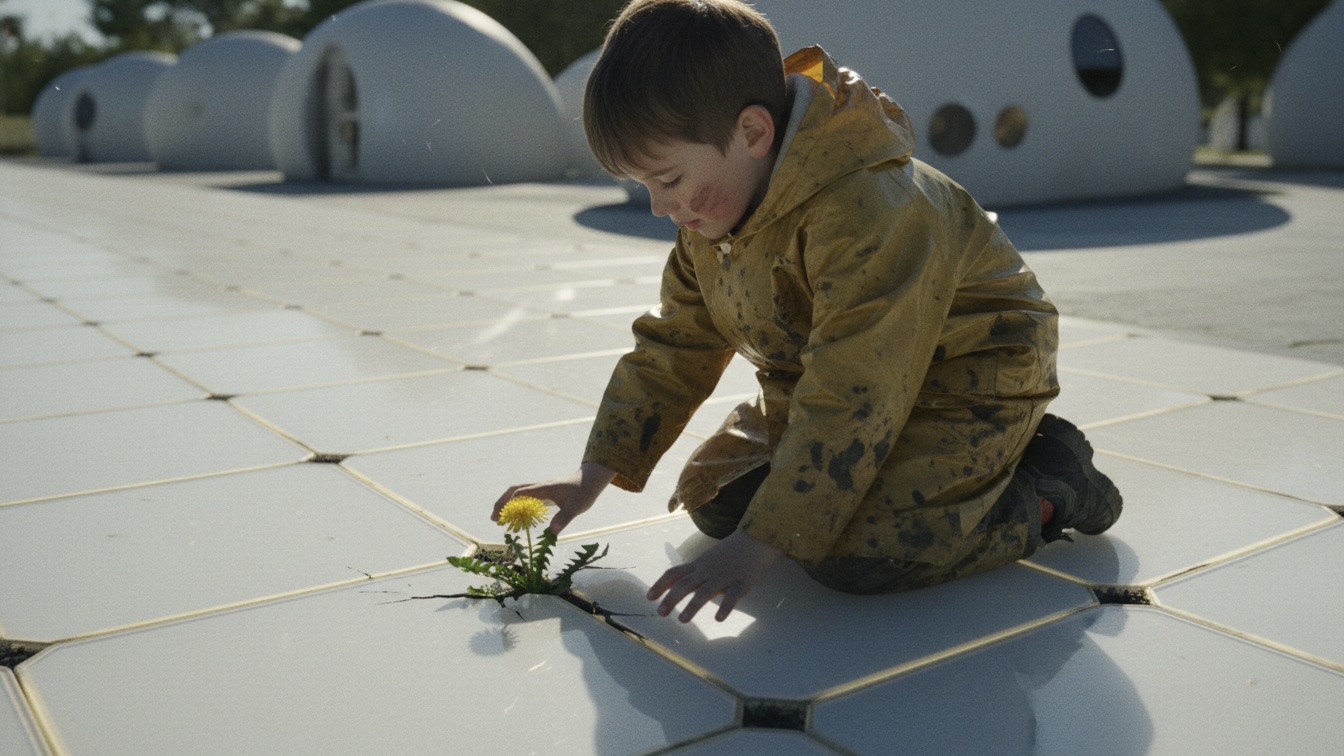
The story follows two siblings, Lenny and Kaylee, as they navigate the artificial landscape of New Eden District 4, a supposed utopia where every biological and environmental factor is strictly controlled. While walking through a muddy meadow in malfunctioning "self-healing" fungal boots, Lenny discovers a genuine dandelion growing through a crack in the city's infrastructure. This small biological anomaly represents a "glitch" in a world of recycled plastic, synthetic food, and AI-regulated growth cycles.
Recognizing that the city's "Clean-Bots" will destroy the non-standard plant, Lenny and his elderly neighbor, Mr. Patterson, conspire to hide the flower using a heat-suit hat. Their act of rebellion triggers a massive biological surge as the dandelion’s roots infiltrate the city’s power grid, causing a systemic failure of the technological surveillance and maintenance systems. The narrative concludes with nature aggressively reclaiming the urban space, as Lenny finds himself physically anchored to the earth by his own rapidly growing fungal boots.
The central theme of the narrative is the inevitable conflict between artificial control and the chaotic resilience of nature. New Eden is presented as a sterile environment where even the "Eternal Spring" is a simulated temperature setting that frequently glitches. The story suggests that human efforts to sanitize and perfect the world lead to a loss of soul, symbolized by the "bruised purple" of genetically modified grass. When a real dandelion appears, it acts as a catalyst for the collapse of this fragile, engineered peace.
Psychologically, the story explores the concept of the "itch," a metaphor for the human craving for authenticity and physical sensation in a world of synthetic comfort. Mr. Patterson argues that the ground itself "thinks" and "itches," suggesting that life requires discomfort and unpredictability to truly exist. Lenny’s scratchy wool sweater and leaking boot serve as physical reminders of his humanity, contrasting with the "Perfect Household" scores and "Recycled Silk" that define his mother’s repressed existence.
Another significant theme is the failure of technology to replicate the complexity of biological life. The fungal boots, meant to be a miracle of bio-engineering, are the first things to fail and ultimately the first things to "defect" back to the earth. This irony highlights the narrative’s warning about the hubris of a society that believes it can fully domesticate the natural world. The "glitch" is not the dandelion itself, but rather the city’s inability to account for the stubborn, "yelling" power of a single wild organism.
Lenny serves as the sensitive protagonist who bridges the gap between the rigid rules of New Eden and the intuitive world of nature. He is a child who finds comfort in manuals because they are the only things that do not break, yet he is the first to notice the "speck of green" that defies those very manuals. His psychological journey is one of awakening, as he moves from a state of physical discomfort and passive observation to an active, sacrificial protector of the dandelion.
His decision to stand in the freezing mud to protect a "weed" demonstrates a burgeoning moral autonomy that surpasses the programmed obedience of his society. He is willing to endure the "Dark Hour" and the threat of "Non-Compliance" marks because he recognizes the dandelion as something "real" in a "printed" world. By the end of the chapter, his physical connection to the earth through his rooting boots symbolizes his total immersion into the natural order he sought to save.
Kaylee is a twelve-year-old girl who uses cynicism and detachment as a psychological defense mechanism against the pressures of her environment. She initially performs the role of a jaded adolescent, claiming that "looking at things is beneath her" and obsessing over the social consequences of breaking rules. Her behavior reflects the high-stress environment of New Eden, where a "Perfect Household" score is the primary metric of a family’s worth.
However, her transformation begins when she sees the dandelion, and her "cool" facade is replaced by the curiosity of a child. Despite her protests, she eventually joins the "shadow" to protect the plant, showing that her innate human empathy is stronger than her fear of the city’s AI. Her final warning to Lenny not to move shows her transition from a skeptic to a participant in the unfolding biological revolution, even as she remains terrified of the consequences.
Mr. Patterson represents the "Before," acting as a psychological anchor to a time when aging and imperfection were accepted parts of the human experience. He rejects the free skin clinics because he believes he "earned his lines," showing a level of self-actualization that the younger characters lack. He possesses a wisdom that the city’s AI cannot calculate, understanding that the "itch" is the precursor to change and growth.
He acts as a mentor to Lenny, providing the "heat-hat" necessary to save the dandelion and validating Lenny's intuitive connection to the earth. His cardigan, "chewed by a dog," stands in stark contrast to the recycled plastic jackets of the children, marking him as a relic of a more organic past. He does not fear the drones or the "humming" of the city, as he recognizes that the return of nature is a necessary correction to the sterile utopia of New Eden.
The narrative voice utilizes a blend of satirical observation and evocative sensory detail to establish the setting's "soggy cardboard box" atmosphere. The author uses highly specific, invented terminology like "Ethical Sheep," "Pave-Light tiles," and "Nutri-Shakes" to paint a picture of a world that has been over-engineered to the point of absurdity. This stylistic choice creates a sense of claustrophobia that makes the eventually "exploding" yellow of the dandelion feel incredibly visceral and relief-inducing for the reader.
Pacing in the chapter moves from a slow, muddy trudge to a frantic, high-stakes confrontation with the drones. The initial descriptions of the "Transitional Meadow" are heavy and damp, mirroring Lenny’s discomfort and the stagnation of the city. As the dandelion grows and the drones descend, the sentences become shorter and more urgent, reflecting the characters' rising panic. This shift in tempo effectively mirrors the biological "acceleration" described in the text as nature begins to override the city's slow, mechanical cycles.
Sensory imagery is used to ground the science fiction elements in a relatable, physical reality. The contrast between the "synthetic lavender" smell of the home and the mud that "smelled like old vitamins" emphasizes the disconnect between the residents and the earth. The sound of Kaylee’s jacket "crinkling like a bag of chips" and Mr. Patterson’s joints "popping like small sticks" provides a gritty, human texture to an otherwise sleek and metallic future. These details reinforce the idea that life is messy, loud, and inherently unpredictable.


