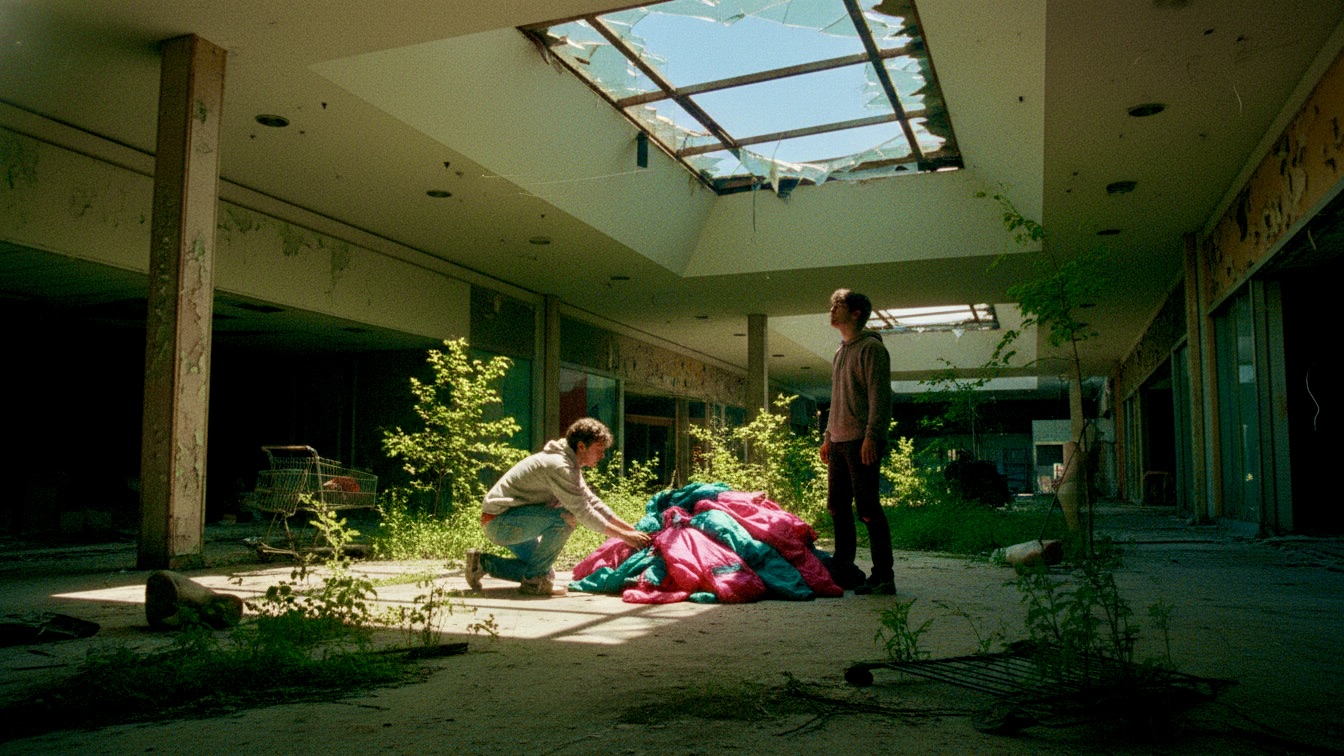
The story follows Len and Toby, two struggling tailors living in a decaying, post-collapse city where physical currency in the form of bottle caps dictates survival. Faced with an impossible rent payment and the threat of eviction by a local landlord named Grist, the duo embarks on a dangerous expedition to a scavenged mall known as the Starlight Galleria. After navigating a treacherous landscape and descending into a hidden sub-basement, they discover a pristine cache of neon-colored, pre-collapse athletic wear. Recognizing the cultural and psychological value of this "dead stock," Len pivots from a simple trade to a high-stakes negotiation with a local warlord, King Riff. By offering the warlord the exclusive right to be styled in these vivid garments, Len secures a new, fortified workshop and protection for himself and Toby, effectively trading aesthetic power for physical security.
The narrative explores the intersection of survival and symbolism in a world stripped of traditional utility. While the characters begin the story fixated on the literal value of bottle caps, they quickly discover that power in their broken society is derived from perception and status. The neon windbreakers function as a form of currency that transcends the hunger-driven desperation of the market, offering a way to command respect through visual dominance.
This theme of transformation through appearance highlights the fragility of the social order. By outfitting the warlord’s guards in bright, clashing colors, Len turns the chaos of the wasteland into a performance of authority. The story suggests that even in a decaying world, the human need for identity and hierarchy remains a potent force. The shift from trading scrap metal to curating a royal wardrobe represents the characters' evolution from passive scavengers to active architects of their own environment.
The tension between the encroaching natural world and the artificiality of human constructs is another central pillar. The relentless, "vicious" sun and the aggressive growth of dandelions serve as a constant reminder that nature is reclaiming the city. Yet, by securing the dealership and the neon stock, Len and Toby attempt to insulate themselves within a bubble of human-made order. This creates a poignant contrast between the vibrant, synthetic fabrics and the gray, crumbling reality that persists just outside their glass walls.
Len serves as the pragmatist of the duo, though he is clearly haunted by the crushing weight of his circumstances. His physical reactions—the popping of his knees, the tightening of his chest during panic attacks, and his raw, chewed fingernails—reveal a man pushed to the brink of physiological collapse. He operates with a high degree of survivalist intelligence, shifting rapidly into "logistics mode" when he realizes the true value of the discovered cache.
His internal conflict stems from a desperate need for control in an environment that offers none. By the end of the chapter, his transformation from a terrified, starving tailor into a calculated negotiator reveals an underlying ruthlessness. He understands that to survive, he must appeal to the vanity of those in power rather than merely offering labor. Len is not just seeking safety; he is seeking a way to impose his own vision of order onto a chaotic world.
Toby acts as the impulsive catalyst for the narrative, driven by a manic energy that often terrifies his partner. He is the one who scouts the market, listens to the rumors of the runner, and possesses the daring required to suggest robbing the Starlight Galleria. His exhaustion is frequently eclipsed by his desire for change, making him the necessary risk-taker in their partnership.
While he often relies on Len to structure his wild ideas, Toby possesses a natural, smooth charisma that helps them survive their encounter with King Riff. He is clearly the more adaptable of the two, willing to lie or improvise when the situation demands it. Despite his bravado, his fear remains palpable, grounding him as a human being who is equally terrified of the warlord’s cruelty as he is of their impending poverty.
The narrative voice is sharp, visceral, and lean, mirroring the harsh reality of the world the characters inhabit. The author utilizes sensory details—the smell of diesel, the screech of mattress springs, and the "slick, cool" texture of the neon nylon—to ground the reader in the immediate physical environment. This focus on tactile and olfactory sensations reinforces the desperation of the setting, making the rare moments of discovery feel like a genuine disruption of the status quo.
The pacing is deliberately tight, mirroring the mounting pressure of the rent deadline and the danger of the scavenge. The transition from the claustrophobic, dirt-filled apartment to the cavernous, cathedral-like silence of the mall creates a rhythmic shift that builds anticipation. By keeping the dialogue sparse and the descriptions punchy, the narrative maintains a sense of urgency that prevents the story from stalling, even during moments of reflection.
The tone is one of guarded cynicism, yet it manages to capture a glimmer of hope through the lens of aesthetic vanity. The author employs metaphor effectively, such as describing the mall as a "massive, sprawling corpse" or the neon jacket as an "alien artifact." These stylistic choices elevate the story beyond a simple survival tale, framing the act of tailoring as a small, defiant rebellion against the slow decay of civilization.


