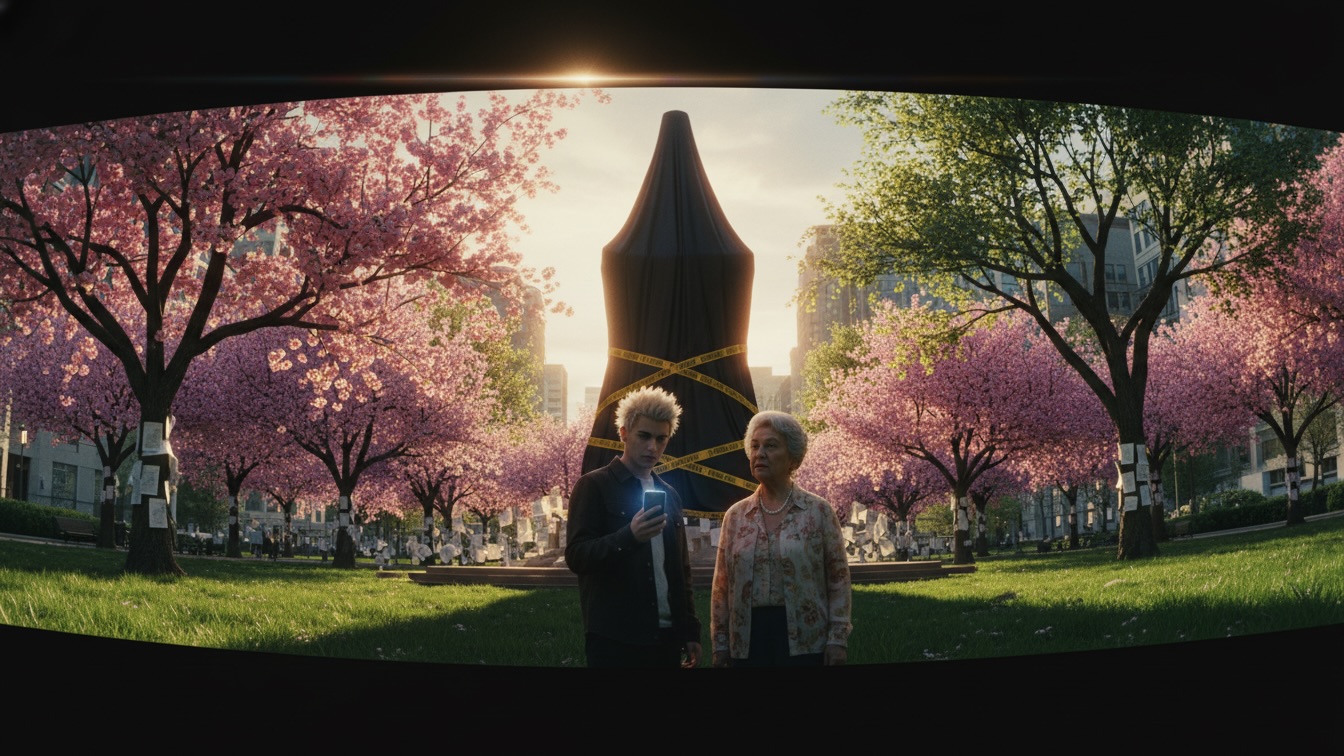
The story follows Ruth, an elderly woman who visits her local park on an uncomfortably hot April day, only to find her usual environment transformed into a site of political and historical protest. Her grandson, Jake, along with a group of his peers, has cordoned off a statue of the town’s founder with yellow caution tape and draped it in black cloth, claiming to be "auditing" the space’s history. The tension between the generations is initially palpable, as Ruth views their actions through the lens of physical reality while Jake speaks in metaphors of digital data and firmware updates.
The arrival of Officer Sampson threatens to end the protest, but Jake successfully uses his phone to livestream the encounter, leveraging the power of social media to freeze the officer in his tracks. Following this confrontation, Ruth discovers that Jake has physically cut pages out of her library book on local history to display them on the park's trees. Rather than reacting with anger, Ruth steps into the center of the protest and provides the oral history that the teenagers lack, recounting a violent 1934 labor strike. The chapter concludes with a sense of reconciliation and shared purpose as Ruth agrees to help the youth continue their work into the night.
The central theme of the narrative is the tension between different modes of historical preservation and the reconciliation of generational perspectives. Ruth represents the physical, lived experience of history, characterized by the weight of books, the smell of sandwiches, and the literal pain in her joints. Jake and his friends represent a digital-native approach, where history is "data" that needs to be "open-sourced" and "updated." The story suggests that while the younger generation has the tools to broadcast the truth, they require the foundational, visceral memories of the older generation to give their activism substance and depth.
Another significant theme is the concept of the "audit" as a form of social justice. By framing the park as an "under-performing asset" in the "truth department," the narrative explores how the younger generation perceives the physical world through the lens of digital systems. They see the gaps in the official narrative as "bugs" or "bad code" that must be corrected. This metaphor highlights a shift in how society views authority and public spaces, moving from passive acceptance of monuments to an active, critical interrogation of what those monuments represent and what they omit.
The story also examines the power of visibility and the shifting nature of authority. Officer Sampson, who represents traditional law and order, finds himself powerless not against physical force, but against the "shield" of a smartphone screen. The narrative illustrates how the "main character energy" of the digital age can be used as a tool for accountability. However, the story ultimately posits that true visibility comes not just from a livestream, but from the act of storytelling. Ruth’s speech transforms the performative "content" of the protest into a profound, shared human experience that commands the attention of the entire park.
Ruth is a woman defined by her resilience and her deep connection to the physical world. Her character is introduced through her sensory experiences—the itch of her collar and the "metallic pop" of her hip—establishing her as an individual who is intimately aware of the toll of time. Psychologically, she possesses a grounded pragmatism that allows her to navigate the radical actions of her grandson without the typical reactionary anger of her peers. She understands that yelling is a sign of lost control, choosing instead to use the "old-world" power of food and presence to maintain her influence.
As the narrative progresses, Ruth undergoes a transition from a passive observer of history to an active participant. Her initial grief over the "surgically removed" pages of her library book reflects her reverence for the sanctity of the written word and the completeness of stories. However, her decision to speak to the crowd demonstrates a psychological shift; she realizes that the "weight" of the book is less important than the dissemination of its contents. By the end of the chapter, she has found a new sense of purpose, trading her role as a solitary reader for that of a communal witness.
Jake is a complex figure who embodies the "thousand-year-old exhaustion" of a generation born into an era of information overload. He navigates the world through a layer of irony and digital terminology, using words like "vibe," "firmware," and "aesthetic correction" to distance himself from the emotional weight of his activism. This psychological defense mechanism suggests a young man who feels the burden of the world's problems but feels he can only address them through the detached medium of a screen. His shaking fingers after the confrontation with Sampson reveal that his "cool and detached" persona is a mask for significant internal anxiety.
Despite his reliance on digital shields, Jake’s actions reveal a desperate hunger for authentic connection to the past. His decision to "stole" the history from Ruth's book and pin it to trees is a violent but sincere attempt to make the abstract tangible. He seeks to bridge the gap between the "digital reality" he inhabits and the "physical space" he stands in. When he asks Ruth to help him paint the names of the strikers, he is acknowledging that his "audit" is incomplete without her lived wisdom, showing a growth in his character from a performative activist to a collaborative historian.
Officer Sampson serves as the personification of the "legacy system" that Jake seeks to update. He is a man who finds comfort in the rigidity of his uniform and the simplicity of following rules, largely because the psychological labor of "thinking for himself" is too taxing. He is not depicted as a malicious villain, but rather as a man caught between two eras. He relies on the traditional authority of his badge, yet he is acutely aware of his vulnerability in the face of modern technology.
The officer’s paralysis when confronted by Jake’s phone screen highlights a profound loss of agency. He is terrified of becoming a "meme," a fear that reflects the modern reality where public perception can be more damaging than physical consequences. His retreat to his truck represents the failure of the old ways of maintaining "peace" through silence. By the end of the scene, his role has shifted from an enforcer to a reluctant listener, as he sits in his truck with the window down, forced to absorb the history he was previously tasked with suppressing.
The narrative voice of the story is characterized by a sharp, observant tone that blends the sensory details of the physical world with the clinical language of the digital age. The author uses vivid metaphors, such as the "wet wool blanket" of the heat and the "mourning thumb" of the draped statue, to create a sense of atmospheric oppression. These descriptions contrast effectively with the "tech-wear" and "lithium battery" aesthetic of the younger characters. This stylistic choice mirrors the thematic conflict between the old and the new, creating a textured world where every object carries symbolic weight.
Pacing in the chapter is handled with a deliberate build-up of tension, starting with the quiet discomfort of the heat and escalating through the confrontation with the police. The dialogue is particularly effective in establishing character dynamics; Jake’s rapid-fire slang and tech-metaphors clash with Ruth’s measured, grounded prose. This linguistic divide highlights the generational gap without resorting to caricature. The moment Ruth begins her speech, the pacing slows down, allowing the historical narrative to take center stage and providing a rhythmic shift that signals the importance of her words.
The use of sensory details—the smell of spicy mustard, the "clack-clack-clack" of the spray paint, and the "hollow metallic thud" of the truck door—anchors the story in a vivid reality. These details serve to make the abstract concepts of "auditing history" and "updating firmware" feel immediate and consequential. The final image of the yellow tape dancing in the wind serves as a poignant closing metaphor. It represents a boundary that is no longer a restriction, but a vibrant, plastic marker of a world in transition, leaving the reader with a sense of cautious optimism.


