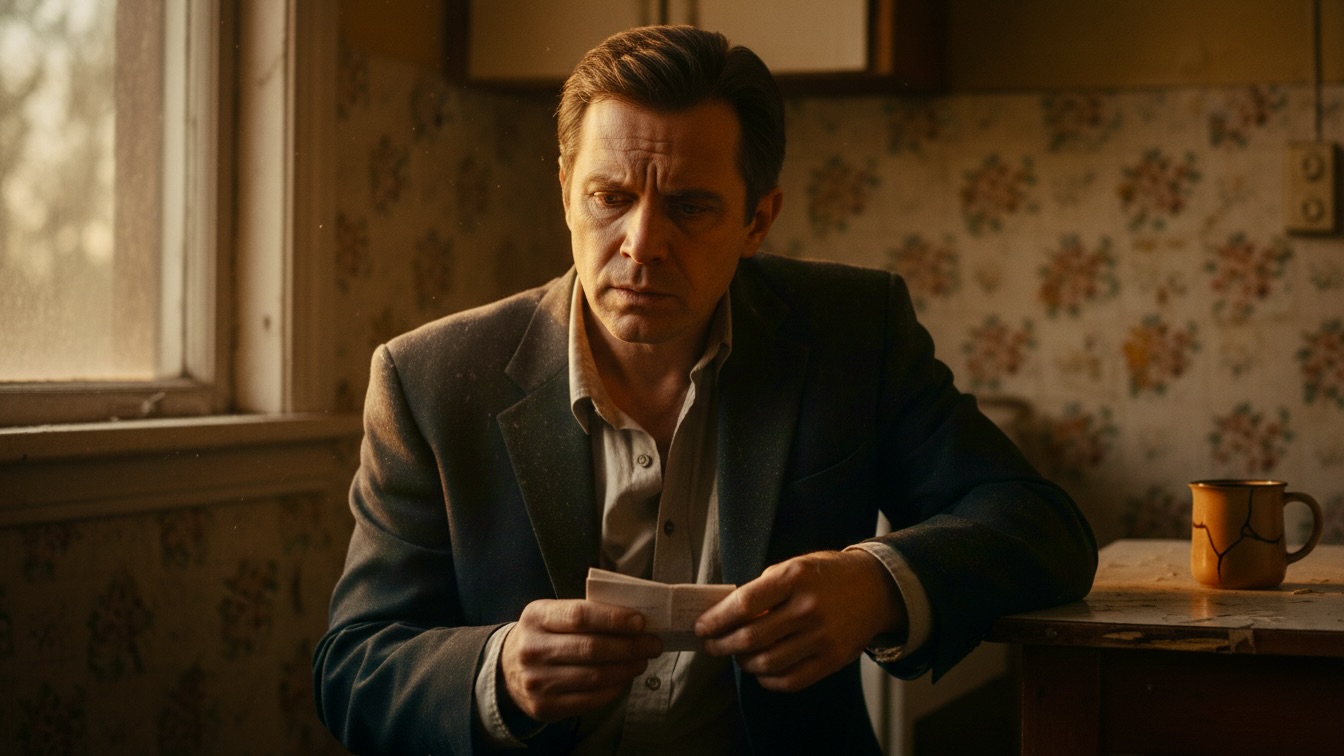
The story follows Thomas Hayes as he returns to his childhood farmhouse following the disappearance of his father, Joe. Upon arriving at the isolated property, Thomas finds the house stagnant, decaying, and imbued with an unsettling, unnatural silence. He navigates the physical remnants of his father's life, from a rotting piece of pie in the refrigerator to a collection of household debris, all while wrestling with his own discomfort and the oppressive atmosphere of the environment. After discovering a cryptic note hidden in a coffee tin, Thomas confronts a strange, light-consuming phenomenon in the meadow behind the house, leaving him trapped in a moment of existential terror and paralyzing indecision.
The narrative is deeply rooted in the theme of the entropy of memory and the physical decay of the past. The farmhouse functions as a tomb for a life that is still technically in progress, where the peeling paint and rotting food serve as metaphors for the decline of Joe’s existence. Thomas struggles to reconcile his objective need for administrative closure with the subjective, visceral horror of encountering his father’s lingering presence. The house acts as a transitional space between the known world and an encroaching, inexplicable void, suggesting that the past is not merely a collection of memories but a physical weight that can consume those who return to claim it.
The concept of the uncanny permeates the setting, transforming mundane objects into sources of dread. The squeaking gate, the half-eaten oatmeal, and the blue toothbrush all emphasize the suddenness of Joe’s absence. These domestic artifacts, which should provide comfort, instead evoke a sense of violation and haunting intimacy. The story posits that the most frightening aspect of death is not the absence of the person, but the lingering debris of their habits, which forces the living to inhabit the ghost of a routine that has been abruptly shattered.
Thomas is a man defined by his rigid adherence to logic and his desperate attempt to maintain control in a situation that defies rational explanation. His internal state is characterized by physical manifestations of stress, such as his acid reflux and the tension in his neck, which highlight his role as a man caught between the sterile, fast-paced world of the city and the slow, suffocating decay of his rural origins. He views his father’s life through a lens of clinical assessment, attempting to categorize the house as a simple administrative task rather than a site of emotional trauma.
His motivation is primarily driven by duty and the need for closure, yet he is clearly burdened by a complicated relationship with his father. The realization that he is beginning to resemble Joe physically creates a profound identity crisis, forcing him to confront his own mortality through the lens of his father’s disappearance. As the story progresses, his reliance on logic begins to fracture, replaced by a primal, intuitive fear that he cannot suppress. By the end of the chapter, Thomas is transformed from a detached executor of his father's affairs into a man standing on the precipice of a terrifying, unknown reality.
Although Joe remains physically absent throughout the narrative, he is a looming, omnipresent force that dictates the rhythm of the story. Through his handwriting and the deliberate placement of his final note, Joe reveals himself to be a man deeply attuned to the strange, possibly supernatural nature of his surroundings. He is a figure of quiet resignation, having accepted the encroachment of the "shadow" that Thomas eventually witnesses. His instructions to his son suggest a desire to protect Thomas from the same fate, even as he acknowledges that the transition from life to the void is inevitable.
The narrative voice is detached and observant, mirroring Thomas’s own attempt to remain objective while navigating the house. The pacing is deliberate and slow, allowing the reader to experience the oppressive silence alongside the protagonist. The author utilizes sensory details—the smell of rotting fruit, the sound of metal on metal, and the visual distortion of the light—to build a sense of mounting dread. This atmospheric density ensures that the house feels like a living, breathing entity that is actively hostile toward the intruder.
The tone shifts subtly from a standard mystery to a psychological thriller with elements of cosmic horror. By focusing on the minutiae of the home, the narrative creates a stark contrast between the mundane reality of unpaid bills and the surreal, vibrating darkness in the meadow. This stylistic choice effectively grounds the supernatural elements in a realistic setting, making the encroaching horror feel more immediate and inescapable. The final image of the shadow in the meadow serves as a powerful, lingering visual that reinforces the story's overall sense of existential dread.


