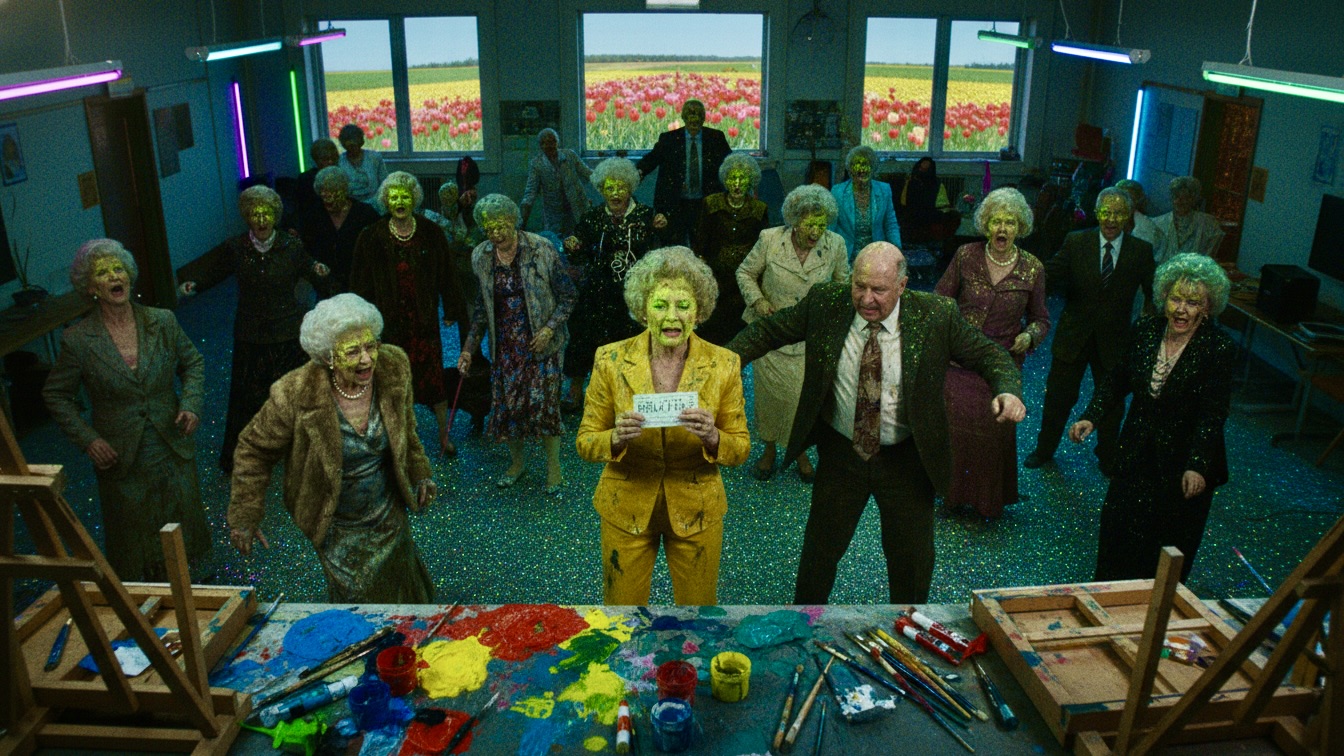
The story begins in the mud-slicked town of Kenora during the Spring Fever Treasure Trail, an annual event that dictates the local social hierarchy. Sheila, a woman of high social standing, discovers a glowing "Lucky Ticket" in a roadside ditch, which she believes grants her first choice of prestigious Crown Land leases. She is immediately challenged by her rival, Barb, who mocks her physical effort and reveals Sheila’s secret Botox treatments after a receipt flies out of Sheila’s purse. This personal conflict sets the stage for a broader communal revelation at the local community center.
During the "glow-paint" night hosted by Mayor Tim, the atmosphere shifts from competitive posturing to public exposure. The Mayor attempts to present a "masterpiece" landscape, but the forensic nature of the neon glow-pollen reveals his work is merely a pre-printed photograph he is coloring in. The tension peaks when the treasure chest is opened, revealing that the "prizes" are nothing more than expired bait shop coupons. The event concludes with a hidden message appearing on the Mayor’s canvas, announcing a full forensic audit of the district. Realizing their shared legal and financial vulnerabilities, Sheila and Barb form an uneasy alliance to hide their records in Barb’s sinking guest house.
The central theme of the narrative is the inevitable collapse of artifice and the exposure of the rot beneath a polished surface. Throughout the text, the author uses the "glow-pollen" and "neon" elements as metaphorical forensic tools that strip away the characters' carefully constructed facades. Whether it is Sheila’s "youthful glow" being revealed as a chemical enhancement or the Mayor’s "artistic vision" being exposed as a digital fraud, the story suggests that truth cannot be suppressed indefinitely. The transition from the "natural" mud of the beginning to the "unnatural" neon of the end mirrors the movement from hidden secrets to public scandal.
Social hierarchy and its inherent fragility serve as another significant theme. The Kenora elite base their entire self-worth on the Spring Fever Treasure Trail, treating a search for paper slips as a high-stakes war for "legacy" and "power." However, the ultimate reward—expired coupons for worm bait—reveals the absurdity and emptiness of their social competition. The story posits that the structures these characters build to elevate themselves are as unstable as Barb’s sinking guest house. When the threat of the "Auditor" arrives, the artificial barriers between rivals vanish, replaced by a desperate, collective need for survival.
The narrative also explores the theme of environmental and moral decay. The "governing" mud of Kenora and the "sinking" foundations of the homes serve as physical manifestations of the characters' ethical lapses. The aggressive "Warming Wind" and the "jagged teeth" of the tulips suggest a nature that is hostile to the pretenses of the townspeople. By the end of the story, the "glow" is no longer a symbol of magic or luck, but a "radioactive intensity" that marks the characters' sins. This suggests that the environment itself is reclaiming the truth from those who have spent years burying it under layers of expensive fertilizer and "clean living."
Sheila is a woman defined by her desperate need for external validation and the maintenance of a flawless public image. Her internal state is one of constant vigilance, as evidenced by her "vertebrae clicking in rhythmic protest" while she attempts to perform the physical labor of the treasure hunt. She views her social standing as a "structural integrity" that must be defended at all costs, even if it requires stooping into a muddy ditch. For her, the Lucky Ticket represents more than property; it is a shield against the reality of her aging and the potential loss of her inherited status.
Her psychological fragility is exposed when her private medical correspondence is revealed to the public. The "cold, radiating fury" she feels is not just a reaction to Barb’s pettiness, but a response to the shattering of her carefully curated persona of "mountain air" and "clean living." Sheila relies on these lies to navigate the competitive waters of Kenora. When the audit is announced, her immediate pivot from social rival to criminal conspirator shows that her morality is entirely situational. She is a creature of the system she inhabits, and she will sacrifice any pretense of dignity to avoid the "deep and dark" consequences of her financial choices.
Barb functions as the cynical mirror to Sheila’s ambitious posturing, using her observational skills as a weapon to maintain her own position. She does not necessarily seek to lead the pack, but she takes immense psychological pleasure in dismantling the pretenses of others. Her wicker basket, held "like a weapon," symbolizes her readiness to collect and use the failures of her peers for her own social leverage. She is acutely aware of the "sinking" nature of their world, both literally in the case of her guest house and figuratively in the case of the town's corruption.
Despite her antagonistic behavior, Barb possesses a pragmatic streak that Sheila lacks. She is the one who recognizes the forensic nature of the glow-pollen first, and she is the one who offers a dark sanctuary when the audit looms. Her relationship with Sheila is symbiotic; she needs a rival to mock just as much as Sheila needs an audience to impress. In the end, her willingness to harbor Sheila’s records suggests that her malice is a social performance. When faced with a true external threat like the government auditor, she recognizes that her survival is tied to the very woman she spent the afternoon ridiculing.
Mayor Tim is the embodiment of institutional fraud and the ultimate expression of the town's hollow values. He carries his "self-importance like a heavy winter coat," a metaphor for the burden of maintaining a massive lie. His psychological makeup is one of profound insecurity masked by theatricality and bullying. By presenting a "paint-by-numbers" image as an original masterpiece, he reveals a man who has completely replaced substance with "stylistic choices." He is a visionary only in his ability to "layer reality" until the truth is buried beneath neon pigments.
His reaction to the exposure of his fraud is one of frantic, uncoordinated desperation. Unlike Sheila and Barb, who find a way to cooperate, the Mayor attempts to flee, literally tripping over his own "neon-green glitter." His failure to manage the town’s budget, diverted to his own "photography equipment," highlights a pathological lack of accountability. He views the citizens not as people to lead, but as spectators to his "ascent." When the "Petal Prophecy" reveals the forensic audit, the Mayor is exposed as the weakest link in the Kenora social chain, a man whose "virgin shore" was always a pre-rendered deception.
The narrative voice of the story is characterized by a sharp, satirical tone that borders on the mock-epic. The author treats the petty squabbles of a small-town social circle with the gravity of a Shakespearean tragedy, which serves to highlight the absurdity of the characters' actions. Descriptions of the mud as something that "governed" and the tulips as "jagged teeth" create an atmosphere of underlying violence and tension. This sensory detail ensures that the reader feels the oppressive nature of the environment, making the eventual "glow" of the community center feel like a fever dream.
Pacing is handled with a gradual escalation that moves from the slow, methodical "stooping" in the mud to the "frantic, uncoordinated scramble" of the finale. The introduction of the glow-pollen acts as a stylistic pivot point, shifting the imagery from natural, earthy tones to a "radioactive" neon palette. This shift visually represents the transition from private secrets to public exposure. The author uses short, punchy dialogue to punctuate the descriptions, allowing the characters' wit and malice to drive the narrative forward without slowing the momentum of the plot.
The use of chemical and forensic terminology—such as "perioral filler," "chemical composition," and "forensic tool"—adds a layer of modern clinical coldness to the story. This contrasts effectively with the "legend" and "prophecy" language used by the characters. By blending the mystical language of a "treasure trail" with the harsh reality of "offshore holdings" and "financial records," the author creates a stylistic tension that mirrors the characters' own internal conflicts. The final image of the "neon dust" settling over the room provides a haunting conclusion, suggesting that the light of truth, once ignited, is a permanent and unforgiving presence.


