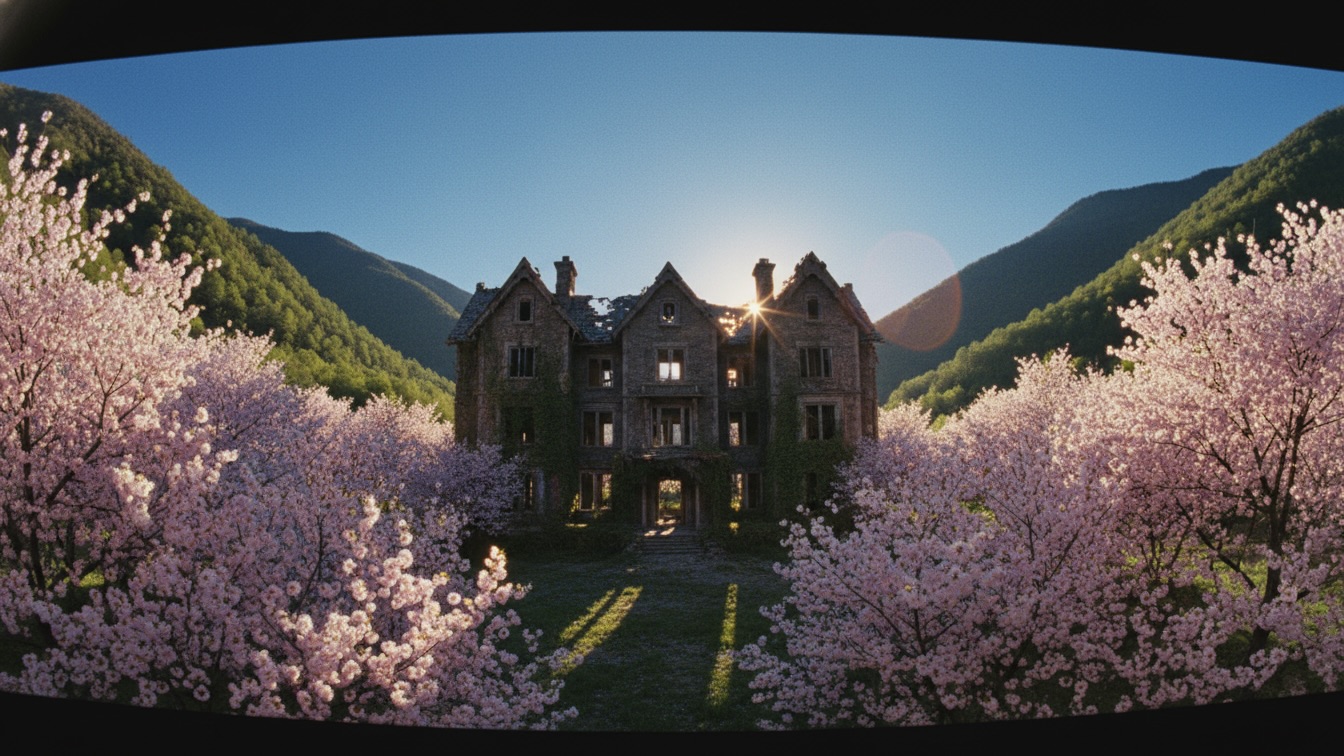
The story begins with Bette receiving a mysterious letter from her father, who has been missing for a decade. The letter originates from Vesper’s End, a location that does not appear on any modern maps. Despite her hesitation, Bette is accompanied by her boyfriend, Mark, whose interest in the journey is clearly fueled by financial desperation rather than emotional support. As they travel into the mountains, the atmosphere grows increasingly surreal and oppressive, signaling a departure from the rational world.
Upon arriving at a decaying Victorian estate, they are met by a cryptic Caretaker who informs them that they are expected. Inside the house, Bette discovers that every mirror is draped in heavy black cloth, creating an environment of funereal gloom. While Mark frantically searches for deeds and bank account numbers, Bette uncovers a ledger that reveals a dark truth. She learns that Mark’s family has been complicit in her father’s disappearance and that Mark’s pursuit of her was a calculated attempt to claim the estate.
The confrontation reaches a climax when Mark attempts to coerce Bette into signing over the property. The Caretaker intervenes, suggesting that Bette holds the power while Mark is merely an expired guest. In a supernatural display of justice, the Caretaker uncovers a mirror, causing Mark to vanish into the glass. Bette is left alone in the house, choosing to embrace her grim inheritance rather than flee. She begins to write her own history in the ledger, accepting her role as the new master of the cursed estate.
The central theme of the narrative revolves around the corrosive nature of debt, both financial and moral. Mark represents the ultimate commodification of human relationships, viewing Bette and her father’s disappearance through the lens of "assets" and "payouts." This transactional worldview eventually leads to his literal liquidation when his "balance" is reduced to zero. The story suggests that some debts cannot be settled with currency but require a sacrifice of the self.
Another prominent theme is the burden of legacy and the inevitability of inheritance. Bette initially seeks her father to find closure or love, but she instead finds a "tomb of paper" and a blood-stained ledger. The estate acts as a physical manifestation of her family's history, one that she cannot escape. By the end of the story, she realizes that the "curse" is her birthright, and she chooses to sit at the desk and manage the accounts, continuing the cycle her father began.
The motif of the mirrors explores the theme of perception and the fear of the true self. The black cloths serve as a psychological barrier, protecting the inhabitants from the monstrous reality of their actions. When the Caretaker removes the cloth, he forces Mark to face a reflection that his ego cannot survive. For Bette, the mirrors remain covered, suggesting that she is not yet ready to see what she has become as the new mistress of the house.
Finally, the story subverts the traditional literary trope of spring as a time of renewal. The cherry blossoms are described as rotting on the asphalt, and the new leaves are a sickly, translucent green. This "false spring" mirrors the rot within the Henderson and Vesper families. It suggests that while nature may attempt to bloom, the weight of past sins creates a permanent winter of the soul within the walls of the estate.
Bette begins the narrative as a woman haunted by a ten-year-old void, driven by a lingering hope for paternal reconnection. Her psychological state is characterized by a high degree of compartmentalization, as she notices the "red flags" in Mark’s behavior but chooses to ignore them in favor of her quest. This suggests a deep-seated need for belonging that overrides her survival instincts. She is a character defined by her observation of details, from the specific hook in a letter to the smell of ozone in the air.
As the story progresses, Bette moves from a passive observer to an active participant in the estate's dark logic. The discovery of Mark’s betrayal acts as a catalyst for her transformation, stripping away her remaining sentimentality. When she refuses to sign the deed, she isn't just rejecting Mark; she is claiming her own agency. Her decision to stay in the house and write in the ledger signifies a shift from a victim of the past to its administrator.
By the end of the chapter, Bette has undergone a chilling evolution. She no longer fears the shadows or the silence of the house, finding them "manageable" rather than terrifying. Her acceptance of the "curse" as an inheritance reveals a pragmatic, perhaps even cold, psychological core. She chooses the certainty of the estate’s power over the uncertainty of her previous life, signaling a final break from her former identity.
Mark is the personification of predatory greed and modern anxiety. His constant monitoring of his bank balance reveals a man who is psychologically tethered to his perceived net worth. He lacks any genuine empathy for Bette, seeing her grief only as a map to a potential payday. His use of "cologne and cheap cigarettes" serves as a sensory metaphor for his attempts to mask his inner decay with a facade of success.
His behavior throughout the journey is marked by urgency and irritability, suggesting that he is running out of time in more ways than one. He views the world as a series of hostile roads and "trash" infrastructure, reflecting his inability to find beauty or meaning in anything that cannot be liquidated. His "mask" of support quickly slips when he is near the source of the wealth he craves. He is a man who has traded his humanity for the hope of a "transfer," making him the perfect antagonist for a Gothic tale of debt.
Mark’s downfall is a direct result of his inability to recognize the supernatural rules of the estate. He treats a haunted Victorian manor like a corporate takeover, failing to respect the "interest" that the house demands. His scream at the end is not just one of terror, but of a sudden, total realization of his own worthlessness. He leaves behind nothing but a cracked phone and a zero balance, a fittingly hollow end for a hollow man.
The Caretaker functions as the atmospheric anchor of the story, representing the house’s sentience and its ancient rules. He is described with imagery of decay, such as "wet cardboard" skin and a "dry rasp" of a voice, suggesting he is more a part of the architecture than a living man. He does not act out of malice but out of a sense of cosmic accounting. He is the arbiter who decides when a guest’s "time is up."
Psychologically, the Caretaker is entirely detached from human emotion, focusing instead on the "changing light" and the "payment" of debts. He acts as a mirror himself, reflecting the intentions of those who enter the house. To Bette, he is a source of grim information; to Mark, he is the executioner. His "glitch-like" movement suggests he exists outside of normal time and space, serving the estate’s eternal needs.
The pacing of the story is masterfully handled, beginning with a slow, domestic tension that gradually accelerates into a Gothic nightmare. The initial focus on mundane details, like a protein bar and Google Maps, grounds the story in reality before sliding into the impossible geography of Vesper’s End. This transition creates a sense of "the uncanny," where the familiar becomes strange and threatening. The rattling of the SUV and the screech of the iron gate serve as auditory cues that the characters are crossing a threshold into a different realm.
The author makes extensive use of sensory details to build an atmosphere of dread. The smell of "ozone" combined with "rot" creates a physical sensation of an impending storm that never breaks, mirroring the internal tension between Mark and Bette. The description of the house as a "skeletal hand" and the wind sounding "underwater" enhances the feeling of claustrophobia and isolation. These details ensure that the setting is not just a backdrop but a character that actively influences the mood.
The narrative voice is sharp and economical, often using short, punchy sentences to convey Bette’s internal clarity. For example, the line "That was the only math that mattered" effectively establishes her priorities without the need for lengthy exposition. The contrast between the "marble floors" and the "invisible cobwebs" highlights the duality of the estate—its outward grandeur and its inner corruption. This stylistic choice keeps the reader focused on the immediate psychological stakes.
Finally, the use of color and light is highly symbolic throughout the text. The "pink snow" of the cherry blossoms that look like they are "rotting" and the "piercing blue" sky that smells like a thunderstorm create a visual dissonance. The "black cloth" on the mirrors is the most striking visual element, serving as a recurring reminder of the hidden and the forbidden. By the end, the "bruised purple" on the white petal signals that while life has returned to the estate, it is a life marked by trauma and shadow.


