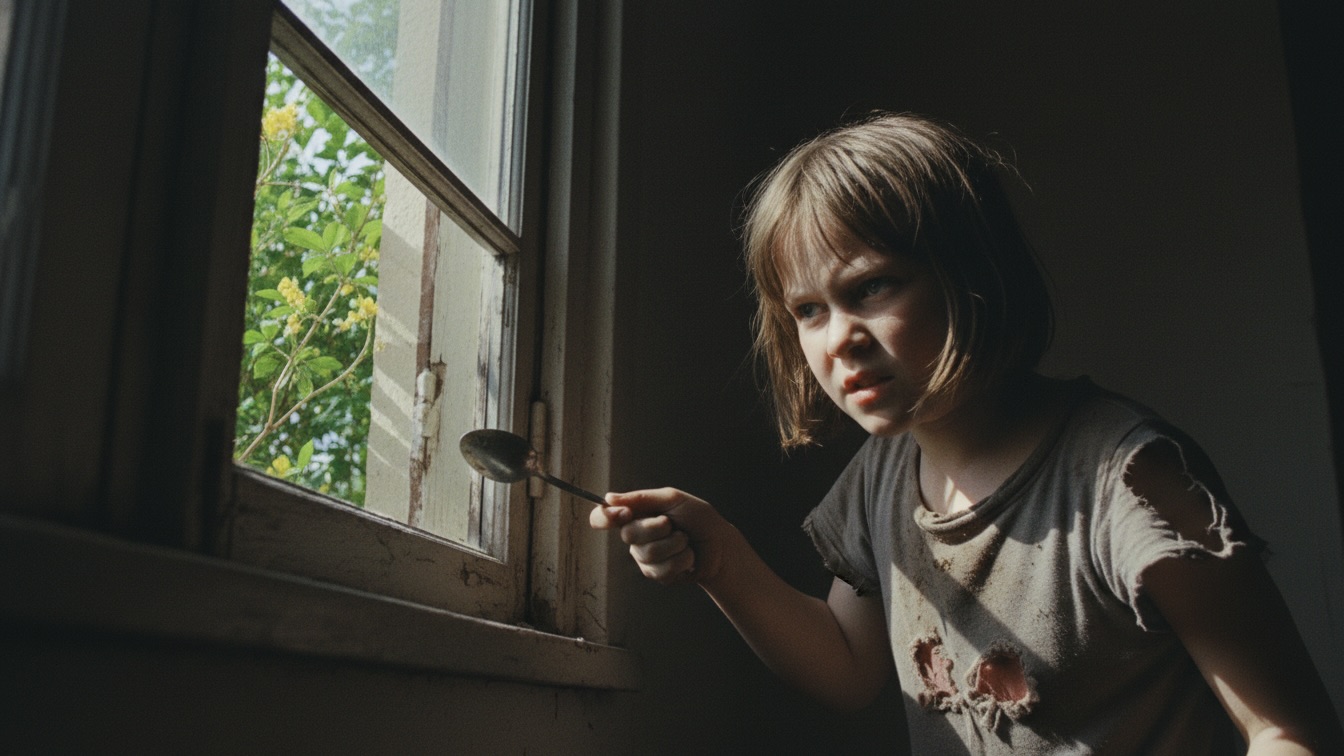
The narrative unfolds in the oppressive atmosphere of Uncle Ben’s dining room, where a bright spring day is abruptly extinguished by a man’s descent into a paranoid delusion. Marie and her younger brother, Vick, find themselves trapped when Ben, convinced that a global technological collapse is occurring, uses a sophisticated smart-home system to seal every exit. Armed with a handgun and fueled by "zero-day" conspiracy theories, Ben creates a fortress of isolation that threatens the safety of the children.
Marie, displaying a level of resourcefulness that far exceeds her twelve years, orchestrates a daring escape using a silver spoon she had previously sharpened in secret. She skillfully manipulates Ben’s obsession with cryptocurrency to distract him, prying open a forgotten, manual window while he is lost in his own technical jargon. As Ben’s delusions are punctured by the mundane reality of a restored internet signal and a pizza coupon notification, Marie and Vick seize the opportunity to leap into the freedom of the outside world.
A primary theme explored in the text is the profound irony of modern isolation and the paradox of digital connectivity. Ben is a man who seeks "decentralization" and "off-grid" living, yet he is entirely enslaved by the devices in his pocket and the "pings" he tracks. His identity is so tied to the digital landscape that a simple Wi-Fi outage triggers a total psychological collapse, demonstrating how technology can become a prison rather than a tool.
The narrative also examines the corruption of the domestic space and the subversion of traditional family roles. The dining room, typically a place of nourishment and safety, is transformed into a "dead zone" where the food is unpalatable and the windows are shielded by metal shutters. In this environment, the adult figure becomes the predator, and the child is forced to adopt the role of the protector, highlighting the fragility of the traditional family structure under the weight of mental illness.
Finally, the story highlights the contrast between the organic reality of nature and the sterile, artificial world of Ben’s delusions. The "sugar and dirt" of the spring air and the "blooming lilacs" represent a life-affirming truth that stands in stark opposition to Ben’s "neon blue" server lights and "burnt rosemary" chicken. This dichotomy suggests that Ben’s "Great Dark" is not a global event, but a personal, internal shadow that he projects onto the world to justify his need for control.
Marie functions as the emotional and tactical anchor of the story, exhibiting a psychological phenomenon known as parentification. At only twelve years old, she has already developed a hyper-vigilance that allows her to anticipate Ben's instability, evidenced by her foresight in sharpening the silver spoon days before the crisis. Her internal state is a mix of terror and cold calculation, as she suppresses her own fear to provide a sense of stability for her younger brother.
She demonstrates a sophisticated understanding of Ben’s psychology, specifically his "hook" or narcissistic supply—his crypto-mining operation. By engaging him in a conversation about his "digital gold," she successfully redirects his aggression into a lecture, buying herself the time needed to execute her escape plan. Her bravery is not the absence of fear, but the mastery of it, as she uses a domestic utensil as a weapon of liberation.
Vick represents the vulnerability of childhood and the immediate psychological impact of domestic trauma. While he is ten years old, the stress of the situation causes him to regress, appearing to Marie as though he were only five. His physical reactions, such as clutching his fork until his knuckles turn white and his inability to eat the "wood-like" chicken, are classic symptoms of a child in a "freeze" state of the fight-or-flight response.
Despite his visible terror, Vick shows a remarkable degree of non-verbal synchronization with his sister. He is able to interpret her subtle cues and provide the necessary distraction by complaining about the food, showing that he trusts her survival instincts implicitly. He is the primary motivation for Marie's actions, serving as the moral compass that keeps her focused on escape rather than succumbing to the same paralysis Ben experiences.
Uncle Ben is a character study in extreme paranoia and the radicalization often found in isolated digital subcultures. His physical description—skin the color of "old milk" and eyes like "tiny pinpricks"—suggests a man who has physically and mentally withered in the glow of a computer screen. He suffers from a profound loss of agency, which he attempts to reclaim by arming himself and exerting total control over his immediate environment.
His "Great Dark" is a manifestation of an internal void, a psychological projection where the end of the world is preferable to his own insignificance. He finds comfort in the idea of a collapse because it would finally make his "digital gold" and "nodes" the center of the universe. The "ding" of the pizza coupon at the end of the story is the ultimate humiliation for him, as it proves that the world he feared was ending is actually continuing in its most mundane and commercial form.
The pacing of the chapter is masterfully handled, beginning with a deceptive, languid description of a spring day before tightening into a claustrophobic thriller. The author uses the mechanical sounds of the smart-locks—"Click. Clack. Thunk."—to create a sense of inevitable entrapment. This auditory imagery shifts the tone from the "muffled rhythm" of Marie’s bouncing leg to a high-stakes race against Ben's fluctuating moods.
Sensory details are used to heighten the contrast between the interior and exterior worlds. The "sweet, fresh spring air" that rushes in through the pried window serves as a powerful olfactory metaphor for hope and reality, cutting through the "stale, rosemary-scented" stagnation of the house. The use of the "neon blue" lights in the basement versus the "golden sparks" of the dust motes further emphasizes the artificiality of Ben’s existence compared to the natural world.
The narrative voice is grounded in Marie’s perspective, which allows for a grounded, visceral experience of the tension. The description of the chicken as "pieces of wood" and Ben’s skin as "old milk" reflects a child’s sharp, unforgiving observation of a deteriorating situation. This perspective ensures that the reader feels the weight of every "scrape" of the spoon and the "hammering" of Marie's heart, making the eventual escape feel like a profound physical relief.


