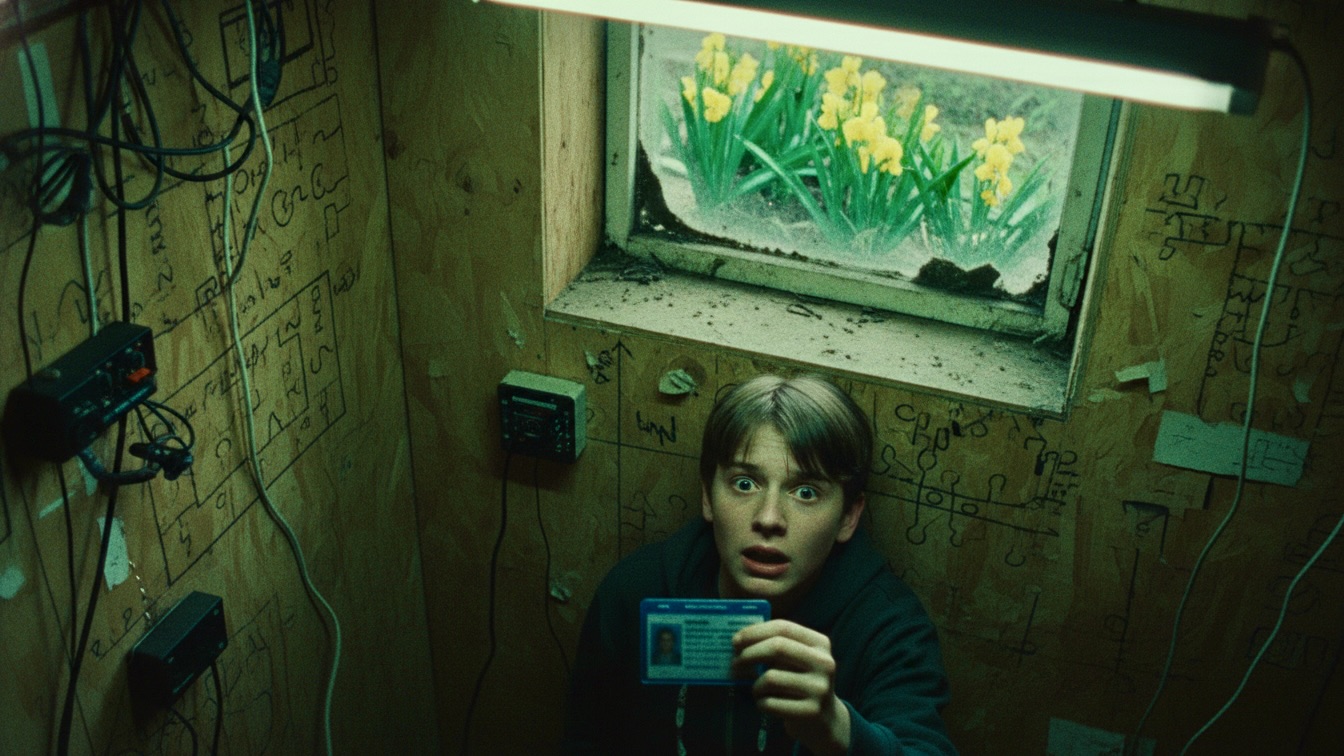
The narrative begins with three friends, Len, Sam, and Carrie, entering a dilapidated escape room facility called Panic Point. While Sam and Carrie treat the experience with typical teenage skepticism and competitive drive, Len is immediately struck by a sense of visceral unease. The atmosphere inside the "Retro Lab" quickly shifts from a scripted game to a disturbing personal encounter when they discover an ID card belonging to their missing friend, Toby. This discovery shatters the illusion of the game, as the room seems to possess intimate knowledge of Len’s life, including his birthday and his shared history with Toby.
As the situation escalates, Len discovers a hidden trapdoor leading to a replica of their school’s theater basement. There, he finds himself not in a game, but in a highly controlled laboratory environment where he is being monitored by observers behind one-way glass. After a frantic sequence involving a red key and a countdown, Len is released into what appears to be the real world. However, the comforting surroundings of his school and a local park are soon revealed to be sophisticated fabrications. The story concludes with Len realizing he is a test subject in a massive simulation, just as his memory is forcibly reset by an embedded chip.
The primary theme of the text is the fragility of reality and the terror of the simulation hypothesis. The story moves through concentric circles of artifice, starting with a literal game and expanding into a simulated society. By revealing that even the "outside" world is a constructed environment with paper petals and plastic grass, the narrative suggests that sensory experience is an unreliable narrator. This creates a profound sense of ontological dread, as the protagonist realizes that his entire existence is a curated performance for an indifferent audience.
Surveillance and the loss of autonomy also serve as central pillars of the narrative. From the high-end camera lenses in the escape room to the girl watching the "world" from a circular window in the sky, Len is never truly alone. This constant observation transforms his private grief and memories into data points for professional analysis. The observers do not see him as a human being with agency, but as "Subject C," a biological machine whose reactions are timed and categorized. This dehumanization highlights the power imbalance between the creators of the system and those trapped within it.
Finally, the story explores the weaponization of memory and personal trauma. The architects of the simulation use Toby’s disappearance and Len’s specific milestones to elicit "elevated emotional distress." By using the blue ID card and the theater basement, the system ensures Len’s engagement with the "level." Grief is not treated as a process for the individual to navigate, but as a lever to be pulled by the observers to maintain the simulation’s momentum. This psychological manipulation suggests that in a controlled environment, one's most sacred memories are merely tools for external control.
Len is a protagonist defined by his hyper-vigilance and a deep-seated psychological fragility. From the opening paragraphs, he is described as "vibrating" and feeling the cold in his teeth, suggesting a high level of sensory processing sensitivity. This trait allows him to notice the "glitches" in his environment that others, like Sam and Carrie, easily dismiss. He is the emotional anchor of the story, driven by a desperate need to find his missing friend, Toby, which makes him the perfect subject for the observers' experiments.
His internal conflict stems from the tension between his instinctual fear and his loyalty to Toby. Even when the environment becomes overtly hostile, Len chooses to descend into the darkness because he believes his friend is in danger. This self-sacrificial nature is ultimately his undoing, as it leads him directly into the traps set by the observers. By the end of the chapter, Len’s realization of the truth leads to a complete psychological collapse, which the system views merely as a "glitch" requiring a reset.
Sam serves as the voice of skepticism and the embodiment of modern irony. He uses his phone and witty banter as defensive shields against the unsettling atmosphere of Panic Point. His constant insistence that the anomalies are just "edgy" marketing or "conspiracy TikToks" represents a psychological refusal to engage with a terrifying reality. He functions as a foil to Len, providing a standard of "normalcy" that makes Len’s eventual discovery of the simulation even more jarring.
Despite his bravado, Sam’s composure cracks as the supernatural elements of the room take hold. His shouting at the intercom and his pale face reveal that his irony is a thin veil for his own fear. In the final sequence, Sam’s role in the simulation becomes ambiguous. Whether he is a fellow victim whose memory has already been reset or a sophisticated AI construct, he serves the purpose of gaslighting Len into staying within the boundaries of the "Real World" level.
Carrie is characterized by her need for structure and control, evidenced by her "five-year plan" and her command-oriented approach to the escape room. She views the world through the lens of logic and rules, which initially makes her the most effective at solving the puzzles. She represents the human desire to master an environment through intellect. However, this same reliance on logic makes her vulnerable when the environment stops following the established rules of physics and fire codes.
As the situation turns dire, Carrie transitions from a leader to a supporter, handing Len the flashlight that facilitates his descent. Her physical reactions, such as her hyperventilation and sweaty palms, ground the horror in a visceral reality. Like Sam, her presence in the final "school" scene suggests a chilling possibility about her existence. She is either a prisoner of the same system, perpetually reset, or a hollow shell designed to keep Len compliant within the artificial jasmine-scented world.
The pacing of the chapter is masterfully handled, beginning with a slow, claustrophobic build-up that mirrors the tension of a real escape room. The author uses sensory details like the smell of "lemon-scented wipes that don't actually clean anything" to establish a gritty, disappointing reality. This grounding in the mundane makes the subsequent shift into the surreal much more impactful. As Len descends into the theater basement, the sentences shorten, and the rhythm of the prose accelerates to match his hammering heart.
The narrative voice is deeply rooted in Len’s perspective, allowing the reader to experience his growing paranoia firsthand. The use of clinical language by the observers provides a sharp, chilling contrast to Len’s frantic internal monologue. Phrases like "Reaction time: twelve minutes" and "Adjust the memory parameters" introduce a cold, technological tone that strips the setting of its humanity. This juxtaposition between Len’s emotional heat and the observers’ icy detachment heightens the sense of tragedy at the end of the chapter.
Sensory irony is a recurring stylistic device throughout the text. The "physical weight" of the sun at the beginning is contrasted with the "fake" sun of the simulation that feels like a spotlight. The cherry blossoms, traditionally symbols of life and renewal, are revealed to be "thin, pink tissue paper." These details serve as breadcrumbs for the reader, echoing Len’s own journey toward the truth. The final image of the petal landing on his nose and feeling like "nothing at all" perfectly encapsulates the theme of a hollow, manufactured existence.


