Format: Short Film / Anthology Episode | Est. Length: 10-12 minutes
Imagine a world where every "immersive" experience is a thinly veiled data-harvesting operation, and every "glitch" in your day is a failure in a massive, unseen architecture. This story serves as a chilling entry point into an anthology series that explores the "Simulation Theory" not as a philosophical debate, but as a corporate reality. The series follows various subjects as they inadvertently stumble upon the boundaries of their manufactured lives, revealing an overarching narrative of a society that has been moved entirely into "The Vault"—a multi-layered containment system designed to study human behavior under extreme psychological stress.
Three teenagers enter a grimy, low-rent escape room for a thrill, only to find that the "props" inside are the actual belongings of a classmate who went missing weeks ago. The game turns deadly when the exit remains magnetically sealed and the room’s high-end surveillance cameras begin tracking their every heartbeat.
A teenager discovers his missing friend’s ID card inside a locked escape room, triggering a descent into a layered simulation where his reality is a controlled experiment. He must navigate a series of psychological traps to uncover the truth, only to realize the world outside is just a larger cage.
The primary themes revolve around the erosion of privacy and the loss of agency in a surveillance-heavy society. It explores the terrifying intersection of immersive entertainment and high-stakes psychological experimentation, questioning whether our memories and surroundings are authentic or merely data points for an unseen observer.
The narrative also touches on the "uncanny valley" of digital existence, where the comfort of the familiar is weaponized against the protagonist. It highlights the isolation of the individual when faced with a system that gaslights them into believing their reality is stable, even as the walls literally begin to crumble.
For Len, the stakes are existential survival and the recovery of his missing friend, Toby. Failure to "solve" the room results in permanent psychological reset or physical disposal, while the broader stakes involve the autonomy of the entire student population being used as unwitting test subjects in a grand social experiment.
The external conflict is driven by the "Panic Point" facility and its mysterious handlers, who use psychological triggers and environmental manipulation to break the subjects. Internally, Len battles his own anxiety and the skepticism of his friends, who are either programmed to ignore the glitches or are part of the simulation themselves, leaving Len entirely alone in his realization.
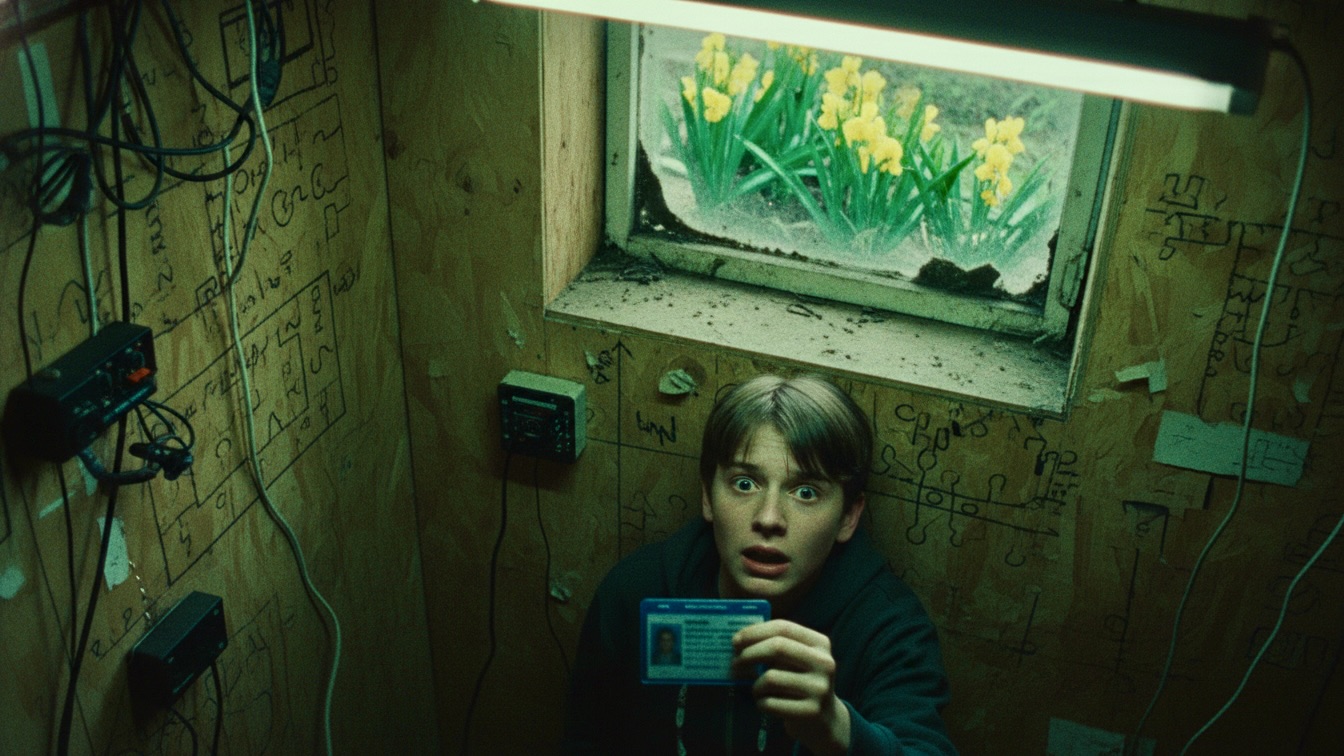
Len, Sam, and Carrie visit "Panic Point," a basement escape room where they are tasked with solving a "Retro Lab" puzzle. The atmosphere shifts from playful to paranoid when Len discovers a backpack and a chipped ID card belonging to their missing friend, Toby, which Len knows is not a prop. As the exit remains locked and the room’s computer begins displaying Len’s personal data, a recording of Toby’s voice leads Len to a hidden trapdoor in the floor.
Len descends into a perfect replica of his school’s theater basement, where he finds a mannequin dressed in Toby's clothes and is confronted by a surveillance team watching him through one-way glass. After a frantic countdown, Len escapes through a hidden door into the "outside" world, only to find his friends have no memory of the event. He soon realizes the cherry blossoms are paper and the grass is plastic, catching a glimpse of a giant observer through a window in the sky before he is forcibly "reset" by a chip in his neck.
Len (Protagonist) begins as a high-strung, observant teenager and ends as a broken "Subject C" who has seen behind the curtain of his reality. Sam serves as the skeptical foil, providing a grounded but ultimately oblivious perspective that heightens Len's isolation throughout the game. Carrie is the pragmatic leader whose reliance on logic and "five-year plans" fails when the environment stops following physical laws. Dave and the Observers represent the cold, clinical antagonistic force managing the simulation, viewing human emotion as nothing more than a metric to be recorded.
The trio enters the "Retro Lab" escape room, where the oppressive atmosphere and malfunctioning tech immediately set a tone of dread. Len notices the surveillance cameras are tracking his specific movements with mechanical precision, far beyond the needs of a simple game. The discovery of Toby’s actual school ID card—complete with a specific chip Len remembers—confirms that this is not a simulation of a mystery, but a crime scene.
The exit door magnetically seals as a recording of Toby’s voice pleads for help, leading Len to rip up the floorboards and find a hidden ladder. He descends into a replica of his school's basement, finding a mannequin wearing Toby's clothes and a red key that triggers a countdown. The room's walls are revealed to be one-way glass, exposing a team of suit-clad observers who are documenting Len's emotional distress as "performance data" for an unknown client.
Len escapes through a hidden door into the "outside" world, only to find his friends have no memory of the escape room and the environment is glitching. He realizes the cherry blossoms are paper and the grass is plastic, eventually seeing a giant observer looking down through a circular window in the sky. A chip in his neck activates, and as he loses consciousness, he hears the handlers preparing to "reset" him for Level Two, leaving the red key as a lingering artifact.
The episode begins with a sense of "urban exploration" thrill that quickly curdles into claustrophobic paranoia. The audience shares Len's gaslit perspective as the familiar world is stripped away, shifting from a grounded mystery to a high-concept sci-fi horror. The final beat is one of utter helplessness and cosmic dread, as the "escape" is revealed to be a transition into a larger, more sophisticated cage.
If expanded, the season would follow Len’s "Level Two" as he retains fragments of his memory, attempting to find other "glitches" in the student body and form a resistance. The narrative would escalate from a single room to the realization that the entire city is a modular testing ground, with Toby acting as a "ghost in the machine" who helps Len navigate the layers.
The thematic escalation would move from personal survival to a systemic rebellion against the corporate entity running the simulation. Each episode would introduce a new "subject" whose unique skills are tested in different environments, eventually converging as they realize their shared reality is a fabrication designed to harvest human resilience.
The aesthetic shifts from the grimy, low-fi "lemon-wipe" basement of Panic Point to the hyper-saturated, "too-perfect" look of the simulated schoolyard. High-angle surveillance shots and unsettlingly smooth camera pans will be used to emphasize the feeling of being watched, creating a clinical and detached atmosphere.
Tonal influences include the clinical coldness of Ex Machina and the suburban paranoia of The Truman Show, blended with the "analog horror" aesthetic of the early 2000s. The color palette will move from sickly grays and greens in the lab to an artificial, neon-bright spring day that feels visually "wrong" to the viewer.
The target audience consists of young adults and fans of psychological thrillers, aged 16-35, who enjoy "puzzle-box" narratives and dystopian sci-fi. It appeals to viewers who frequent escape rooms and those interested in internet-era creepypastas, simulation theories, and the "liminal spaces" aesthetic.
The pacing follows a relentless "ticking clock" structure, starting with the 60-minute timer in the escape room and accelerating as the reality-bending elements emerge. The 12-minute runtime is divided into three distinct "levels": the Room (4 mins), the Basement (4 mins), and the Simulated Park (4 mins), with each transition increasing the tempo of the edit.
The transition from the basement to the park requires a seamless "match cut" or a practical rotating set to emphasize the jarring change in environment. The "Retro Lab" should be built with practical, tactile props that feel lived-in, contrasting with the obviously fake, "stage-managed" look of the park in the final scene.
Special attention must be paid to the "sky window" effect, which should be achieved through a mix of practical lighting changes and high-end VFX to make the observer feel truly gargantuan. The "paper cherry blossoms" and "plastic grass" are essential practical effects that ground the reveal of the simulation in a tactile, disturbing reality for the audience.


