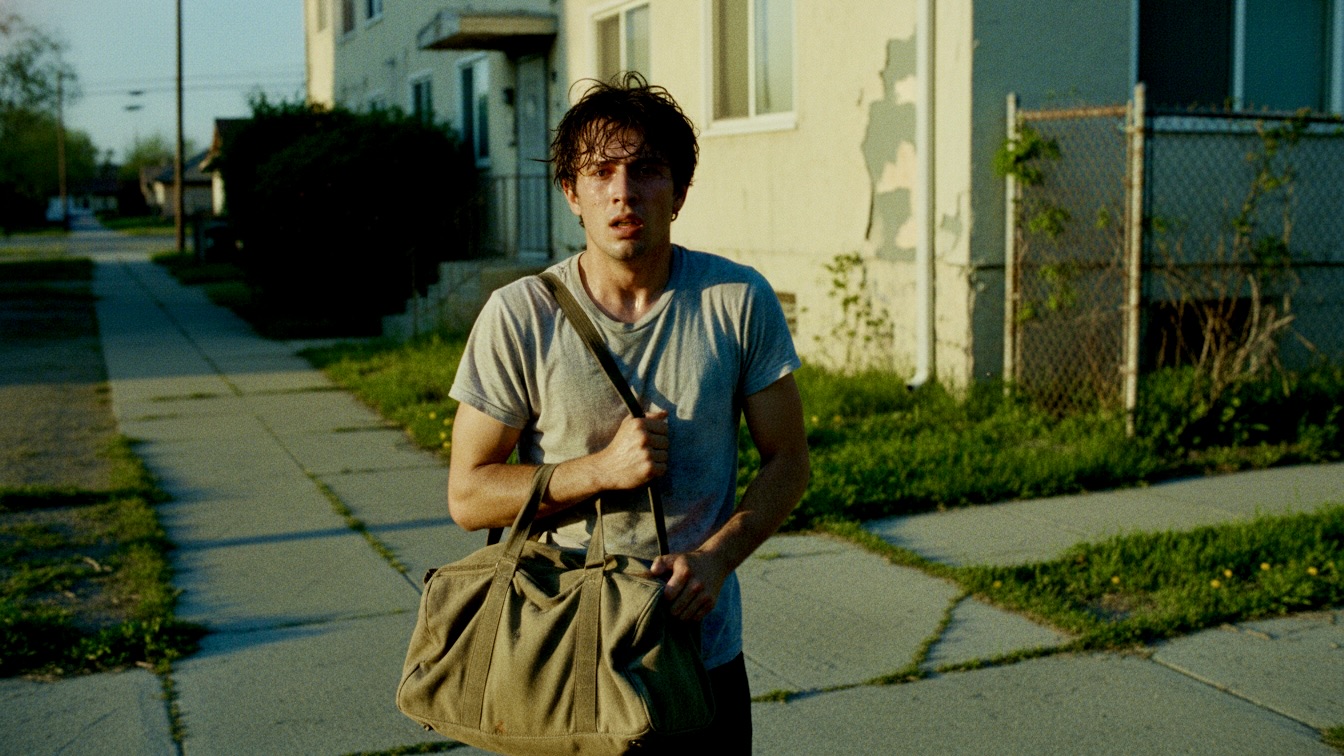
Benji, a young man burdened by the weight of an impending life commitment, experiences a surreal psychological breakdown while driving. He finds himself at a decaying, nightmarish carnival that manifests his internal anxieties about his failing relationship and his lack of direction. After being forced onto a claustrophobic, tightening roller coaster by an eyeless carny, Benji struggles to escape the physical and metaphorical trap that represents his engagement to Clara. He eventually escapes through a funhouse mirror, only to wake up in his own bed, discovering that the physical ring he bought remains a tangible reality. Driven by a desperate, primal need to avoid the suffocating life he sees ahead, he packs his belongings and flees his apartment, leaving behind his girlfriend and his old life in a frantic, uncertain bid for freedom.
The central theme of this narrative is the suffocating nature of societal expectations and the paralyzing fear of premature adulthood. Benji views the traditional markers of a successful life—marriage, a mortgage, and a stable career—not as achievements, but as a mechanical trap designed to slowly crush his sense of self. The carnival serves as a manifestation of this dread, where the game booths replace symbols of innocence and nurture with the cold, cynical reality of financial and domestic obligations.
The story further explores the psychological weight of guilt and the cowardice often masked by indecision. Benji is trapped between his desire to please Clara and his total lack of readiness to commit to the life she envisions. His inability to communicate his fears leads to a internal fracturing, where the dream world and reality bleed into one another. The recurring motif of the noose, applied to the ring, underscores the idea that what is meant to be a symbol of love and future stability has become an instrument of his own destruction.
Benji is a character defined by his profound sense of fragmentation and inadequacy. He is a young man standing on the threshold of a life he does not want, yet he lacks the emotional maturity to articulate his dissent to his partner. His physical symptoms—the clicking jaw, the erratic foot tapping, and the sudden bouts of nausea—reveal a body that is actively rejecting the path he is currently treading. He is fundamentally dishonest with himself, attempting to perform the role of a stable partner while internally screaming for escape.
His reaction to the carnival and his subsequent flight reveal a deeply ingrained pattern of avoidance. When faced with the terrifying prospect of the "ride"—the inevitable progression of his relationship—he chooses to tear himself free through sheer, violent force rather than through honest conversation. His decision to leave without a note or a final word highlights his deep-seated immaturity and his inability to handle the emotional fallout of his choices. He is a man who runs from the consequences of his existence, ultimately choosing a lonely, uncertain future over the crushing weight of a life that does not fit his spirit.
Though Clara never appears in the present timeline of the narrative, her presence is the gravitational force around which Benji orbits. She represents the societal, linear progression of life that Benji finds so terrifying. Through his memories, she is depicted as tired, pragmatic, and increasingly resentful of his lack of ambition. She is an anchor, but in Benji's warped perception, an anchor is merely a weight that prevents him from drifting where he pleases. She is the embodiment of the "real world" that he is desperate to evade.
The narrative voice utilizes a visceral, sensory-heavy style to mirror Benji’s deteriorating mental state. The author employs sharp, tactile descriptions—such as the yellow pollen coating the windshield or the smell of wet wool and stale beer—to ground the surreal elements of the carnival in a disgusting, tangible reality. This sensory overload forces the reader to inhabit Benji’s claustrophobia, making the narrowing midway and the tightening safety bar feel like immediate, physical threats.
The pacing of the story is expertly controlled to reflect the protagonist's internal rhythm. The initial drive is sluggish and hazy, characterized by a lack of memory and a slow descent into the subconscious. Once the roller coaster begins, the pace accelerates into a frantic, repetitive blur, mirroring the panic of a mind trapped in a loop of its own making. The transition between the dream and reality is seamless, which serves to emphasize that for Benji, the nightmare of his life is just as oppressive as the nightmare of the carnival.


