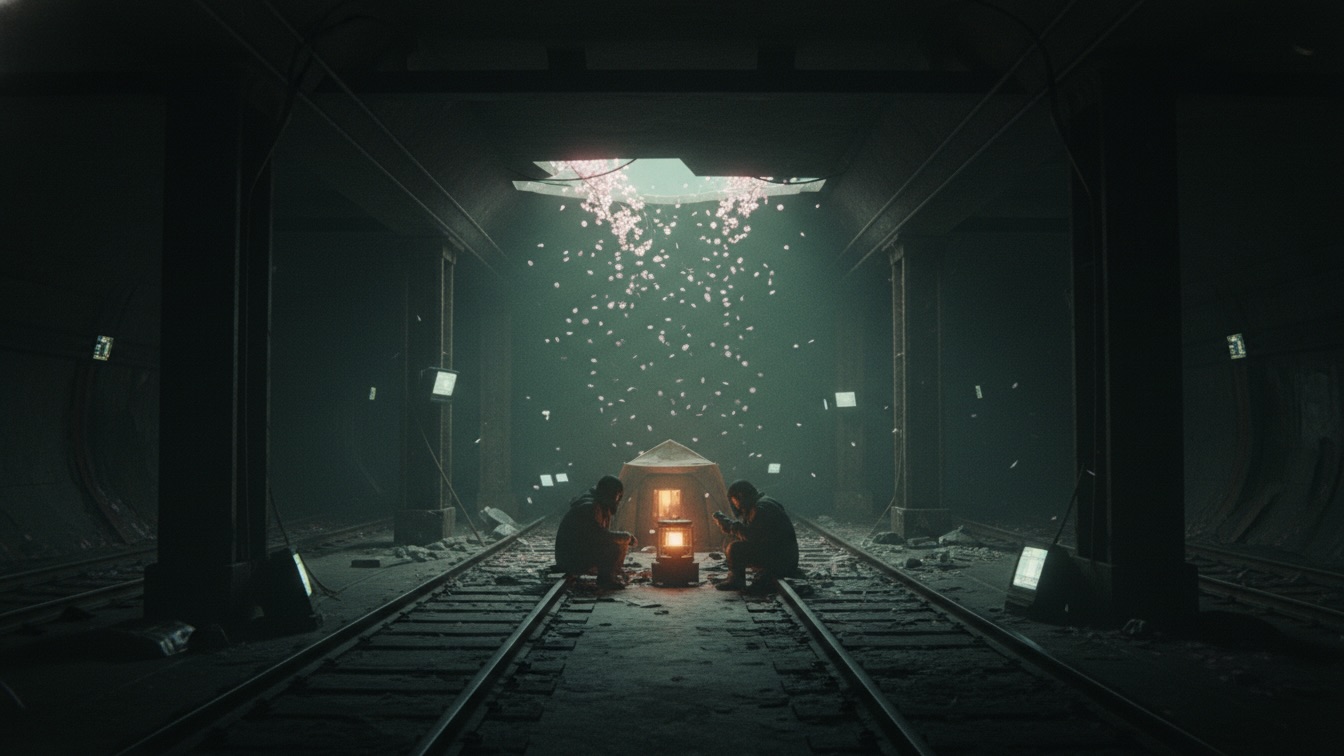
The narrative opens with Mike and Peter making a desperate, violent descent into the subterranean tunnels beneath a city governed by a pervasive, technological regime. After surviving a harrowing landing that leaves Mike injured and Peter potentially incapacitated, the pair evades a lethal drone searchlight by retreating into the remnants of an abandoned transit system. They encounter a group of scavengers living in the dark, led by a woman named Finn who operates a data-runner relay. Mike bargains for their survival by offering a physical drive he claims contains valuable infrastructure bypass codes, though it actually holds the only remaining digital traces of his lost companion, Chloe. After Finn scrubs their biometric data and renders them non-existent to the system, she reveals she accessed the drive and heard the personal files, confirming Mike has traded his last tether to his past for the chance at a future.
The central theme of the story is the tension between biological survival and the preservation of identity in an increasingly dehumanized world. Mike is forced to navigate a landscape where the Board prioritizes data flow over human life, yet he finds himself in a position where he must weaponize his own history to secure safety. By sacrificing the drive containing Chloe’s voice and sketches, the narrative explores the heavy cost of anonymity. To become a ghost in the system, Mike must effectively erase the evidence of his own humanity, suggesting that true freedom in this dystopia requires the total abandonment of one's personal, emotional legacy.
Furthermore, the story critiques the commodification of existence. Finn and her cohorts represent a subculture that survives by trading in secrets and digital potential, viewing human life through the cold lens of risk versus reward. When Mike lies about the value of the drive, he engages in the same transactional logic that governs the world above, yet he does so for a noble, if tragic, purpose. The contrast between the cold, green-on-black terminal and the warm, human memories stored on the drive highlights the disparity between the world as a system of code and the world as a collection of lived experiences.
Mike is defined by a profound, hollow grief that he attempts to mask with a facade of tactical pragmatism. His internal state is one of exhaustion, both physical and existential, as he carries the weight of his injuries alongside the crushing burden of his memories. He is motivated primarily by a protective instinct toward Peter, even going so far as to fabricate a backstory for the boy to increase his perceived value to the scavengers. This reveals a man who is willing to lie to the world and to himself to ensure that those he cares about are not discarded like trash.
His conflict is internal and devastatingly final. Throughout the chapter, Mike struggles with the decision to relinquish the drive, viewing it as a betrayal of his connection to Chloe. When he finally hands it over, he experiences a sensory shift that signifies his transformation from a person with a history into a void, a mere string of zeros. His decision to let go of the drive illustrates a man who chooses the survival of the body over the survival of the soul, leaving him physically safe but emotionally bankrupt as he emerges into the spring air.
Finn serves as the gatekeeper of the underground, possessing a cynical, hardened exterior that is necessary for survival in the tunnels. She is highly observant, quickly identifying the risk inherent in harboring a child, yet she is not entirely without empathy. Her use of digital static to obscure her face signifies her own need for protection from the surveillance state, demonstrating the pervasive fear that dictates all interactions in this setting.
Despite her transactional nature, Finn displays a moment of genuine, albeit brief, humanity when she acknowledges the contents of the drive. Her remark about the girl’s voice suggests that even those who live in the shadows of the data-runners are moved by the remnants of the life that was lost. She acts as a catalyst for Mike’s transformation, providing the means for his escape while simultaneously stripping him of his final link to the past.
The narrative employs a stark, visceral tone that mirrors the harsh environment of the tunnels. The author utilizes sharp, sensory-heavy imagery, such as the freight train impact and the sound of a punctured tire, to ground the reader in the immediate physical trauma of the characters. This gritty realism effectively contrasts with the ethereal, flickering nature of the technology, creating a world that feels both tactile and dangerously intangible.
The pacing is frantic and claustrophobic, reflecting the ticking clock of the Peacekeeper search grid. The transition from the high-speed tension of the chase to the slow, heavy finality of the data scrub creates a rhythmic descent into silence. By ending on the note of Mike’s emptiness, the narrative voice reinforces the tragedy of his choice. The prose remains lean and efficient, eschewing unnecessary ornamentation to mirror the brutal, stripped-down reality the characters inhabit.


