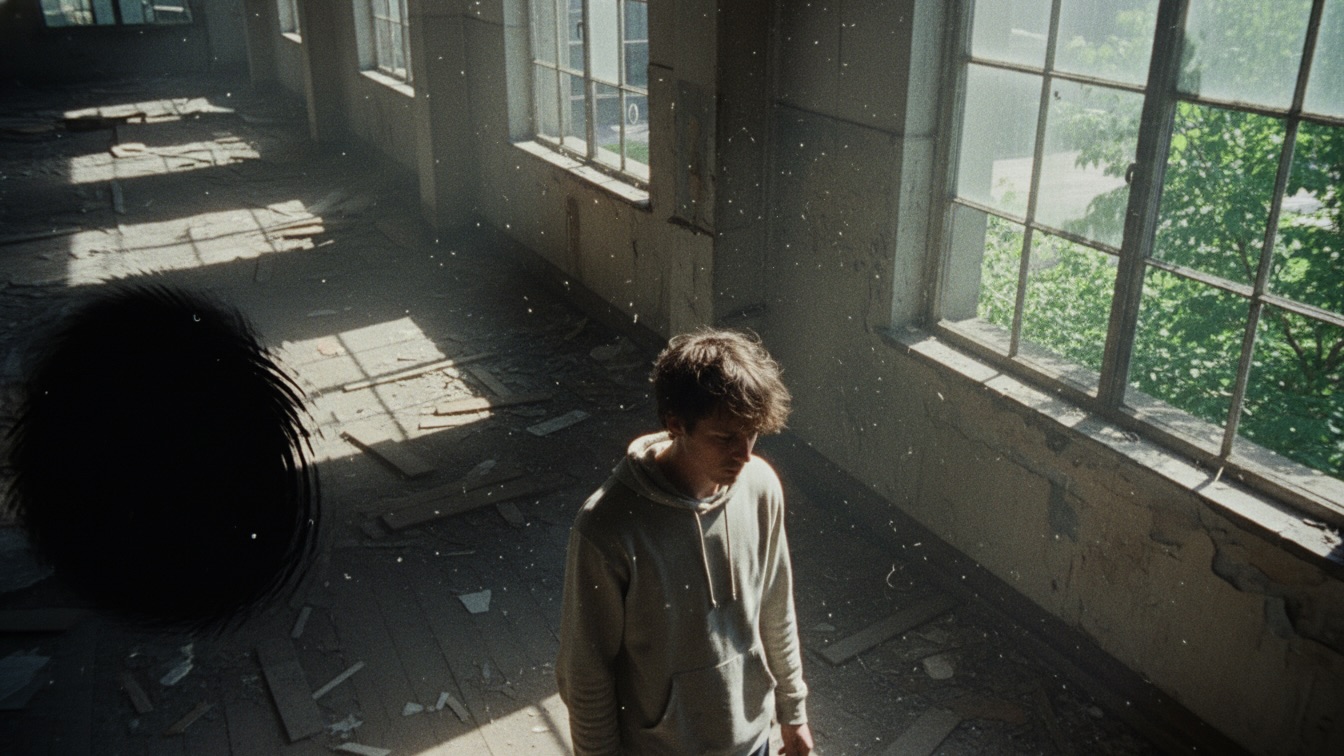
A visual glitch in a dying town's art gallery reveals a darkness far deeper than local politics and toxicity.
The dust motes didn't dance. They just hung there, suspended in the stagnant air of the Old Mill, like a frozen frame in a video that wouldn't load. It was April, but the spring sun hitting the grimy floorboards felt cold. It was that sharp, intrusive morning light that shows you exactly how much work you haven't done.
I stood in the center of the main room, holding a roll of gaffer tape. My hands were dry, skin peeling around the cuticles. I’d been here since 5:00 AM, trying to prep the walls before the board showed up to tell me why I couldn't use them. The walls were brick, painted a shade of white that had turned the color of a smoker’s lung over the last forty years.
Then I saw it. In the corner, near the old service elevator, the light wasn't working right. It wasn't just a shadow. A shadow is a lack of light. This was a presence. It was a smudge on the world, a three-dimensional smear that seemed to absorb the sound of my own breathing. I blinked, rubbing my eyes. My vision was grainy from lack of sleep and too much caffeine. I figured it was a floater, one of those little protein bits in the eye that drifts across your field of view. But when I turned my head, the smear stayed in the corner. It didn't move.
"Leo?"
The voice made me jump. I dropped the tape. It hit the floor with a hollow thud that echoed way too long. Sarah stood in the doorway, her silhouette framed by the bright spring green of the trees outside. She was wearing an oversized hoodie and carrying two cardboard trays of coffee.
"You look like shit," she said.
"Good morning to you too," I replied. I looked back at the corner. The smudge was still there. It felt like a dead pixel in the middle of a high-def screen.
She walked over, her boots clumping on the wood. She handed me a cup. "Drink. You're vibrating. Literally. I can see your hand shaking."
I took a sip. It was cheap, bitter, and exactly what I needed. "Did you talk to Miller?"
Sarah sighed, leaning against a ladder. "He’s being a prick. He says the insurance won't cover the 'experimental' pieces. By which he means anything that isn't a painting of a barn or a sunset. He called your installation 'a liability.'"
"It's just wire and glass, Sarah. It’s not a bomb."
"In this town? It might as well be. They’re scared of anything they didn't see coming twenty years ago. The board meeting is at ten. Prepare for a funeral."
I looked at the corner again. The smear seemed larger. It was about the size of a basketball now, hovering a few inches off the floor. It was a matte black that looked deeper than any paint I’d ever seen. It felt... heavy. Like the air around it was being pulled inward.
"Do you see that?" I pointed.
Sarah looked. She squinted. She walked closer to the service elevator, her brow furrowing. She stopped about three feet away from it. "See what? The grease stain?"
"No. The... the hole. The thing that looks like a Photoshop error."
She moved her head side to side. "Leo, I think you’re actually having a breakdown. There’s nothing there but dust and bad vibes."
I walked over to her. As I got closer, the temperature dropped. It wasn't a draft. It was a sudden, violent loss of heat. My breath hitched. I reached out a hand, my fingers trembling.
"Don't," Sarah said. Her voice was suddenly sharp.
"Why?"
"I don't know. Just... don't. You're acting weird."
I stopped. She was right. I was acting weird. I was 23, back in my hometown after failing to make it in the city, trying to prove to a group of retirees that I wasn't a loser by putting on an art show in a building that should have been demolished in the nineties. The stress was probably just manifesting as visual hallucinations.
"Right. Okay. Coffee. Focus," I muttered.
We spent the next three hours working. It was physical, grueling labor. We hauled the large canvases from my van, our breathing heavy in the quiet space. Every time we passed that corner, I felt a prickle on the back of my neck. I tried not to look. I focused on the tactile reality of the work: the sticky residue of the tape, the weight of the frames, the smell of sawdust and old oil.
Sarah was efficient. She didn't talk much, which I appreciated. We had this shorthand that came from knowing each other since we were kids. She’d stayed here, worked at the library, kept her head down. I’d left and come back with nothing but a degree and a bruised ego. There was a tension between us that we didn't talk about—a mix of old friendship and the potential for something else that we were both too tired to navigate.
Around nine, the front door creaked open. Miller walked in. He was sixty, wearing a windbreaker that swished with every step. He looked at the half-hung gallery like he was inspecting a crime scene.
"The board has concerns, Leo," Miller said. He didn't look at me. He looked at a piece of abstract metalwork Sarah was leveling.
"We talked about this, Miller. The contract is signed," I said, trying to keep my voice level.
"The contract mentions 'community-appropriate content.' Some of the members feel this..." he gestured vaguely at a sculpture of a distorted human face, "...is a bit much for the spring festival. We want families here. Not nightmares."
"It’s art. It’s supposed to make you feel something."
"It makes me feel like I’m wasting the town’s budget," Miller snapped. He finally looked at me. His eyes were small and hard. "We’re having a vote. I’d keep your stuff in the crates if I were you. Save you the trouble of packing it back up."
He turned to leave, but he stopped near the service elevator. He frowned, looking at the floor.
"What is this?" Miller asked.
I froze. "What?"
"This... mess. Did you spill something?" He stepped toward the corner. He was walking right toward the smudge.
"Miller, wait," I said.
He didn't listen. He stepped into the space where the light felt wrong. I watched his reflection in a nearby glass frame. For a split second, his image distorted. His shoulder seemed to stretch, his head tilting at an angle that should have snapped his neck. He didn't notice. He just looked down at the floor, confused.
"There’s a hole in the floorboards," Miller said. His voice sounded thin, like it was coming from a long way away.
"There isn't a hole," Sarah said, walking over. "I swept that corner an hour ago."
Miller reached down. As his hand entered the shadow mass, his fingers disappeared. Not like they were behind something—they just ceased to be visible. He let out a sharp yelp and pulled back.
"What the hell?" he whispered. He held his hand. It was pale, the fingertips blue as if they’d been submerged in ice water.
"I told you something was there," I said, my heart hammering against my ribs.
Miller looked at his hand, then at the corner, then at me. His face went from confusion to a cold, focused anger. "What did you do? What kind of garbage are you bringing into this building?"
"I didn't do anything! It was just there when I got here."
"This is exactly what I’m talking about," Miller hissed. "You bring this weirdness, this... this glitchy crap into our town. I’m calling the police. This is a safety hazard. This whole show is over."
He stormed out, his windbreaker swishing aggressively. The door slammed, and the sound echoed like a gunshot.
Sarah and I stood there in the silence. The spring light was shifting, the sun higher now, but the gallery felt darker than it had at dawn. The shadow mass in the corner was definitely growing. It was now a jagged rip in the air, about four feet tall. It didn't have edges. It just... ended.
"He’s going to kill the show," Sarah said. She sounded defeated. She sat down on a crate of bubble wrap.
"He can't. We have a lease for the week."
"He’s the head of the council, Leo. He can do whatever he wants. This town is a closed loop. You forgot that."
I looked at the shadow. It was vibrating. A low, sub-bass hum started to fill the room. It wasn't a sound you heard with your ears; you felt it in your teeth.
"I didn't forget," I said. "That’s why I left."
"And yet you came back."
"I didn't have anywhere else to go, Sarah. Okay? Is that what you want to hear? I failed. I’m a cliché. The art kid who couldn't cut it."
She looked at me, her expression softening. "I didn't say that."
"You didn't have to."
I walked toward the shadow. The hum got louder. The air felt thick, like walking through water. I could see the dust motes being sucked into the blackness. They didn't come out the other side. They just vanished.
"What are you doing?" Sarah asked, standing up.
"Miller said it’s a hole. Maybe he’s right. Maybe it’s not just a visual thing."
"Leo, stay away from it. It’s dangerous. Look at his hand."
"If this show is dead anyway, what does it matter?"
I was being dramatic, and I knew it. I was leaning into that self-destructive urge that comes when everything you’ve worked for starts to dissolve. It was a defense mechanism. If I ruined myself before the town could ruin me, I was still in control.
I reached out. My hand felt the cold before I even touched the mass. It was a bone-deep chill that made my joints ache. I touched the edge of the blackness.
It didn't feel like air. It felt like static. Like the feeling of a limb falling asleep, but intensified a thousand times. I pushed my hand in further.
"Leo! stop!"
I didn't stop. I couldn't. There was a pull. A literal, physical suction. My arm was being drawn in. I planted my feet, trying to pull back, but the floorboards felt slick.
Sarah grabbed my waist, her arms locking around me. "Pull back! Pull back, damn it!"
We both strained. I could feel the heat of her body through my shirt, a sharp contrast to the void that was trying to swallow my arm. We stumbled backward, collapsing into a heap on the dusty floor as my arm popped out of the mass.
I gasped, clutching my hand. It was white. I couldn't feel my fingers.
"Are you insane?" Sarah shouted. She was breathing hard, her hair messy. She looked terrified and furious.
"I... I saw something," I whispered.
"What?"
"Inside. It wasn't just black. It was... more of this. But different. Like the building, but... wrong."
I looked at my hand. The feeling was slowly coming back, a painful pins-and-needles sensation. But as the color returned, I saw something else. A thin, black line was etched into my skin, running from my wrist up under my sleeve. It looked like a vein, but it was perfectly straight, like a line of ink.
"What is that?" Sarah pointed at my wrist.
"I don't know."
Suddenly, the front door burst open again. It wasn't Miller. It was two police officers and a woman I recognized from the planning committee—Mrs. Gable. She was holding a clipboard like a shield.
"That’s him," she said, pointing a manicured finger at me. "He’s the one Miller was talking about. Look at this place. It’s a mess. And what is that smell?"
I didn't smell anything until she said it. Then it hit me. Ozone. And something like rotting flowers.
"Officers, we need this building cleared," Mrs. Gable said. "The structural integrity has been compromised. We’re revoking the permit immediately."
"You can't do that without a formal hearing," Sarah said, standing up and brushing the dust off her jeans. She stepped in front of me, her voice steady.
"We can if there’s an immediate public safety risk," one of the cops said. He looked bored. He was a guy I’d gone to high school with—Ben. He’d been a linebacker. Now he looked like he was just waiting for his shift to end. "Come on, Leo. Don't make this a thing. Just pack up and go."
"Look in the corner, Ben," I said. "Tell me that’s a structural issue."
Ben looked at the corner. He looked right at the shadow mass, which was now pulsing slowly, like a heartbeat. He blinked.
"I don't see anything but a dirty wall, Leo. You need to get some sleep, man."
I looked at Sarah. She looked at the shadow, then at Ben. Her eyes widened. "You really don't see it?"
"See what?" Mrs. Gable snapped. "The only thing I see is two kids playing house in a condemned building. Get out. Now. Or we’ll have to charge you with trespassing."
They didn't see it. They literally couldn't see the hole in reality that was currently vibrating the floorboards beneath their boots.
"We’re leaving," Sarah said. She grabbed my hand—the one that wasn't numb—and pulled me toward the door.
"Wait, my work—"
"Leave it, Leo. We’ll come back for it when they’re gone. Just move."
We walked past the cops and Mrs. Gable. I felt their judgment like a physical weight. It was the same look I’d gotten my whole life in this town. The look that said I didn't belong, that my interests were a waste of time, that I was an outsider even in my own home.
As we reached the door, I turned back one last time. The shadow mass wasn't in the corner anymore. It had detached itself from the wall. It was drifting toward the center of the room, hovering over the spot where Sarah and I had been standing.
And it was changing shape. It was starting to look like a person.
We got outside into the bright, jarring spring afternoon. The town square was quiet. A few people were sitting on benches, eating lunch. The trees were in full bloom, pink and white blossoms contrasting against the blue sky. It looked like a postcard. It looked perfect.
It felt like a lie.
Sarah led me to her car, an old hatchback with a cracked windshield. We sat inside, the heat of the sun through the glass making me sweat.
"They didn't see it," I said. My voice was flat.
"I know."
"Why?"
Sarah turned to me. She looked tired. "Because they don't want to. This town... it’s built on not seeing things, Leo. They don't see the poverty. They don't see the shops closing. They don't see that the world is moving on without them. Why would they see a hole in the universe?"
I looked down at my wrist. The black line had moved. It was now halfway up my forearm. It felt cold.
"We have to go back in," I said.
"Are you kidding? They’ll arrest us."
"Sarah, that thing is growing. And if they can't see it, they won't stop it. It’s going to eat the building. It might eat the whole block."
"And what are we supposed to do? We’re not ghostbusters. We’re an art school dropout and a librarian."
"I touched it. I think... I think it’s connected to me now."
I showed her my arm. The line was pulsing now, in sync with the heartbeat of the shadow I’d felt in the gallery.
Sarah stared at it. She reached out and touched the line. She shivered. "It’s freezing."
"We need to get my stuff out. The glass installation. The wire. I think... I think the way I built them might be the only thing that can interact with it. It’s about the materials. They’re non-traditional. They’re not part of this town’s 'reality.'"
Sarah looked at the gallery building. The windows were dark, reflecting the spring sky. "This is the stupidest thing I’ve ever been a part of."
"Probably."
"Fine. But if we get arrested, you’re paying my bail."
"With what money?"
"We’ll figure it out."
We waited until the cops' cruiser pulled away. Mrs. Gable stayed for a few minutes, locking the front door and putting up a 'Closed by Order of the Town Council' sign. She looked satisfied. She got into her SUV and drove off.
We didn't go to the front door. We went around to the back, where the loading dock was. I knew the lock on the side door was loose—I’d meant to report it to Miller, but I’d forgotten. Now, I was glad I was lazy.
We slipped inside. The air in the gallery had changed. It was no longer just stagnant; it was heavy, like being underwater. The silence was absolute. No birds chirping outside, no distant traffic. Just the hum.
The shadow mass was in the center of the room now. It had expanded into a towering figure, nearly seven feet tall. It didn't have a face, but it had the suggestion of limbs. It was standing in front of my main installation—a series of suspended glass panels etched with maps of the town.
"Leo," Sarah whispered. "Look at the art."
The glass panels were glowing. Not with light, but with a strange, silvery refraction. The etchings—the maps—were moving. The streets were shifting, the buildings dissolving and reforming.
I walked toward the installation. My arm was throbbing now. The black line was at my elbow.
"It’s not just a shadow," I said. "It’s a memory. It’s everything the town tries to hide."
"What do you mean?"
"The old mill. The people who lost their jobs. The history they painted over. It’s all condensed into this one spot. The toxicity of this place... it finally hit critical mass."
I reached for one of the glass panels. As my fingers touched the edge, the black line on my arm flared. A jolt of energy shot through me, and for a second, I saw the town not as it was, but as it felt. I saw the resentment, the bitterness, the fear of the future. I saw Miller’s anger. I saw Mrs. Gable’s insecurity. It was a sea of gray sludge, and the shadow mass was the drain.
"We have to break it," I said.
"Break what? The shadow?"
"The loop. The art... it’s a record. If we shatter the record, we break the connection."
I grabbed the heaviest panel. It was a map of the square, the center of the town’s pride.
"Leo, wait! What if it makes it worse?"
"It can't get much worse than this!"
I swung the panel against the brick wall.
CRACK.
The sound was like a thunderclap. The glass shattered into a thousand pieces, but they didn't fall to the floor. They hung in the air, caught in the shadow’s gravity.
The shadow figure turned. It didn't have eyes, but I felt it looking at me. It let out a sound—a low, grinding noise like stones rubbing together.
"More," I said to Sarah. "Help me!"
She didn't hesitate. She grabbed a metal rod from my toolkit and started smashing the other panels. We were a whirlwind of destruction in the quiet gallery. Glass flew, wire snapped, and with every break, the shadow figure flickered. It was losing its shape, becoming less like a person and more like a cloud of smoke.
The hum in the room rose to a shriek. I felt the black line on my arm beginning to recede. It was working.
But then, the shadow lunged.
It didn't move like a person. It folded through space, appearing right in front of me. A cold, dark hand—or what looked like a hand—reached out and grabbed my throat.
I couldn't breathe. The cold was absolute. My vision started to go black at the edges. I saw Sarah shouting, swinging the metal rod, but it passed right through the shadow like it wasn't there.
"Leo!"
I looked into the center of the mass. I didn't see a void. I saw a mirror.
I saw myself. But it was the version of me that Miller saw. The failure. The kid who was too sensitive, too weird, too much. I saw my own fear of never being enough.
That was the weight. That was the shadow. It wasn't the town. It was what the town made me believe about myself.
I stopped fighting. I didn't go limp, but I stopped resisting the cold. I looked at the reflection and I thought: You’re just a story. And I’m tired of reading you.
The grip on my throat loosened. The shadow figure began to blur, its edges softening. The room started to brighten. The real spring sun, the warm one, finally broke through the grime on the windows.
With a final, silent pulse, the shadow mass imploded. A wave of pressure knocked us both back.
I hit the floor hard. The air was suddenly light. The hum was gone. The only sound was the distant chirping of a bird and the settling of dust.
I lay there for a long time, staring at the ceiling. Sarah was beside me, her hand gripping my shoulder.
"Is it over?" she asked. Her voice was shaky.
I looked at my arm. The black line was gone. My skin was just skin—pale, a bit dry, but normal.
"Yeah," I said. "I think so."
We looked around the room. The gallery was a disaster. Broken glass was everywhere. My installation was destroyed. The 'community-appropriate' paintings were knocked off the walls.
"Miller is going to have a heart attack," Sarah said, a small, hysterical laugh bubbling up.
"Good. Maybe it’ll clear his head."
We stood up, leaning on each other. The room felt different now. It was just a room. An old, dusty, slightly shitty room in a town that had a lot of problems. But the weight was gone. The 'unnatural' silence had been replaced by the normal, messy sounds of life.
We walked to the door. I didn't care about the art anymore. I didn't care about the show. I felt lighter than I had in years.
"What now?" Sarah asked as we stepped out onto the loading dock.
"Now? I think we leave. For real this time."
"Together?"
I looked at her. The spring sun was hitting her face, showing the fine lines around her eyes and the smudge of dust on her cheek. She looked beautiful. She looked real.
"Together," I said.
We walked toward her car. But as I reached for the door handle, I saw something in the side mirror.
Back in the gallery window, a single, tiny black dot was pressed against the glass. It wasn't dust. It wasn't a fly.
It was a dead pixel.
And then, the glass cracked.
I didn't say anything. I just got in the car. Sarah started the engine, and we pulled away, leaving the Old Mill behind. We drove past the square, past the library, past the houses with their perfectly manicured lawns and their hidden secrets.
We were halfway to the highway when I felt a cold prickle on the back of my neck.
I didn't look back. I couldn't. I just watched the road ahead, the bright green of the trees blurring into a smear of color.
"Leo?" Sarah said. She was looking at the rearview mirror. Her face had gone pale.
"Don't look, Sarah," I said. "Just drive."
"But the sky..."
I looked up through the windshield. The bright blue spring sky was still there. But right in the center of the sun, there was a tiny, perfect black square.
It was growing.
And then the radio cut out, replaced by a low, familiar hum.
I reached over and took Sarah’s hand. Her grip was tight, her knuckles white.
"We're going to be okay," I said. I didn't know if I was lying.
We hit the highway, the speedometer climbing. The town disappeared behind the hills, but the black square in the sun stayed right where it was, getting larger with every mile we traveled.
It wasn't just the town. The glitch was everywhere.
I looked at the map on the dashboard. The lines were starting to shift. The names of the towns were dissolving into nonsense characters.
"Where are we going?" Sarah asked. Her voice was small.
"Away," I said. "As far as we can."
We passed a road sign. It was blank. Just a white rectangle reflecting the dying light of the sun.
I looked at my hand. The black line was back. But this time, it wasn't just a vein. It was a word.
It said: RUN.
I closed my eyes, feeling the vibration of the car, the heat of Sarah’s hand, and the cold, relentless pull of the shadow.
The adventure wasn't over. It was just starting. And this time, we weren't just fighting for a gallery show. We were fighting for reality itself.
As the car roared down the empty highway, the world around us began to flicker, the vibrant greens of spring turning to a dull, digital gray.
We were running out of road.
And the shadow was right behind us.
“The world around us began to flicker, and I realized the road ahead was simply ending in a void of unrendered static.”


