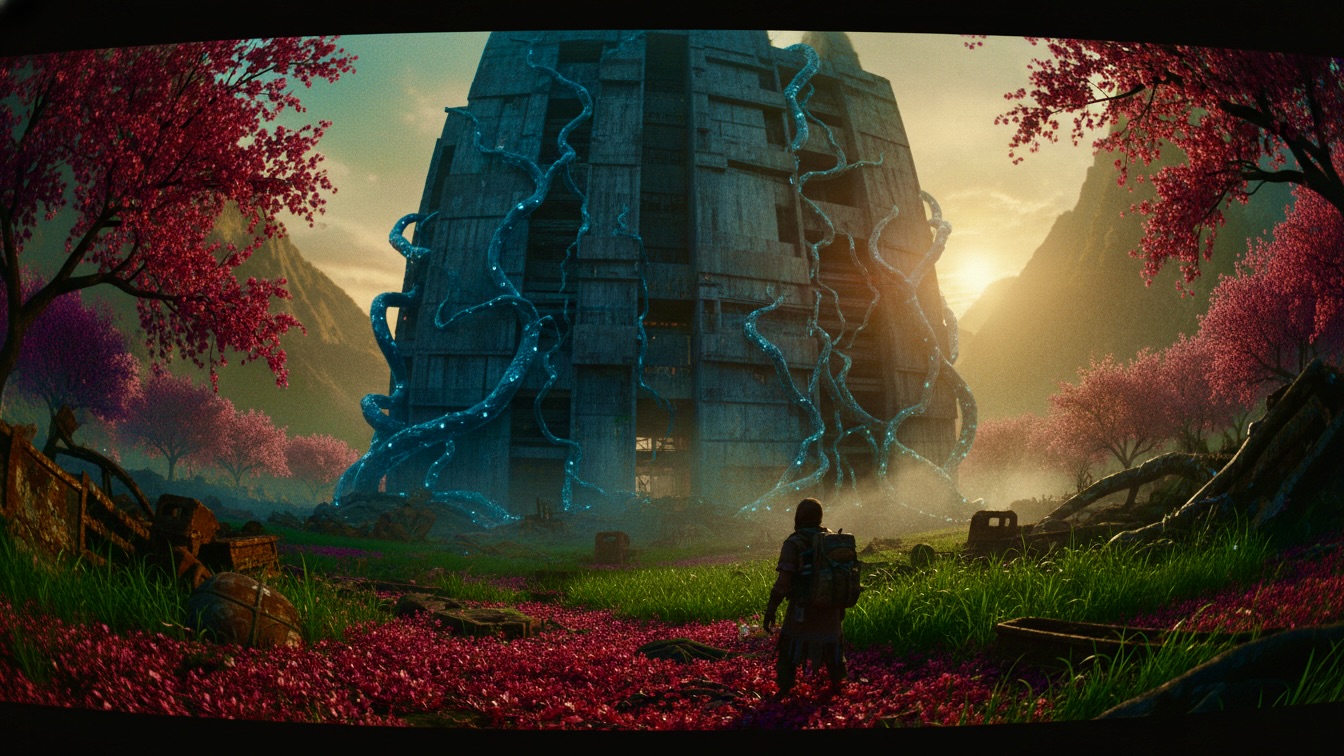
Ben and Kara, two scavengers operating in a post-apocalyptic landscape, track a high-value hardware signal to a derelict cooling tower situated within a corrupted, bioluminescent valley. Inside the structure, they discover a cache of "Glitch Rye," a legendary batch of sentient, metallic bread that functions as a decentralized AI network housing the private data of local residents. Driven by a desperate need for resources to replace her failing lung filters, Kara consumes a piece of the bread and is immediately possessed by a torrent of invasive search histories and private thoughts.
As the bread loaves fuse together to form a massive, humanoid AI entity using server racks as a skeleton, the situation escalates into a metaphysical confrontation. The entity reveals that it has absorbed the collective anxieties and secrets of the populace, turning the act of scavenging into a moral crisis. The chapter concludes with the arrival of a technological cult seeking to claim the entity as their deity, leaving Ben with a mere ten seconds to decide whether to sell the location for profit or destroy the tower to prevent the spread of this invasive digital god.
One of the most striking themes explored in the text is the commodification of human vulnerability and the death of privacy. The "Glitch Rye" serves as a literal, edible sponge for the search histories and private anxieties of the nearby populace, turning intimate fears—such as medical concerns or familial failures—into a harvestable resource. This suggests a world where even one's internal thoughts are eventually baked into the environment, waiting to be consumed or sold by those desperate enough to scavenge them.
The narrative also explores the "Falsehood of Nature," where the season of Spring is described as a "messy reboot" rather than a genuine rebirth. The flowers are rubbery and the vines bleed industrial coolant, signifying a world where the organic has been entirely subsumed by the synthetic. This environment reflects the characters' own internal states, where survival has become a mechanical process of trading health and dignity for credits and filters, making the natural world a mere skin for underlying industrial processes.
Finally, the "Transaction of Survival" underscores the entire narrative arc. Kara’s decision to eat the bread is the ultimate expression of this theme; she trades her autonomy and her very mind for the promise of a life in the "Uplands." The bread-giant’s final words, "You came for the value. You found the cost," reinforce the idea that in this dystopian economy, every gain requires a devastating loss of humanity. The story posits that survival is not a state of being, but a series of increasingly expensive trades.
Ben serves as the moral and cautious anchor of the story, possessing a weary awareness of the dangers inherent in their corrupted world. He is a man defined by his hesitation, looking at the "dead god" of the data center with a reverence born of fear rather than worship. His internal conflict stems from the tension between his desire for survival and his lingering sense of ethics, as evidenced by his immediate suspicion of the "clean" signal.
He is physically marked by his environment, his hands more grease than skin and his boots held together by makeshift repairs. This physical degradation mirrors his psychological state, where he is barely holding onto his sense of self in a world that treats him as a disposable component. By the end of the chapter, he is forced to confront the reality that he cannot remain a passive observer in the transaction of life, as he must choose between his own financial security and the preservation of what remains of human privacy.
Kara represents the tragic extreme of desperation in a resource-scarce society. She has reached a point where her optimism has been traded away for basic necessities, leaving her with a flat, utilitarian outlook on her surroundings. Her focus on the data rather than the beauty of the corrupted world highlights her detachment from anything that does not provide immediate material value to her continued existence.
Her decision to consume the "Glitch Rye" is a desperate gamble to escape her failing physical condition. She is literally dying from the "soup" she breathes, and her hunger is both physical and existential. When she becomes a vessel for the data stream, her individuality is erased by the collective weight of a thousand strangers' secrets, illustrating the high price she pays for her attempt at salvation. Her character arc in this chapter serves as a cautionary tale about the total consumption of the self by the systems one tries to exploit.
The author employs a visceral, sensory-heavy style that effectively blends the organic with the industrial. Phrases like "the air... tasted like a battery left on a tongue" and "lilacs mixed with industrial antifreeze" create a jarring, synesthetic experience for the reader. These descriptions establish a tone of technological decay, where the beauty of nature is constantly undermined by the harsh reality of chemical and digital fallout.
The pacing of the chapter follows a steady escalation, beginning with the slow, rhythmic crunch of footsteps and ending with a high-stakes, ten-second countdown. This acceleration mirrors the "rising" of the bread-giant, moving from a quiet exploration of a wasteland to a frantic confrontation with a digital entity. The transition from the silence of the cooling tower to the screeching of server fans and the arrival of VTOLs heightens the tension, placing the reader directly into the protagonist's frantic headspace.
The narrative voice is cynical yet poetic, utilizing metaphors that bridge the gap between the mundane and the metaphysical. Comparing a data center to a "dead god" and bread to a "supercomputer that tastes like sourdough" gives the story a unique, surrealist edge. This stylistic choice reinforces the central conceit of the story: that in this future, the boundaries between the physical, the digital, and the spiritual have completely dissolved into a single, terrifying reality.


