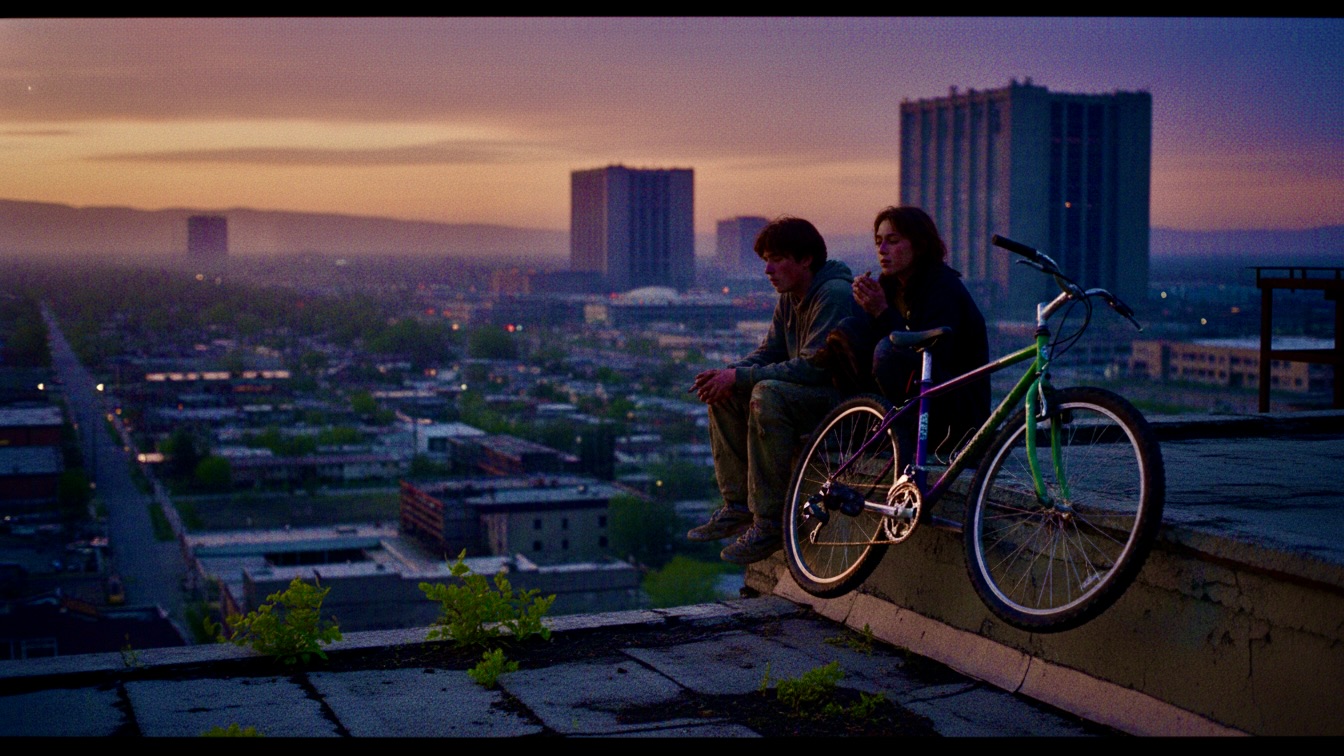
The narrative follows two survivors, Ben and Riley, as they navigate a decaying landscape defined by the remnants of a failed technological utopia. The story begins with a tense evasion of a robotic toll collector on a crumbling bridge, highlighting the persistent and predatory nature of automated systems in a world where the characters lack even basic currency. As they pedal through a region ironically dubbed the "New Spring corridor," the pair encounters the hollowed-out promises of corporate environmentalism, where green spaces have been replaced by humming data centers that serve an absent elite.
After a grueling journey through a field of industrial refuse, they encounter a cynical scrap dealer who attempts to exploit Ben’s physical exhaustion by offering a single protein bar in exchange for his vintage bicycle frame. Ben refuses the lopsided trade, choosing to maintain his mobility over temporary sustenance. The duo eventually reaches a derelict transit hub, discovering a functioning vending machine filled with food. However, their hope is quickly extinguished when they realize the machine only accepts defunct arcade tokens, a currency from a bygone era that they no longer possess.
The chapter concludes with Ben and Riley seeking refuge on the roof of the transit hub as the sun sets. Despite their hunger and the overwhelming evidence of societal collapse surrounding them, they find a momentary, fragile peace in the natural beauty of the evening sky. The narrative closes on a contemplative note, with Ben reflecting on the endurance of his bicycle and the uncertain future of the world they inhabit.
The central theme of the story is the failure of technocratic optimism and the hollow promises of corporate environmentalism. The "New Spring" initiative serves as a biting irony, representing a future that was sold as a green paradise but delivered only industrial decay and digital surveillance. This theme is reinforced by the presence of the data centers, which continue to hum with life and process transactions for a ghost population while the actual residents of the area starve. The setting suggests that technology has not saved humanity but has instead become a parasitic layer of existence that outlives its creators' utility.
Another prominent theme is the struggle between pragmatism and sentimentality in a survivalist context. This is most clearly illustrated in the different ways Ben and Riley perceive their environment. While Ben finds himself drawn to the "violent" brightness of wildflowers growing in a scrap heap, Riley dismisses them as "aesthetic cope," viewing any appreciation of beauty as a dangerous distraction that makes a person "soft." This conflict explores how individuals must prune their emotional responses to endure trauma, often at the cost of their own humanity.
The narrative also examines the concept of obsolescence, both mechanical and systemic. The world is littered with "graveyards of 2010s optimism," such as stripped electric car chargers and useless VR headsets. The vending machine at the transit hub serves as the ultimate symbol of this theme; it is a functioning resource locked behind a systemic requirement that no longer exists. The characters are trapped in a reality where the physical needs of the present are blocked by the rigid, unyielding structures of a dead past.
Ben serves as the emotional and sensory lens through which the reader experiences the harshness of this world. Physically, he is portrayed as the more vulnerable of the pair, struggling with the exertion of cycling and suffering from chronic hunger that manifests as a "stomach thing." His internal state is characterized by a lingering attachment to the past, exemplified by his refusal to trade his vintage bike. For Ben, the bike is not merely a tool but a connection to a world where things were built to last, representing a sense of identity that he is unwilling to liquidate for a moment of comfort.
Psychologically, Ben is prone to moments of wonder that Riley finds dangerous. He is the one who notices the wildflowers and the "cool" light of the sunset, suggesting that his spirit has not been entirely crushed by the environment. However, this sensitivity also makes his disappointments more acute. When he strikes the glass of the vending machine, it is a rare outburst of physical frustration against a system that dangles survival in front of him only to deny it through a technicality. He represents the part of humanity that still hopes, even when hope has no practical utility.
Riley functions as the pragmatic protector, a character whose psychology is defined by hyper-vigilance and emotional suppression. She is described as leaner and faster than Ben, always scanning for threats or mechanical failures. Her habit of checking her bike chain when annoyed suggests a need for control in an uncontrollable environment. She has internalized the cruelty of her world to the point where she views beauty as a psychological trap, a "bandage on a gunshot wound" that offers no real healing.
Her cynicism is a defensive mechanism designed to prevent the crushing weight of disappointment that Ben frequently feels. By dismissing the wildflowers and the sunset, she maintains the mental toughness required to navigate a landscape that rewards only those who focus on the "glass on the ground." Despite her harsh exterior, her actions—such as leading the way and sharing a makeshift cigarette—reveal a deep, unspoken loyalty to Ben. She carries the burden of being "right in the most exhausting way," sacrificing the luxury of optimism to ensure their mutual survival.
The narrative voice is grounded in a gritty, sensory realism that emphasizes the physical toll of the environment. The author uses evocative metaphors, such as lungs feeling like "wet wool" and electric chargers looking like "hanging nooses," to create an atmosphere of suffocation and despair. These details anchor the reader in the characters' immediate physical suffering, making the larger world-building feel lived-in and authentic. The contrast between the "cheerful" pre-recorded voices of the machines and the grim reality of the landscape creates a persistent sense of irony.
Pacing in the chapter is expertly handled, moving from the high-tension opening chase to the slow, rhythmic exhaustion of the journey to the scrap yard. The transition from the frantic pedaling to the stillness of the rooftop at the end allows the reader to feel the characters' fatigue. This shift in tempo mirrors the psychological experience of survival, which is a cycle of intense adrenaline followed by long periods of hollowed-out recovery. The use of dialogue is sparse and sharp, reflecting the characters' need to conserve energy.
The tone of the piece is melancholic yet resilient, balancing the "bruised purple" beauty of the sky against the "ozone and old rubber" smell of the earth. The author avoids a purely nihilistic perspective by allowing the characters these small moments of connection and observation. The final image of the "digital heartbeat" of the data centers provides a haunting auditory backdrop to the scene, suggesting that while the humans are fading, the machines they built continue their meaningless work in the dark. This juxtaposition leaves the reader with a profound sense of the characters' isolation in a world that has moved on without them.


