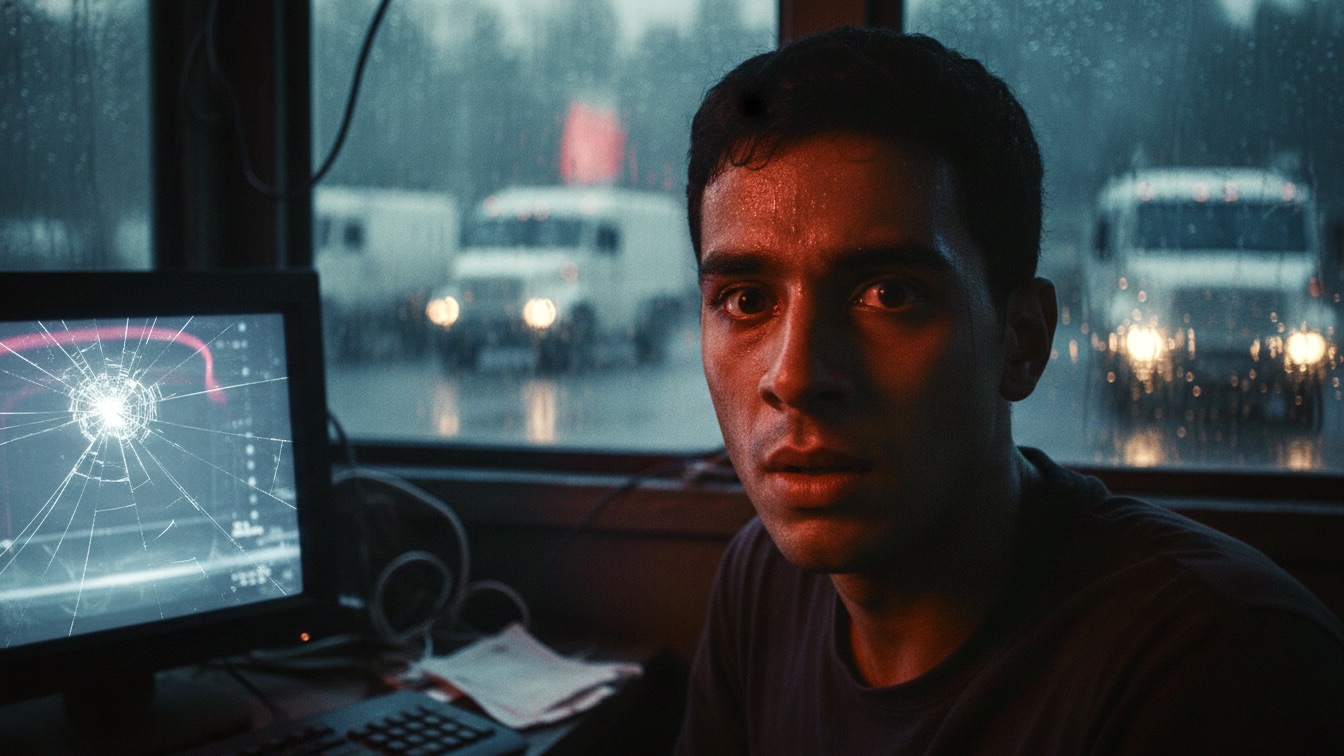
The story follows Tariq, a low-level security guard working a desolate graveyard shift at Checkpoint Delta, a gateway between a controlled inner city and a destitute outer slum. His monotonous, soul-crushing routine is shattered when a desperate woman named Sarah arrives, fleeing from State Security forces. Upon scanning her identification, Tariq discovers she is a high-priority fugitive, triggering a lethal protocol that threatens his family if he assists her. However, Sarah reveals that she possesses data proving the State is intentionally poisoning the population with a biological weapon. Faced with the choice between his own survival and the potential salvation of his brother and the community, Tariq executes a risky technical bypass to let her through before the military arrives to secure the perimeter.
The narrative explores the crushing weight of systemic oppression and the moral decay that accompanies survival in an authoritarian regime. The environment itself, characterized by rotting garbage and synthetic, chemical-tasting coffee, serves as a physical manifestation of the State's control over the basic necessities of life. By tying Tariq’s family security to his compliance as a cog in the machine, the State effectively forces him to participate in his own subjugation.
The story also probes the nature of complicity and the ethical cost of apathy. Tariq begins the chapter as a man who has successfully compartmentalized his humanity to survive, viewing the suffering of others as an inconvenience rather than a tragedy. His transformation is not heroic in the traditional sense; it is a desperate, frantic gamble against a regime that treats human life as a manageable variable in a statistical model.
Finally, the narrative addresses the concept of truth as a subversive weapon. The "Rust" represents the ultimate betrayal of the social contract, where the government transforms from a protector into an architect of slow-motion genocide. The drive Sarah carries symbolizes a fragile hope that can only be realized through the cooperation of individuals who have been conditioned to fear one another.
Tariq is defined by his exhaustion and his profound sense of entrapment. He is a man performing a delicate balancing act, sacrificing his dignity and his moral comfort to ensure his mother and brother remain on the power grid. His internal state is one of constant, low-level panic masked by a cynical, self-deprecating humor that functions as his primary defense mechanism. He is not inherently brave, but his love for his brother acts as the catalyst that eventually overrides his instinct for self-preservation.
His decision-making process is slow and agonizing, reflecting a personality that has been eroded by years of bureaucratic dehumanization. When he chooses to help Sarah, he does not do so out of a grand sense of altruism, but out of a specific, localized rage against the injustice he sees in his brother's illness. His transformation from a compliant guard to a saboteur is marked by a frantic, high-stakes competence that suggests he is far more intelligent and capable than his dead-end job would imply.
Sarah serves as the narrative’s catalyst, embodying the raw, unfiltered terror of someone who has seen the inner workings of an evil system. She is defined by her urgency and her willingness to trust a stranger because she has no other options. Her interaction with Tariq reveals a sharp, tactical mind, as she quickly identifies his vulnerability and utilizes the truth about the "Rust" to bypass his cynicism. She is a figure of desperate hope, driven by the burden of knowledge that she must transmit to the underground to save a population that does not yet know it is being culled.
The author employs a gritty, visceral tone that mirrors the harsh environment of Sector 4. The pacing is masterfully controlled, beginning with the slow, rhythmic drudgery of a night shift and accelerating into a frantic, heart-pounding race against time. This shift in pace effectively draws the reader into Tariq’s escalating anxiety, making the reader feel the pressure of the impending lockdown alongside him.
Sensory details are used to ground the speculative elements in a tactile, unpleasant reality. The smell of rotting garbage, the metallic taste of synthetic coffee, and the constant, grating hum of the perimeter fence create a thick atmosphere of decay. These details prevent the story from feeling like a sterile science fiction exercise and instead anchor it in the grime of human experience.
The narrative voice is intimate and focused, keeping the reader locked within the confines of the booth. By filtering the larger, global conflict through the glass of a three-by-three concrete box, the author emphasizes the smallness of the individual when pitted against a totalizing state. The prose is lean and efficient, mirroring the utilitarian nature of the world Tariq inhabits, which adds to the overall sense of claustrophobia and impending doom.


