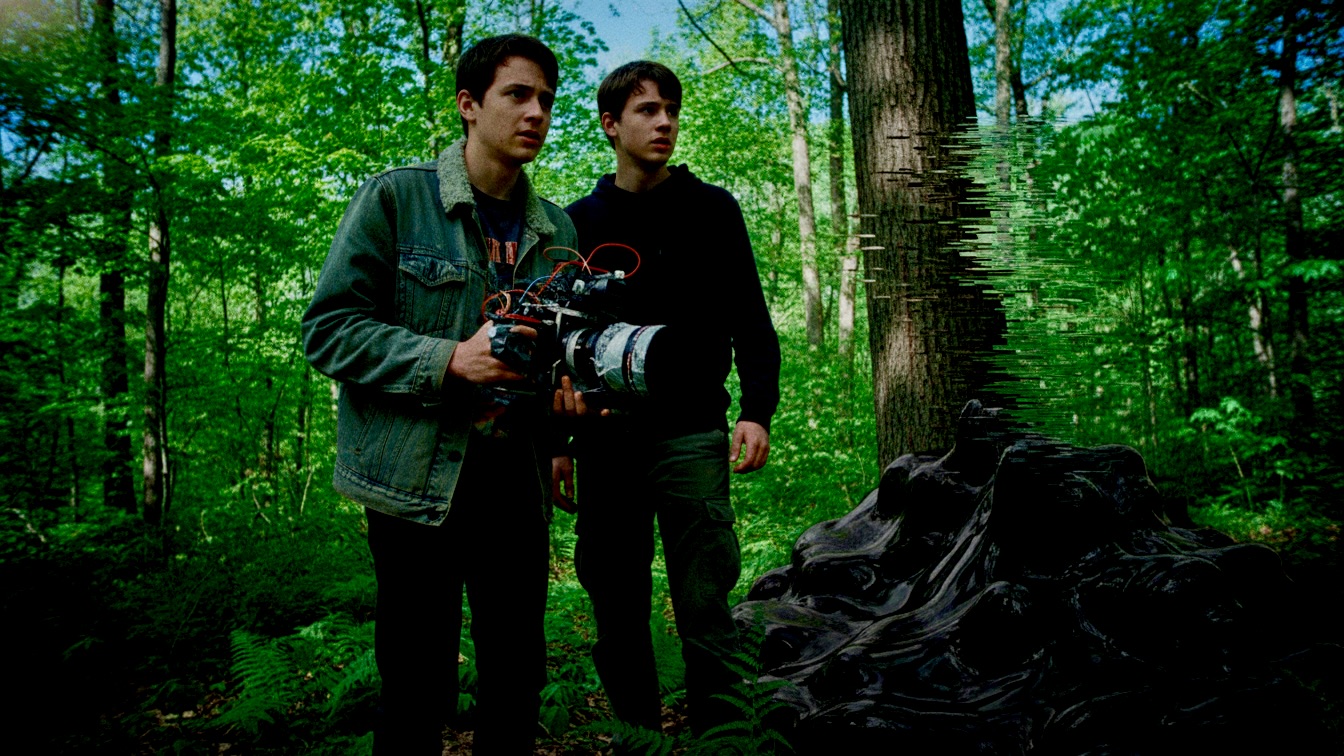
The story follows two young men, Jacob and Corey, as they embark on a trek into a remote forest in 2032 to locate a rumored cabin, the coordinates of which were sourced from an anonymous online forum. As they venture deeper into the wilderness, the digital and physical boundaries of their world begin to dissolve, manifesting in distorted light, missing sounds, and a surreal, glitching landscape. They eventually encounter a structure that defies reality, appearing as a low-resolution void that seems to consume the surrounding environment. After a harrowing confrontation with the shifting geometry of the woods, the pair manages to escape back to the ridge, where the world seemingly reverts to its normal, tangible state. However, the chapter concludes with the chilling implication that their experience was not merely a hallucination, as Jacob receives a cryptic notification confirming that their presence in the woods was recorded and uploaded.
The narrative serves as a profound meditation on the alienation inherent in a hyper-digital existence. By framing the forest as a "logic gate" or a "glitch," the author explores the anxiety of living in a world where the distinction between objective reality and simulated experience has vanished. The characters are so conditioned by their dependence on constant connectivity that they perceive the natural world through a lens of technological terminology, struggling to interpret the forest without the framework of a user interface. This creates a haunting contrast between the organic, spring-filled setting and the cold, hollow nature of the digital void they encounter.
Furthermore, the story touches upon the loss of human agency in the face of an inscrutable, systemic power. When the world reveals itself to be a "lie" or a "skin," the protagonists are rendered as mere data points within an uncaring architecture. The fear expressed by the characters is not just of the unknown, but of being observed and categorized by an omnipresent force that operates beyond their comprehension. The final notification, "UPLOAD COMPLETE," suggests that their autonomy has been compromised, turning their personal experience into a consumable or stored asset for an entity they cannot name.
Jacob serves as the grounded, albeit increasingly terrified, lens through which the reader experiences this fragmentation of reality. His motivation for the trip is rooted in a mundane desire to escape the crushing pressure of academic life, yet he quickly finds himself forced into a role of reluctant observer. He demonstrates a tactile connection to the world, often touching trees or checking his camera, which highlights his desperate need for physical verification in an environment that is rapidly losing its substance. His internal conflict is defined by the struggle to maintain his sanity while the sensory evidence of his surroundings directly contradicts his understanding of physics.
Corey presents a more complex, performative exterior that masks a deep-seated vulnerability. He adopts the persona of a philosopher to cope with the "post-authentic" world, using academic-sounding language to distance himself from the visceral dread he feels. His obsession with the cabin acts as a psychological defense mechanism, a way to reclaim a sense of purpose in a life dominated by digital burnout. However, as the environment begins to fail, Corey’s facade crumbles, revealing a boy who is just as lost and frightened as his friend. His rapid oscillation between intellectual detachment and primal panic underscores the fragility of the human ego when confronted with the uncanny.
The pacing of the chapter is expertly calibrated to mirror the transition from mundane hiking to existential terror. The early passages utilize a slow, rhythmic cadence that mimics the physical exertion of the walk, allowing the reader to settle into the setting before the subtle "glitches" begin to disrupt the narrative flow. As the characters approach the cabin, the sentences become sharper and more fragmented, reflecting the breakdown of the environment and the characters' mounting hysteria. The shift from the lush, spring imagery to the sterile, "wireframe" descriptions effectively disorients the reader, mirroring the confusion felt by the protagonists.
The sensory details are particularly evocative, relying on the contrast between the warmth of the sun and the freezing, unnatural cold of the void. By emphasizing the "loud" sunlight and the "silence" that functions as a physical weight, the author creates a sensory experience that feels inherently wrong. The narrative voice remains intimate and claustrophobic, pulling the reader into the characters' perspective so that the final reveal feels like a personal violation. The use of technological metaphors—such as "rendering," "logic gate," and "uploading"—firmly grounds the story in its futuristic setting while heightening the sense of pervasive, inescapable dread.


